CompTIA Network+ N10-009 Practice Exam
CompTIA Network+ N10-009
The CompTIA Network+ N10-009 certification validates the skills needed to design, configure, manage and troubleshoot wired and wireless networks. The exam covers networking concepts, network implementation, network operations, network security, and network troubleshooting. Candidates demonstrate knowledge of the OSI model, ports and protocols, IPv4 addressing and subnetting, routing and switching, wireless technologies, cloud connectivity, monitoring, disaster recovery, IPv4 and IPv6 services, security concepts and defenses, and troubleshooting cabling, services and performance. The exam consists of 90 questions over 90 minutes, with a 75% passing score.
Exam version: V9
901 questions in the bank
Question bank updated : questions, answers, explanations and chapters.
Certification Overview
- Exam name: Network+ N10-009
- Vendor: CompTIA
- Exam code: N10-009
- Duration: 90 minutes
- Total questions: about 90
- Official passing score: 720 on a scale of 100-900 (source)
- Our practice exam pass mark: 75%
Who Should Take This Exam?
Network Administrator, Network Technician, Help Desk Technician, Systems Administrator, NOC Technician, Network Field Technician, Junior Network Engineer
Prerequisites
No formal prerequisite. CompTIA recommends A+ and nine to twelve months of hands-on experience in a networking role.
Topics Covered
- Networking Concepts
- Network Implementation
- Network Operations
- Network Security
- Network Troubleshooting
Question Types
- Multiple Choice (Single Answer)
- Multiple Choice (Multiple Answers)
- Drag and Drop
- Scenario-Based
Network+ N10-009 Practice Questions
Our question bank contains 901+ practice questions for this certification. Sample questions from each exam chapter. Expand a question to see the answer choices. With full access, you get unlimited practice exams with randomized questions from our full question bank.
Networking Concepts
Which OSI layer is responsible for logical addressing and the routing of packets between networks?
- A. Layer 2 - Data Link
- B. Layer 4 - Transport
- C. Layer 3 - Network Correct answer
- D. Layer 5 - Session
Option C is correct because Layer 3 (Network) handles logical addressing with IP and routes packets between networks using routers. Layer 2 uses physical MAC addresses within a local segment, Layer 4 provides end-to-end transport, and Layer 5 manages sessions, so none of them route packets.
What is the name of the protocol data unit (PDU) created by TCP at the Transport layer?
- A. Segment Correct answer
- B. Frame
- C. Packet
- D. Bit
Option A is correct because the PDU at the Transport layer is called a segment for TCP (a datagram for UDP). Frame belongs to Layer 2, Packet to Layer 3, and Bit to Layer 1.
A technician needs to open a firewall rule for secure remote command-line administration of a Linux server. Which default port does SSH use?
- A. TCP 23
- B. TCP 3389
- C. TCP 21
- D. TCP 22 Correct answer
Option D is correct because SSH uses TCP port 22 by default for encrypted command-line administration. TCP 23 is Telnet (unencrypted), TCP 3389 is RDP, and TCP 21 is FTP control.
Which functions are performed at the Data Link layer? (Choose two.)
- A. Routing packets between subnets
- B. Framing data with source and destination MAC addresses Correct answer
- C. Translating data formats
- D. Establishing TCP sessions
- E. Detecting errors with a frame check sequence Correct answer
Options B and E are correct because the Data Link layer frames data with source and destination MAC addresses and appends a frame check sequence so the receiver can detect corrupted frames. Routing between subnets is a Network layer job, data format translation belongs to the Presentation layer, and TCP sessions are established at the Transport layer.
Network Implementation
A NAT-enabled router forwards an outbound TCP packet from a private host to the internet. Which header fields does the router modify?
- A. Layer 2 addresses plus source IP and source port Correct answer
- B. Only the source IP address
- C. Source IP address and destination port, but not the Layer 2 addresses
- D. Layer 2 addresses and the application payload
Option A is correct because a NAT router rewrites the source IP address and, with port address translation, the source port, and it also rebuilds the Layer 2 addresses at the hop. Changing only the source IP would break multiple hosts sharing one public address, the destination port is left alone, and the application payload is not modified.
Which routing protocol is the exterior gateway protocol used to exchange routes between autonomous systems on the internet?
- A. OSPF
- B. RIPv2
- C. IS-IS
- D. BGP Correct answer
Option D is correct because BGP is the exterior gateway protocol that exchanges routes between autonomous systems across the internet. OSPF, RIPv2, and IS-IS are interior gateway protocols meant for routing within a single autonomous system.
Which functions does a wireless LAN controller perform for lightweight access points? (Choose two.)
- A. Caching web content
- B. Balancing server traffic
- C. Coordination of channel and power settings Correct answer
- D. Converting between fiber and copper
- E. Central configuration of the access points Correct answer
Options C and E are correct because a wireless LAN controller centrally configures lightweight access points and coordinates their channel and transmit power settings. Web caching is a proxy function, server load balancing is done by load balancers, and fiber-to-copper conversion is a media converter task.
Refer to the output shown. How many broadcast domains does this switch create?
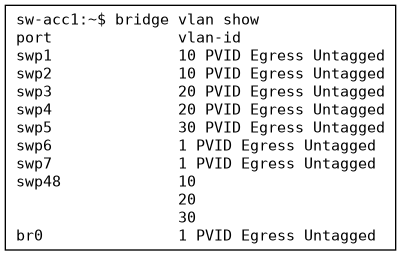
- A. 5
- B. 8
- C. 4 Correct answer
- D. 3
Option C is correct because each VLAN is its own broadcast domain, and the bridge VLAN table contains exactly four distinct VLAN IDs: 10, 20, 30, and 1. The trunk port swp48 carries VLANs 10, 20, and 30 again, and br0 is in VLAN 1, so neither adds a new domain. Counting ports (eight) or VLAN entries (more than four) overstates the total.
Network Operations
A company wants its cloud application to survive the failure of a single data center within a region. What should it deploy across?
- A. A single availability zone with larger instances
- B. Multiple subnets in one zone
- C. A larger VPC CIDR block
- D. Multiple availability zones Correct answer
Option D is correct because each availability zone is a separate data center (or group of them), so spreading across multiple zones survives the loss of one. Larger instances, extra subnets in one zone, or a larger CIDR block all remain within a single failure domain.
Log timestamps from several switches differ by minutes. Which protocol and port should be verified to synchronize their clocks?
- A. SNMP over UDP 161
- B. Syslog over UDP 514
- C. NTP over UDP 123 Correct answer
- D. DNS over UDP 53
Option C is correct because NTP synchronizes clocks and uses UDP port 123. SNMP monitors devices, syslog carries log messages, and DNS resolves names, so none of them synchronize time.
Which protocols provide encrypted remote management of network devices? (Choose two.)
- A. HTTP
- B. TFTP
- C. Telnet
- D. HTTPS Correct answer
- E. SSH Correct answer
Options D and E are correct because HTTPS and SSH encrypt management sessions, protecting credentials and commands. HTTP, Telnet, and TFTP all send data in clear text, and TFTP is a file transfer protocol rather than a management session protocol.
Using the output shown, which message carries the most severe syslog level?
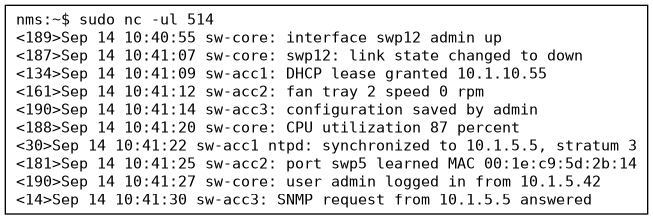
- A. CPU utilization 87 percent
- B. fan tray 2 speed 0 rpm Correct answer
- C. configuration saved by admin
- D. swp12: link state changed to down
Option B is correct because the fan tray line carries priority <161>, which is facility local4 (160) plus severity 1 (Alert), the lowest severity number and therefore the most severe in the capture. The link-down message is <187> (severity 3, Error), the CPU line is <188> (severity 4, Warning), and the configuration-saved line is <190> (severity 6, Informational).
Network Security
Which term describes the practice of connecting physical devices such as sensors and thermostats to a network so they can exchange data?
- A. Software-defined WAN (SD-WAN)
- B. Infrastructure as code (IaC)
- C. Internet of Things (IoT) Correct answer
- D. Zero-touch provisioning (ZTP)
Option C is correct because the Internet of Things describes connecting physical devices like sensors and thermostats to a network so they can exchange data. SD-WAN is a WAN overlay, IaC manages infrastructure through code, and ZTP automates device onboarding.
Which switch feature limits the number of MAC addresses allowed on an access port to defend against MAC flooding?
- A. DHCP snooping
- B. Dynamic ARP inspection
- C. BPDU guard
- D. Port security Correct answer
Option D is correct because port security limits the number of MAC addresses on an access port, which defends against MAC flooding. DHCP snooping and dynamic ARP inspection protect DHCP and ARP, and BPDU guard protects spanning tree.
Which features help defend against rogue devices on a switched LAN? (Choose two.)
- A. NAT
- B. Port security Correct answer
- C. Route summarization
- D. DHCP snooping Correct answer
- E. Split horizon
Options B and D are correct because port security limits which MAC addresses can use a port and DHCP snooping blocks unauthorized DHCP servers, both countering rogue devices. NAT, route summarization and split horizon are Layer 3 features that do not police who connects to a switch port.
Using the output shown, a client cannot connect to TCP 8080 on 10.9.9.20. What does the capture indicate?
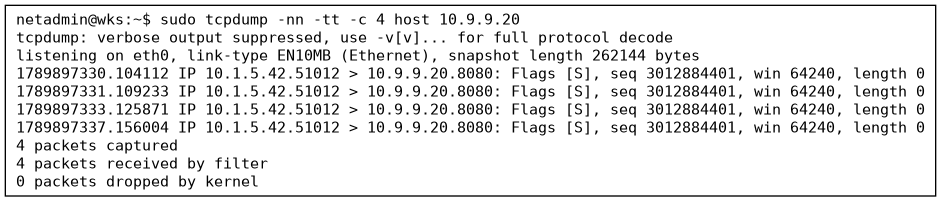
- A. The client is sending a different sequence number each attempt
- B. The SYN packets are being dropped before any reply is sent Correct answer
- C. The server reset the connection because nothing is listening
- D. The handshake completed, then the server closed the session
Option B is correct because the capture shows only SYN packets from 10.1.5.42 to port 8080, retransmitted at growing intervals with the same sequence number, and no SYN-ACK or RST comes back. That silence points to the SYNs being dropped, typically by a firewall or ACL, before any reply. A closed port would produce an immediate RST from the server, the sequence number is identical on every attempt, and no handshake completes.
Network Troubleshooting
A ceiling-mounted access point has no nearby power outlet. Which device can deliver both data and power over the same Cat 6 cable?
- A. PoE switch Correct answer
- B. Media converter
- C. Unmanaged hub
- D. Patch panel
Option A is correct because a PoE switch (802.3af/at/bt) supplies power along with data over the same Ethernet cable, ideal for a ceiling-mounted AP. A media converter, unmanaged hub, and patch panel do not provide power over Ethernet.
A 1000BASE-LX single-mode SFP is patched to a 1000BASE-SX multimode SFP and the link stays down. What is the most likely reason?
- A. The transceivers use different wavelengths and fiber types (1310 nm versus 850 nm) Correct answer
- B. The ports have a duplex mismatch
- C. The PoE budget is exhausted
- D. Spanning tree is blocking the port
Option A is correct because 1000BASE-LX uses 1310 nm over single-mode fiber while 1000BASE-SX uses 850 nm over multimode, so the two ends are incompatible. Duplex mismatch, PoE budget, and spanning tree are not caused by mismatched optics.
Which are PoE standards? (Choose two.)
- A. IEEE 802.3at Correct answer
- B. IEEE 802.1X
- C. IEEE 802.3ab
- D. IEEE 802.3af Correct answer
- E. IEEE 802.3z
Options A and D are correct because 802.3af (PoE) and 802.3at (PoE+) are the Power over Ethernet standards. 802.1X is port-based authentication, 802.3ab is 1000BASE-T, and 802.3z is gigabit over fiber.
Based on the output shown, the workstation reaches local servers but no other networks. What is the most likely cause?
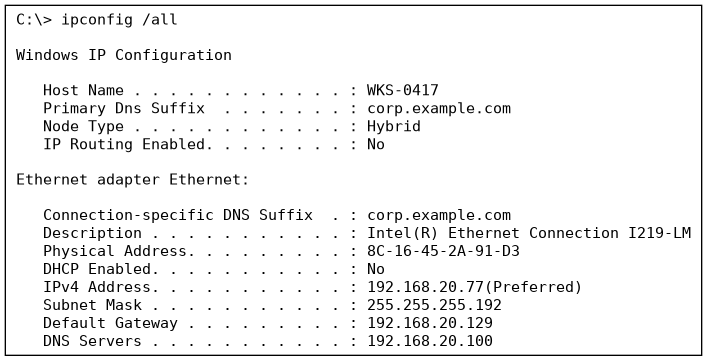
- A. The default gateway is outside the subnet the host address and mask define Correct answer
- B. The DNS server is on a different subnet from the workstation
- C. The host address is the network address of its subnet
- D. DHCP is disabled, so the adapter cannot send traffic off its subnet
Option A is correct because the exhibit shows a host address of 192.168.20.77 with mask 255.255.255.192 (/26), which places the host in the 192.168.20.64-127 range, while the default gateway 192.168.20.129 lies in the next subnet. With an unreachable gateway the host can talk to local servers but cannot route to other networks. The DNS server 192.168.20.100 is inside the host's subnet, .77 is a valid host address rather than the network address, and a static configuration (DHCP Enabled: No) does not by itself stop off-subnet traffic.
Free Study Guide
Read the free CompTIA Network+ N10-009 study guide: every exam topic explained in plain English, with diagrams, exam tips and the mistakes to avoid.
More CompTIA Practice Exams
Practice with realistic mock exams to prepare for your CompTIA certification.