CompTIA CySA+ CS0-004 Practice Exam
CompTIA Cybersecurity Analyst (CySA+) CS0-004
The CompTIA CySA+ CS0-004 certification validates the skills security analysts use to detect, analyze and respond to threats through continuous security monitoring. The exam covers four domains: security operations, vulnerability management, incident response and management, and reporting and communication. Candidates analyze logs and exhibits from SIEM, EDR and packet-capture tools, correlate indicators of malicious activity, manage the vulnerability lifecycle and prioritize remediation, apply the incident response process, and communicate findings to technical and business stakeholders. It also introduces the use of AI and automation in security operations. The exam has a maximum of 85 questions over 165 minutes.
Exam version: V4
682 questions in the bank
Question bank updated : questions, answers, explanations and chapters.
Certification Overview
- Exam name: CySA+ CS0-004
- Vendor: CompTIA
- Exam code: CS0-004
- Duration: 165 minutes
- Total questions: about 85
- Official passing score: 750 on a scale of 100-900 (source)
- Our practice exam pass mark: 75%
Who Should Take This Exam?
Security Analyst, SOC Analyst, Threat Intelligence Analyst, Vulnerability Management Analyst, Incident Response Analyst, SOC Engineer, Threat Hunter
Prerequisites
No formal prerequisite. CompTIA recommends Network+ and Security+ or equivalent knowledge, plus about four years of hands-on cybersecurity experience.
Topics Covered
- Security Operations
- Vulnerability Management
- Incident Response and Management
- Reporting and Communication
Question Types
- Multiple Choice (Single Answer)
- Multiple Choice (Multiple Answers)
- Drag and Drop
- Scenario-Based
CySA+ CS0-004 Practice Questions
Our question bank contains 682+ practice questions for this certification. Sample questions from each exam chapter. Expand a question to see the answer choices. With full access, you get unlimited practice exams with randomized questions from our full question bank.
Security Operations
Which Windows event log records authentication activity such as successful and failed logons?
- A. Security Correct answer
- B. Setup
- C. Application
- D. System
Security is correct because Windows records authentication events, including logon successes (event 4624) and failures (event 4625), specifically in the Security log. Setup logs feature installation activity, Application logs record software events, and System logs record driver and service-level events - none of them track logon activity.
Which principle is central to a zero trust architecture?
- A. Grant broad access once a device authenticates, then stop checking it
- B. Trust traffic that originates from inside the corporate LAN
- C. Place all critical assets behind a single hardened perimeter firewall
- D. Verify every access request explicitly wherever it originates Correct answer
Verifying every access request explicitly wherever it originates is the core zero trust principle: no user or device is trusted by default, even inside the corporate network. Granting broad access after one authentication, trusting internal traffic, and relying on a single perimeter firewall are all perimeter-based assumptions that zero trust specifically rejects.
Which network behavior is most characteristic of command-and-control beaconing?
- A. Bursts of outbound HTTPS to a cloud storage provider during nightly backups
- B. Small outbound connections to one external host at near-identical intervals Correct answer
- C. Large inbound transfers from a software vendor's update servers each month
- D. Repeated internal DNS queries for the domain controller at user logon
Option B is correct because malware beaconing typically produces small, regular outbound connections to the same external host at near-identical intervals, a hallmark of a command-and-control check-in. Bursts of nightly backup traffic, vendor update downloads, and domain controller lookups at logon are routine, business-justified patterns rather than beaconing.
Which log sources best show successful logons and Kerberos ticket activity on a Windows domain controller? (Choose two.)
- A. Security log event 4624 for successful logons Correct answer
- B. Application log event 1000 for application crashes
- C. System log event 7036 for service state changes
- D. Setup log entries for feature installations
- E. Security log event 4768 for Kerberos TGT requests Correct answer
Options A and E are correct because event 4624 records a successful logon and event 4768 records a Kerberos TGT request, which together show both authentication success and ticket activity on a domain controller. Application crashes, service state changes, and feature installation logs don't record logon or ticket events at all.
Examine the proxy log shown. Which host is most likely compromised, and what observation supports that conclusion?
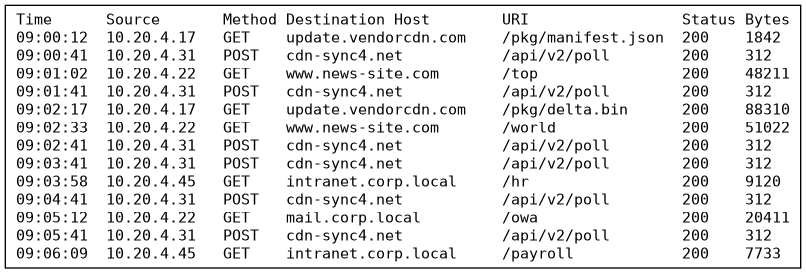
- A. 10.20.4.31, because it sends identical 312-byte POST requests to one external domain every 60 seconds Correct answer
- B. 10.20.4.22, because it made repeated requests to an external website with large responses
- C. 10.20.4.17, because it downloaded a binary file from an external domain over HTTP
- D. 10.20.4.45, because it requested internal pages that contain human resources data
Option A is correct because 10.20.4.31 sends identical 312-byte POST requests to the same external domain, cdn-sync4.net, at a steady 60-second cadence, exactly the pattern of automated beaconing rather than a person browsing. Options B, C, and D show a large news-site session, a legitimate vendor download, and normal intranet or webmail access to internal hosts - all traffic a real user could plausibly generate.
Vulnerability Management
Which Nmap option performs a TCP SYN (half-open) scan?
- A. -sS Correct answer
- B. -sU
- C. -sT
- D. -sV
-sS performs Nmap's TCP SYN (half-open) scan, which sends a SYN packet and evaluates the response without completing the handshake. -sU performs a UDP scan, -sT performs a full TCP connect scan, and -sV performs service and version detection - none of these describe the SYN scan technique.
In detection engineering, what is a false negative?
- A. An alert triggered twice for a single event
- B. An alert routed to the wrong analyst queue
- C. A malicious event that generates no alert Correct answer
- D. A benign event that generates an alert
A false negative is a malicious event that generates no alert at all, meaning the detection failed to fire when it should have. A duplicated alert, a misrouted alert, and a benign event triggering an alert (a false positive) are all different detection-engineering problems, not a missed detection.
Which type of scan logs in to a target with valid credentials to inspect its configuration and installed software?
- A. Non-credentialed scan
- B. Passive scan
- C. Credentialed scan Correct answer
- D. Discovery scan
A credentialed scan logs in to the target with valid credentials to inspect installed software and configuration directly, giving far deeper visibility than external probing alone. A non-credentialed scan tests only what's visible without logging in, a passive scan just observes traffic, and a discovery scan only identifies live hosts - none of them authenticate to the target.
Which scanning approaches minimize disruption to fragile systems? (Choose two.)
- A. Scans that repeatedly retry failed logins at high speed
- B. Throttled scans in an agreed maintenance window Correct answer
- C. Full-rate scans during peak production hours
- D. Aggressive scans with every intrusive plugin enabled
- E. Passive monitoring of network traffic Correct answer
Options B and E are correct because throttled scans in an agreed maintenance window and passive monitoring both limit or eliminate the intrusive traffic that could disrupt fragile systems. Rapid repeated login retries, full-rate scans at peak hours, and aggressive intrusive plugins all increase the load and risk to sensitive systems rather than reducing it.
Using the diagram shown, which assets will the vulnerability scanner fail to assess, and what change would correct this?
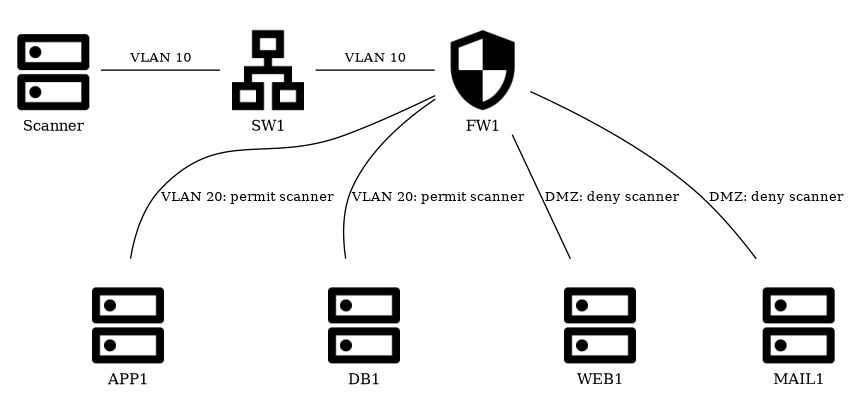
- A. WEB1 and MAIL1, because the firewall denies the scanner, so permit the scanner or deploy a scanner or agent in the DMZ Correct answer
- B. APP1 and DB1, because they are in a different VLAN from the scanner, so move them into VLAN 10
- C. All four servers, because the scanner is a server itself, so replace it with a workstation-based scanner
- D. MAIL1 only, because mail servers cannot be scanned, so exclude it from the scan scope
Option A is correct because the diagram shows the firewall explicitly denies the scanner's traffic to the DMZ segment holding WEB1 and MAIL1, while permitting it to APP1 and DB1 in the server VLAN, so those two DMZ hosts would go completely unassessed unless the rule is changed or a scanner/agent is placed inside the DMZ itself. Options B, C, and D misread the diagram: APP1 and DB1 are already permitted and being scanned, the scanner itself being a server type is irrelevant to what it can reach, and mail servers are not inherently unscannable - the actual blocker shown is the firewall rule.
Incident Response and Management
What best describes the purpose of proactive threat hunting?
- A. Waiting for IDS alerts to trigger a formal investigation
- B. Applying vendor patches to internet-facing systems on a schedule
- C. Searching for threats that have evaded existing automated detections Correct answer
- D. Reviewing compliance evidence ahead of an external audit
Proactive threat hunting means actively searching for threats that have already evaded existing automated detections, rather than waiting for an alert. Waiting for IDS alerts is reactive detection, patch scheduling is vulnerability management, and audit preparation is compliance work - none describe the proactive, hypothesis-driven nature of hunting.
An analyst wants to know which internal hosts contacted a known malicious IP address in the past 30 days. Which data source is best suited?
- A. The email gateway's quarantine reports
- B. NetFlow or firewall connection logs Correct answer
- C. Endpoint patch compliance reports
- D. Vulnerability scanner plugin feeds
NetFlow or firewall connection logs record which internal hosts communicated with which external addresses, making them the best source for identifying contact with a known malicious IP over a time window. Email quarantine reports, patch compliance data, and vulnerability scanner feeds don't record network connection history.
Which SIEM capability links a failed VPN login, a successful login from a new country and a large file download into one alert?
- A. Log normalization
- B. Event correlation Correct answer
- C. Time synchronization
- D. Log compression
Event correlation is the SIEM capability that links separate, individually low-signal events - a failed VPN login, a login from a new country, and a large download - into a single higher-confidence alert. Log normalization standardizes formats, time synchronization aligns clocks, and log compression only reduces storage size.
Which are elements of the Diamond Model of intrusion analysis? (Choose three.)
- A. Victim Correct answer
- B. Kill chain
- C. Exploit kit
- D. Mitigation
- E. Infrastructure Correct answer
- F. Adversary Correct answer
Options A, E, and F are correct because the Diamond Model's four core features are adversary, capability, infrastructure, and victim, and victim, infrastructure, and adversary are three of those four. The Kill Chain, exploit kits, and mitigations are all separate concepts from other frameworks or general security terminology, not features of the Diamond Model itself.
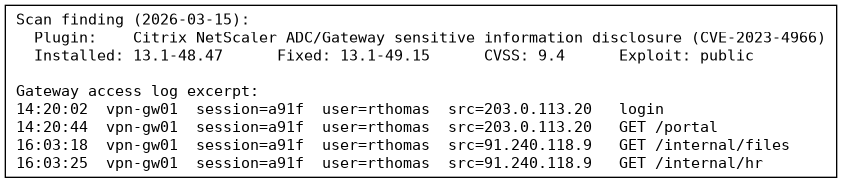
Based on the scan finding and gateway log shown, which response is most appropriate?
- A. Ask rthomas to change the password, because the session was opened from a normal address
- B. Treat it as a likely compromise: patch the gateway, terminate active sessions and hunt for the session reuse Correct answer
- C. Schedule the patch for the next monthly window, because the finding is only rated at CVSS 9.4
- D. Close the finding as a false positive, because the log shows only successful portal requests
Option B is correct because the scan shows a critical, publicly exploitable Citrix flaw, and the gateway log shows the same session ID switching from a normal address to a foreign IP address mid-session before accessing internal file shares and HR data, strongly suggesting session hijacking following exploitation, so patching, terminating sessions, and hunting for further reuse are all warranted. Options A, C, and D would treat this as routine, defer the patch despite active signs of compromise, or dismiss the finding entirely, none of which account for the suspicious mid-session IP change and sensitive internal access shown in the log.
Reporting and Communication
Which change would most reduce mean time to detect for phishing in a SOC?
- A. Holding a weekly review meeting to walk through all reported messages
- B. Automated triage of user-reported phishing that detonates attachments and URLs Correct answer
- C. Extending mailbox retention so reported messages remain searchable for 90 days
- D. Requiring manager approval before any reported message can be analyzed
Automated triage that detonates attachments and checks URLs the moment a user reports phishing removes the wait for manual review, directly cutting the time to detect a real threat. A weekly review meeting, longer retention, and requiring manager approval before analysis all add delay rather than accelerating detection.
Which metric shows how long vulnerabilities remain open before being fixed?
- A. Mean time between failures
- B. Recovery time objective
- C. Annualized loss expectancy
- D. Mean time to remediate Correct answer
Mean time to remediate directly measures how long vulnerabilities stay open before they're fixed. Mean time between failures measures reliability, recovery time objective measures acceptable downtime after a disruption, and annualized loss expectancy estimates yearly financial risk - none of them track vulnerability remediation duration.
Which metrics measure SOC efficiency? (Choose two.)
- A. Total number of log sources
- B. Mean time to contain Correct answer
- C. Storage used by the SIEM
- D. Mean time to acknowledge Correct answer
- E. Number of firewall rules
Options B and D are correct because mean time to contain and mean time to acknowledge both directly measure how quickly the SOC responds to and resolves incidents. The number of log sources, SIEM storage used, and firewall rule count are all infrastructure or inventory metrics that don't measure actual response efficiency.
Which elements belong in an executive vulnerability summary? (Choose two.)
- A. Top risks and their business impact Correct answer
- B. Detailed exploit code for each CVE
- C. A trend of critical findings over time Correct answer
- D. Full raw scanner output for every host
- E. Plugin IDs for each finding
Options A and C are correct because top risks with their business impact, along with a trend of critical findings over time, give executives the high-level picture they actually need to make decisions. Detailed exploit code, full raw scanner output, and plugin IDs are all overly technical details that don't belong in an executive summary.
Refer to the SOC metrics shown. Which conclusion is best supported?

- A. Alert volume is stable, so automation has not affected outcomes in any of the four weeks
- B. Automation has improved detection quality, because median time to acknowledge fell every week
- C. The SOC needs more analysts, because the number of escalated alerts has fallen every week
- D. Auto-closure is now too aggressive, because faster acknowledgment came with more incidents found only later Correct answer
Option D is correct because median time to acknowledge fell every week while the number of incidents found only later after being missed rose from 1 to 8, showing that faster auto-closure is coming at the cost of real incidents slipping through undetected. Options A, B, and C misread the data: alert volume is actually rising slightly, faster acknowledgment alone doesn't mean quality improved when missed incidents are also rising, and falling escalations reflect more aggressive auto-closure rather than an analyst staffing shortage.
Free Study Guide
Read the free CompTIA CySA+ CS0-004 study guide: every exam topic explained in plain English, with diagrams, exam tips and the mistakes to avoid.
More CompTIA Practice Exams
Practice with realistic mock exams to prepare for your CompTIA certification.