CompTIA SecAI+ CY0-001 Practice Exam
CompTIA SecAI+ CY0-001
The CompTIA SecAI+ CY0-001 certification validates the skills security professionals use to secure AI systems and to use AI in security work. The exam covers four domains: basic AI concepts related to cybersecurity at 17 percent, securing AI systems at 40 percent, AI-assisted security at 24 percent, and AI governance, risk and compliance at 19 percent. Candidates apply AI threat-modeling resources, implement model, gateway, access and data controls, monitor AI systems, analyze attacks such as prompt injection and poisoning, and work within frameworks such as the EU AI Act and the NIST AI RMF. The exam has a maximum of 60 questions over 60 minutes.
Question bank updated : questions, answers, explanations and chapters.
Certification Overview
- Exam name: SecAI+ CY0-001
- Vendor: CompTIA
- Exam code: CY0-001
- Duration: 60 minutes
- Total questions: about 60
- Official passing score: 600 on a scale of 100-900 (source)
- Our practice exam pass mark: 60%
Who Should Take This Exam?
Security Engineer, Security Analyst, AI Security Engineer, SOC Analyst, Security Architect, AI Governance Specialist, Cloud Security Engineer, Penetration Tester
Prerequisites
No formal prerequisite. CompTIA recommends 3 to 4 years of IT experience and about 2 years of hands-on cybersecurity experience, with Security+, CySA+, PenTest+ or equivalent knowledge.
Topics Covered
- Basic AI Concepts Related to Cybersecurity
- Securing AI Systems
- AI-assisted Security
- AI Governance, Risk, and Compliance
Question Types
- Multiple Choice (Single Answer)
- Multiple Choice (Multiple Answers)
- Drag and Drop
- Scenario-Based
SecAI+ CY0-001 Practice Questions
Our question bank contains 654+ practice questions for this certification. Sample questions from each exam chapter. Expand a question to see the answer choices. With full access, you get unlimited practice exams with randomised questions from our full question bank.
Basic AI Concepts Related to Cybersecurity
A SOC manager wants a tool that reads lengthy incident tickets and drafts plain-language summaries for executives. Which of the following AI types is designed to produce this kind of new text?
- A. An isolation forest anomaly detector
- B. A transformer-based large language model Correct answer
- C. A logistic regression classifier
- D. A k-means clustering model
Option B is correct because a transformer-based large language model is a generative model that produces new text such as plain-language summaries. The isolation forest, logistic regression and k-means models detect outliers, classify, or group data and do not write prose.
An organization is piloting an AI agent that learns which containment action shortens attacker dwell time by receiving a score after each action. Before the agent is given authority over production firewalls, which of the following should the security team require?
- A. Fine-tuning on labeled past incidents that mark the correct action
- B. Live production trials where a rollback script reverses any harmful action
- C. Training and testing in a simulated network with a limited action set Correct answer
- D. Clustering of unlabeled firewall logs into groups of similar responses
Option C is correct because a reinforcement learning agent learns by trial and error, so it must do that in a simulated network where mistakes cannot harm production, with a limited action set to bound what it can try. Option A describes supervised learning, option D describes unsupervised clustering, and option B lets the agent's exploration cause real damage before it has been proven safe.
A company's policy prohibits sending incident logs to any external provider, but analysts want natural-language summaries of those logs. Which of the following approaches BEST meets both needs?
- A. Send the logs to a hosted large language model under a signed data agreement
- B. Store the log text in a vendor-managed retrieval index and query it there
- C. Run a smaller language model on infrastructure the company controls Correct answer
- D. Mask the IP addresses in the logs and submit them to a public chatbot
Option C is correct because running a smaller language model on company-controlled infrastructure keeps the logs inside the organization while still producing summaries. Options A, B and D all send the log content to an external provider, which the policy prohibits, and a contract or IP masking does not change that.
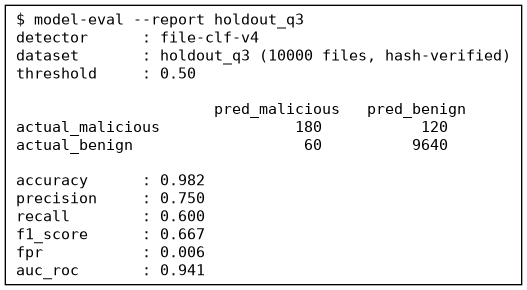
The evaluation report shown was produced for a file-scanning model that a SOC manager wants to deploy as the only malware control because of its 98.2% accuracy. Which of the following BEST describes the main problem with that plan?
- A. The 0.750 precision shows most of its malicious verdicts are wrong, so analysts would be flooded with false alerts
- B. The model labeled 60 benign files malicious, and that false positive count makes the accuracy figure unreliable
- C. The 0.006 false positive rate shows the model is overfitted to benign files and will fail on any new malware
- D. The model labeled 120 of the 300 malicious files benign, and the large benign majority inflates the accuracy figure Correct answer
Option D is correct because the matrix shows 120 of the 300 malicious files were labeled benign (recall 0.600), and with 9,700 benign files the 98.2% accuracy is dominated by the easy benign majority, so it hides a model that misses 40% of malware. Option A is wrong because a precision of 0.750 means most malicious verdicts are right. Option B is wrong because 60 false positives out of 9,700 benign files is a tiny error rate and does not make accuracy unreliable. Option C is wrong because a low false positive rate does not show overfitting.
A company calls a vendor-hosted model through a stable alias. The vendor swapped the model behind that alias, extraction accuracy for the contracts assistant fell and some refusals stopped, and the team learned of it two weeks later from user tickets. Which TWO controls would detect such a change sooner? (Select two.)
- A. Log the model identifier returned in each provider response and alert when it differs from the approved value Correct answer
- B. Have the provider sign an annual attestation stating that no model changes occurred outside the notification window
- C. Run a fixed behavioral test set daily against the live route and alert when answers or refusal rates leave the stored baseline Correct answer
- D. Subscribe the security mailbox to the provider's status page and treat each incident notice as a change event
- E. Compare the monthly invoice with the contracted token volume to spot any change in the provider's pricing tier
Options A and C are correct. Alerting when the returned model identifier differs from the approved one (option A) and running a fixed behavioral test set daily against the live route (option C) detect a silent swap quickly, even if the identifier stays the same. Options B, D and E are contractual or indirect signals that do not show a change in behaviour when it happens.
Securing AI Systems
A company is hiring an outside team to label support conversations that contain customer account details. Which of the following BEST protects that data during the labeling work?
- A. A company-hosted workspace with named accounts and downloads disabled Correct answer
- B. Encrypted data files emailed to each contractor with a shared passphrase
- C. A one-time export sent to the vendor under a signed NDA
- D. A vendor-hosted workspace protected by one team-wide login
Option A is correct because a company-hosted workspace with named accounts and downloads disabled keeps the data under company control, gives individual accountability, and prevents copies leaving. Options B, C and D move the data to the vendor or rely on shared credentials or an NDA alone, so the company loses control and traceability.
To train a churn model, data scientists copied production customer records into a sandbox that has broad team access and no monitoring. Which of the following actions BEST addresses the risk?
- A. Limit sandbox read access to team leads and review the list yearly, with the data owner
- B. Move the training code into the production source repository
- C. Apply the production access and encryption and monitoring controls to the sandbox Correct answer
- D. Remove direct identifiers from the report that summarizes the model results
Option C is correct because copied production data keeps its sensitivity, so the sandbox must carry the same access, encryption and monitoring controls as production. Options A, B and D leave the data weakly protected or address something other than the exposed copy.
An AI gateway stores full prompts and responses for investigations. A review finds API keys and customer personal data in the logs, readable by all IT staff. The logs must remain useful for incident response. Which of the following should the security team do?
- A. Stop logging prompt and response text and keep only request metadata and token counts
- B. Shorten retention to seven days and tag the stored logs as confidential
- C. Encrypt the log store with a new key and keep the current access groups
- D. Mask secrets and personal data before storage and limit access to incident responders Correct answer
Option D is correct because masking secrets and personal data before storage removes the sensitive content while the logs stay useful, and limiting access to incident responders applies least privilege. Option A removes the content investigators need, and options B and C leave the sensitive data readable by all IT staff.
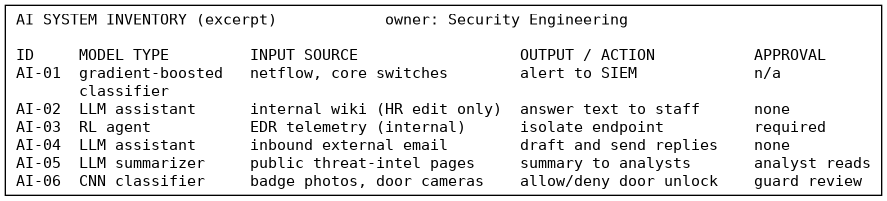
Refer to the AI system inventory shown. A security engineer must choose which system to test first for indirect prompt injection that could trigger an unapproved action outside the company. Which of the following systems should be tested first?
- A. AI-05, because it ingests public web pages that any attacker can write to and publish
- B. AI-04, because it is a language model that reads email from external senders and sends replies with no approval Correct answer
- C. AI-02, because its wiki content is read by every staff member and can change the answers they receive
- D. AI-03, because it can isolate endpoints and an attacker could trigger that action through crafted telemetry
Option B is correct because AI-04 is a language model that reads inbound external email, which an attacker can fill with hidden instructions, and it can draft and send replies with no approval, so an injected instruction can cause an unapproved action outside the company. Option A is wrong because AI-05 reads attacker-writable pages but only produces a summary that an analyst reads. Option C is wrong because AI-02 reads wiki content that only HR can edit and outputs only text to staff. Option D is wrong because AI-03 takes internal telemetry and its isolate action requires approval.
A threat modeler maps a red team's narrative against a hosted fraud model to MITRE ATLAS tactics. Step one: staff read the company's public conference talks and engineering posts to learn which model family and input format the model uses. Step two: they published a poisoned copy of a popular dataset on a public hub under a look-alike name, hoping a developer would pull it. Neither step touched a company system. Which TWO tactics do these steps represent? (Select two.)
- A. Resource Development: staging a poisoned dataset on a public hub under a look-alike name for the team to pull Correct answer
- B. Initial Access: gaining the first foothold in the training pipeline when a developer downloads the planted dataset
- C. Reconnaissance: collecting public talks and posts to learn which model family and input format the target uses Correct answer
- D. Impact: degrading the fraud model's accuracy once the planted data enters a retraining run and shifts its weights
- E. Exfiltration: copying the model's proprietary weights from the registry to an account the attacker controls
Options A and C are correct. Collecting public talks and posts to learn the model family and input format is Reconnaissance (option C), and staging a poisoned dataset under a look-alike name on a public hub is Resource Development (option A), because both happen before any company system is touched. Options B and D describe later outcomes of a pulled dataset (foothold, then degraded accuracy), and option E, exfiltration of weights, appears in neither step.
AI-assisted Security
An accounts payable clerk receives a call in what sounds like the CFO's voice, asking for an urgent wire transfer to a new vendor. The request is unusual, and the voice may be AI-generated. Which of the following actions BEST reduces the risk?
- A. Check that the incoming number matches the CFO's directory entry
- B. Ask the caller to confirm the amount and the beneficiary's name
- C. Compare the caller's voice with recordings of earlier CFO calls
- D. Call the CFO back on a known number before acting Correct answer
Option D is correct because calling the CFO back on a known number verifies the request through an independent channel that the caller does not control. Options A, B and C can be defeated by caller ID spoofing, information the caller already knows, or a cloned voice.
A network team wants to find previously unseen command-and-control traffic inside encrypted sessions without decrypting them, using only packet sizes, directions, and timing. Which of the following approaches BEST fits?
- A. A signature engine that matches known C2 payload strings
- B. A blocklist of domains reported in threat intelligence feeds
- C. A neural network trained on labeled flow-metadata sequences Correct answer
- D. A TLS-intercepting proxy that decrypts sessions for inspection
Option C is correct because a neural network trained on labeled flow-metadata sequences can learn timing, size and direction patterns and generalize to new C2 variants without decrypting traffic. Options A and B only catch known payloads or domains, and option D decrypts the sessions, which the requirement excludes.
A mail security team finds that phishing messages keep rewording the same lure so that keyword rules miss them. Which of the following techniques BEST supports detecting the reworded messages?
- A. Counting misspelled words and unusual phrases in each message body
- B. Checking each sender's domain registration age against a reputation list
- C. Comparing message embeddings to find semantically similar emails Correct answer
- D. Hashing each message body and comparing the digests to known phishing
Option C is correct because embeddings represent meaning, so reworded versions of the same lure land close together even when the keywords differ. Options A, B and D rely on surface features, sender attributes or exact digests that rewording defeats.
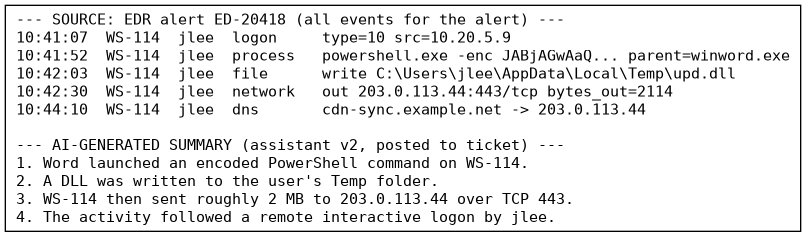
An analyst compares an AI-generated incident summary with the source alert, both shown, before escalating the ticket. Which of the following summary statements is contradicted by the source and must be corrected before escalation?
- A. Statement 3, because the alert records about 2 KB sent out, not 2 MB Correct answer
- B. Statement 4, because logon type 10 does not indicate a remote interactive session
- C. Statement 2, because the alert shows the DLL was written outside the user's profile
- D. Statement 1, because the alert does not show which process started PowerShell
Option A is correct because the alert records bytes_out=2114, about 2 KB, while statement 3 claims roughly 2 MB, which overstates the exfiltration by a factor of about a thousand and must be corrected. Option B is wrong because logon type 10 is a remote interactive (RDP) logon, so statement 4 matches the source. Option C is wrong because the DLL was written to the user's Temp folder under their profile, as statement 2 says. Option D is wrong because the alert shows parent=winword.exe for the PowerShell process, so statement 1 is supported.
A SOC lead is comparing a signature-and-rules detection engine with a machine learning detector for new malware variants. Which of the following statements about the two approaches are accurate? (Select two.)
- A. A machine learning detector learns from the rule base itself and needs no labeled or historical examples before deployment
- B. A rules engine misses variants that fit none of its written conditions until an analyst adds or edits a rule Correct answer
- C. A rules engine produces the same verdict for the same input and every verdict traces to a specific written condition Correct answer
- D. A rules engine generalizes to unseen variants better than a learned model because experts wrote its conditions
- E. A machine learning detector's verdicts map to a short list of written conditions that analysts can read and audit directly
Options B and C are correct because a rules engine detects only what its written conditions describe, so variants that fit none of them slip past until an analyst edits a rule, and its verdicts are repeatable and traceable to a specific condition. Option A is wrong because a machine learning detector needs historical or labeled examples to learn from, not the rule base. Option D is wrong because rules do not rewrite themselves and need ongoing tuning, and rules do not generalize to unseen variants better than a learned model. Option E is wrong because a learned model's verdicts are not a short list of readable conditions.
AI Governance, Risk, and Compliance
Developers at a law firm send customer contract text to a third-party hosted language model API. Legal requires that the provider neither keeps the prompts after processing nor uses them to improve its models. Which of the following should the security team do?
- A. Encrypt the API traffic with TLS 1.3 and pin the provider's certificate
- B. Pseudonymize the contract text with a reversible token map before it is sent
- C. Restrict API access to the developers' corporate network through a private link
- D. Get zero-retention and training opt-out terms in the contract and enable them Correct answer
Option D is correct because a provider's retention and training use is governed by its terms and settings, so zero-retention and training opt-out must be contracted and enabled. TLS with pinning (A) and a private link (C) protect data in transit and the network path but not what the provider does afterward, and reversible pseudonymization (B) reduces exposure without meeting the stated legal requirement.
Developers at a manufacturer have been pasting proprietary firmware source code into a public chatbot to debug it, and leadership does not want to lose the productivity gain. Which of the following responses best reduces the exposure?
- A. Publish a policy prohibiting public chatbots for company source code and have developers acknowledge it each year
- B. Block the five most-used public chatbot domains at the DNS resolver and review the list each quarter
- C. Provide a sanctioned enterprise AI service with contractual data protections and block uploads to unsanctioned AI sites at the proxy Correct answer
- D. Require developers to strip comments, variable names and file headers from source before pasting it into public tools
Option C is correct because it removes the reason for shadow use by giving developers a sanctioned enterprise AI service with contractual data protections, while proxy controls inspect or block uploads to unsanctioned sites. A policy alone (A), blocking a few domains (B) and asking developers to strip comments and names by hand (D) are easy to bypass or leave proprietary logic exposed.
A security team has budget to fix one asset in the register shown this month. Which of the following assets should be remediated first, based on the register?

- A. D2, because contract vectors are stored with no encryption at rest, even though the index is private
- B. D3, because the evaluation set is reachable from the internet and is stored without encryption at rest
- C. D1, because 14 roles can read confidential tickets, the widest internal access of the private assets
- D. D4, because restricted PII is reachable from the internet over a deprecated TLS version Correct answer
Option D is correct because D4 holds restricted PII, the highest class, and is reachable from the internet over TLS 1.0, a deprecated protocol, so the most sensitive data has the greatest exposure and weakest transport protection. Option A is wrong because D2 lacks encryption at rest but is private with only 4 roles. Option B is wrong because D3 is internet-exposed and unencrypted but contains only a public benchmark. Option C is wrong because D1 is encrypted at rest and in transit with TLS 1.3 and is private, so 14 roles is a lower risk.
After a summarization assistant goes live, a risk lead assigns the next tasks to the four NIST AI RMF functions. Which TWO tasks belong to the Manage function? (Select two.)
- A. Running test suites and tracking metrics for robustness, security and bias against thresholds the team agreed on
- B. Documenting the system's intended purpose, deployment context and affected stakeholders to frame its likely risks
- C. Defining the policies and accountability structure that decide who owns AI risk decisions across the organization
- D. Maintaining response and recovery procedures that include the criteria for deactivating the system if it misbehaves Correct answer
- E. Ranking the identified risks and recording a treatment decision for each, such as mitigate, transfer, avoid or accept Correct answer
Options D and E are correct. Manage covers prioritizing and treating identified risks (option E) and keeping response, recovery and deactivation procedures ready (option D). Option A is Measure, option B is Map, and option C is Govern.
A defense supplier fine-tunes a model on documents marked restricted. Which TWO handling decisions are correct for the resulting model? (Select two.)
- A. Release the weights to partner teams after the source documents are deleted from the training bucket
- B. Classify the fine-tuned weights at the level of the most sensitive document in the training set Correct answer
- C. Assign the weights the classification of the network zone that hosts the training platform
- D. Limit use of the model and its outputs to staff who are cleared for that same classification Correct answer
- E. Reclassify the weights one level below their sources once duplicate documents are removed from the training set
Options B and D are correct. Fine-tuned weights can carry the content of the training documents, so they take the classification of the most sensitive source (option B) and are limited to staff cleared at that level, along with their outputs (option D). Deleting sources, using the hosting zone's level, or lowering the classification does not remove what the weights learned.
Free Study Guide
Read the free CompTIA SecAI+ CY0-001 study guide: every exam topic explained in plain English, with diagrams, exam tips and the mistakes to avoid.
More CompTIA Practice Exams
Practise with realistic mock exams to prepare for your CompTIA certification.