Cisco CCNA 200-301 v2.0 Practice Exam
Cisco Certified Network Associate (CCNA) 200-301 v2.0
The Cisco CCNA 200-301 v2.0 exam validates the skills to configure, diagnose and troubleshoot small and medium networks, and replaces v1.1 from 3 February 2027. It covers five domains: Network Infrastructure and Connectivity (25%), Switching and Network Access (25%), IP Routing (20%), Network Services and Security (20%), and AI, and Network Operations and Management (10%), including agentic AI and prompts to generative AI. This practice exam mirrors that style with single-answer, multiple-answer, drag and drop and exhibit-based questions built on topologies and IOS command output.
Exam version: v2.0
1,242 questions in the bank
Question bank updated : questions, answers, explanations and chapters.
Certification Overview
- Exam name: CCNA 200-301 v2.0
- Vendor: Cisco
- Exam code: 200-301
- Duration: 120 minutes
- Total questions: about 100
- Our practice exam pass mark: 80%
Who Should Take This Exam?
Network Engineer, Network Administrator, Network Technician, Systems Administrator, IT Support Specialist, Technical Support Engineer, Infrastructure Engineer, NOC Analyst
Prerequisites
No formal prerequisite. Cisco designs the CCNA as a starting point and recommends hands-on practice with routers and switches.
Topics Covered
- Network Infrastructure and Connectivity
- Switching and Network Access
- IP Routing
- Network Services and Security
- AI, and Network Operations and Management
Question Types
- Multiple Choice (Single Answer)
- Multiple Choice (Multiple Answers)
- Drag and Drop
- Scenario-Based
CCNA 200-301 v2.0 Practice Questions
Our question bank contains 1242+ practice questions for this certification. Sample questions from each exam chapter. Expand a question to see the answer choices. With full access, you get unlimited practice exams with randomized questions from our full question bank.
Network Infrastructure and Connectivity
Which statement accurately describes collision domains?
- A. All computers in the collision domain have the potential to have a frame collision. Correct answer
- B. All computers in the collision domain have the potential to receive layer 2 broadcast messages.
- C. All computers in the collision domain have the potential to receive layer 3 broadcast messages.
- D. All computers in the collision domain are set to 10 Mb/s full-duplex.
All computers in a collision domain can indeed experience frame collisions, which is a fundamental concept in networking.
What is a correct statement when switches are used instead of hubs?
- A. The replacement increases collision domains Correct answer
- B. The replacement decreases collision domains.
- C. The replacement increases broadcast domains.
- D. The replacement decreases broadcast domains.
When you replace a hub with a switch, collision domains increase. A hub creates one large collision domain for all connected devices, meaning they all compete for bandwidth and collisions occur frequently. A switch creates a separate collision domain for each port, allowing devices to communicate simultaneously without collisions. This microsegmentation improves network performance significantly.
What is the highest data transfer rate on a single port of a 48-port Gigabit Ethernet switch?
- A. 1,000 Mb/s Correct answer
- B. 2 Gb/s
- C. 48 Gb/s
- D. 96 Gb/s
A single port of a Gigabit Ethernet switch has a maximum data transfer rate of 1,000 Mb/s, which is equivalent to 1 Gb/s. This is the standard for Gigabit Ethernet as defined in networking principles.
A site connects 4 headquarters routers to 6 branch routers. Every headquarters router has its own routed point-to-point link to every branch router, no two routers of the same group are linked, and each link is numbered with its own /30. Which TWO statements are true? (Select TWO).
- A. The link addressing consumes 96 IPv4 addresses Correct answer
- B. The design has 10 headquarters-to-branch links
- C. The design has 15 branch-to-branch links
- D. The link addressing consumes 192 IPv4 addresses
- E. The design has 24 headquarters-to-branch links Correct answer
Options A and E are correct because 4 headquarters routers each linked to 6 branch routers give 4 x 6 = 24 headquarters-to-branch links, and each link has its own /30 using 4 addresses, so 24 x 4 = 96 addresses. There are no links inside a group, so the branch-to-branch count is zero, and 10 and 192 do not match either calculation.
Switching and Network Access
What is a role of a layer 2 switch?
- A. Forwarding the data based upon logical addressing
- B. Repeating the electrical signal to all ports
- C. Learning the MAC address by examining the destination MAC addresses
- D. Determining the forwarding interfaces based upon the destination MAC address and tables Correct answer
A layer 2 switch determines the forwarding interfaces based upon the destination MAC address and its MAC address table, which is a fundamental function of switches in networking.
Why would a network administrator use a switch to segment a network?
- A. Create more broadcast domains.
- B. Create isolation of ARP messages.
- C. Create less collision domains.
- D. Isolate traffic between segments. Correct answer
Using a switch to isolate traffic between segments is a fundamental function of switches in networking. It helps to manage traffic more efficiently and enhances network performance.
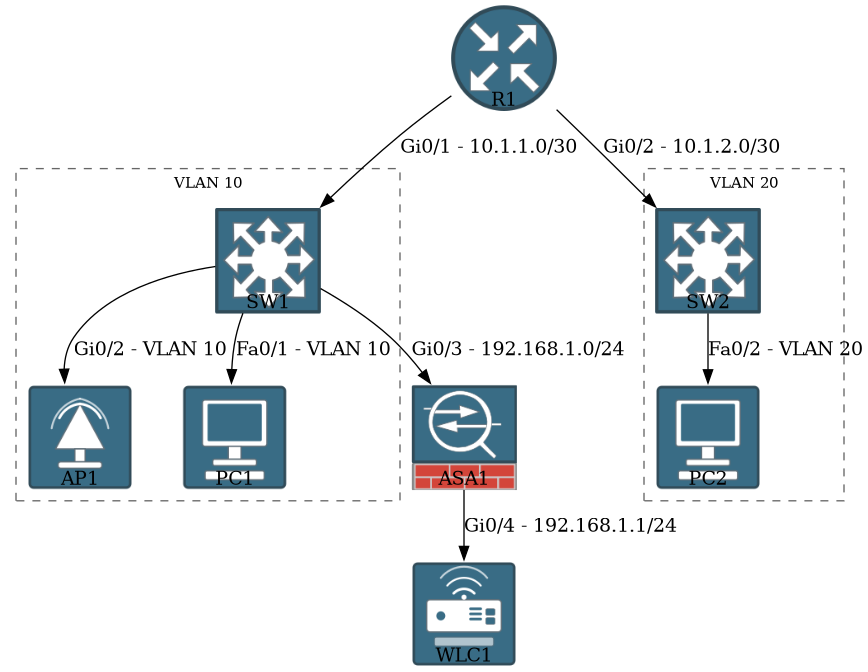
Based on the exhibit shown, which device is responsible for routing traffic between VLAN 10 and VLAN 20?
- A. ASA1
- B. R1 Correct answer
- C. SW2
- D. SW1
Option B, R1, is correct because routers are responsible for routing traffic between different VLANs. In a typical network setup, a router or a Layer 3 switch is used to route traffic between VLANs. Options D (SW1) and B (SW2) are likely Layer 2 switches, which do not perform routing functions. Option A (ASA1) refers to a firewall, which may have routing capabilities but is not typically the primary device for inter-VLAN routing in a standard setup. Therefore, R1 is the most appropriate choice for routing between VLAN 10 and VLAN 20.
A multilayer switch has SVI VLAN 10 with 192.168.10.1/26 and SVI VLAN 20 with 192.168.10.65/26. Which TWO statements are true? (Select TWO).
- A. Host 192.168.10.63 is a usable address in VLAN 10
- B. Host 192.168.10.100 belongs to the VLAN 20 subnet Correct answer
- C. Host 192.168.10.64 is a usable address in VLAN 20
- D. Routing between the two SVIs requires ip routing on the switch Correct answer
- E. A Layer 2 switch with the same SVIs routes between the VLANs by default
Options B and D are correct. A /26 gives blocks of 64, so VLAN 10 is 192.168.10.0 to .63 and VLAN 20 is .64 to .127, which puts 192.168.10.100 in VLAN 20. A multilayer switch only routes between its SVIs once ip routing is enabled. Host .63 is the VLAN 10 broadcast address, .64 is the VLAN 20 network address, and a Layer 2 switch does not route between VLANs at all.
IP Routing
When you observe a route marked with S* in a routing table, what type of route is it?
- A. Static route
- B. Default route Correct answer
- C. Dynamic route
- D. OSPF route
An S* entry specifically represents a Static Default Route (typically pointing to 0.0.0.0/0). It tells the router that if it doesn't know exactly where a packet should go, it should follow this path - acting as the exit point for all unknown destinations, such as traffic heading to the internet.
Which command enables you to verify routes line by line within a specific subset of the general route statement?
- A. Router#show ip route 160.45.23.0 255.255.255.0 longer-prefixes Correct answer
- B. Router#show ip route 160.45.23.0 255.255.255.0
- C. Router#show ip route bgp
- D. Router#show ip route
The command 'show ip route 160.45.23.0 255.255.255.0 longer-prefixes' is used to verify routes that match a specific prefix and includes longer prefixes. This allows network administrators to see more detailed routing information for a specific subnet, making it a valid choice for the question asked.
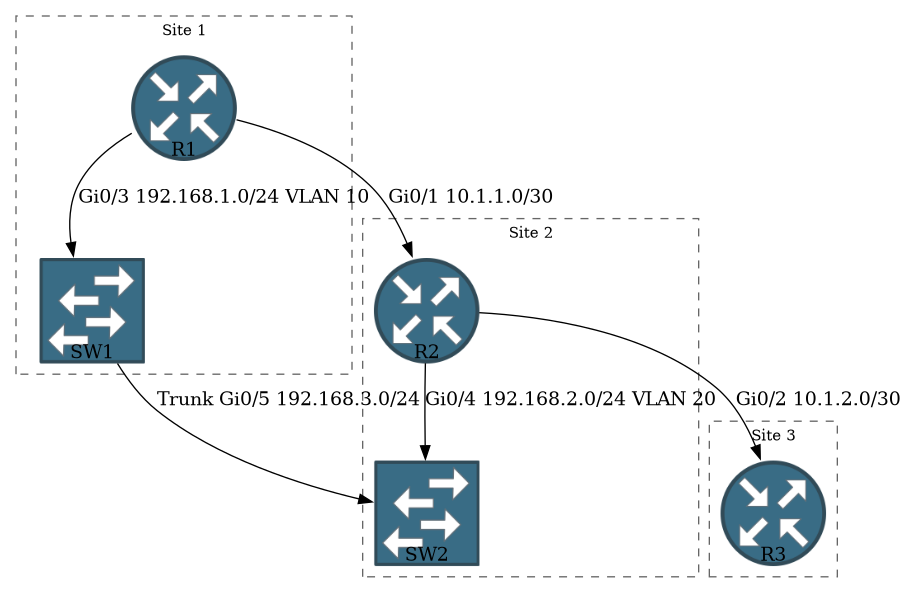
Examine the exhibit shown. What would be the next hop IP address for traffic from R1 destined for the 192.168.2.0/24 network?
- A. 10.1.1.1
- B. 192.168.3.1
- C. 10.1.1.2 Correct answer
- D. 10.1.2.1
Option C (10.1.1.2) is the correct next hop IP address for traffic from R1 destined for the 192.168.2.0/24 network, as it is typically the next hop in a routing scenario for that destination. The other options (A, D, and B) do not correspond to the correct next hop for the specified destination network based on standard routing practices.
R1 can learn each prefix below from the listed source, and all next hops are reachable. Which TWO routes does R1 install in its routing table? (Select TWO).
- A. 10.0.0.0/8 from RIP (AD 120)
- B. 10.0.0.0/8 from a static route (AD 1) Correct answer
- C. 10.1.0.0/16 from RIP (AD 120)
- D. 10.1.0.0/16 from OSPF (AD 110) Correct answer
- E. 10.0.0.0/8 from OSPF (AD 110)
Options B and D are correct because the router first matches routes by exact prefix, then picks the lowest AD only among routes for the same prefix. For 10.0.0.0/8 the static route (AD 1) beats RIP and OSPF. For 10.1.0.0/16 OSPF (AD 110) beats RIP (AD 120). The two prefixes are different, so one route for each is installed.
Network Services and Security
What is necessary when using private IP addresses to communicate with hosts on the Internet?
- A. Internet router
- B. IPv4 tunnel
- C. VPN tunnel
- D. Network Address Translation Correct answer
Network Address Translation (NAT) is necessary for private IP addresses to communicate with hosts on the Internet, as it translates private IP addresses to a public IP address.
What application allows for terminal emulation across a network?
- A. SNMP
- B. Telnet Correct answer
- C. HTTP
- D. TFTP
Telnet is a widely recognized application for terminal emulation across a network, allowing users to connect to remote devices and manage them through a command-line interface.
Which two methods are commonly used to secure access to a switch's management interface?
- A. Using SSH for remote access Correct answer
- B. Enabling HTTP access
- C. Implementing access control lists (ACLs) Correct answer
- D. Using Telnet for remote access
Using SSH for remote access encrypts the management traffic, enhancing security. Implementing access control lists (ACLs) restricts management access to authorized users only.
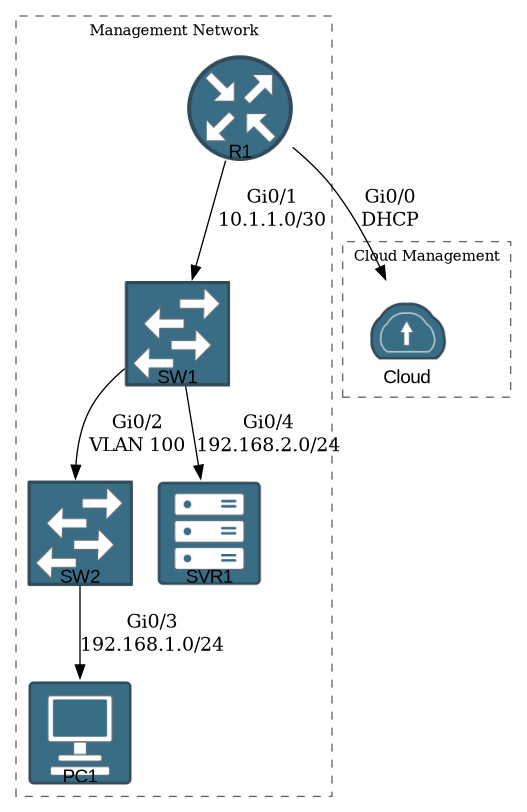
Examine the exhibit shown. Which management access method is most suitable for securely managing the devices in the network topology?
- A. SSH Correct answer
- B. Console
- C. Telnet
- D. HTTP
Option A, SSH, is correct because it provides a secure method for managing devices over a network by encrypting the data transmitted, which is essential for protecting sensitive information. The other options are not suitable: A (Telnet) is not secure as it transmits data in plaintext; B (HTTP) is also not secure for management purposes as it does not encrypt data; D (Console) is a local access method and does not apply to remote management securely over a network.
AI, and Network Operations and Management
The WAN interface of branch router R4 gets its address from the ISP by DHCP, and the address can change at renewal. The NMS identifies agents by source address and rejects traps after each change. Which command keeps the trap source address constant?
- A. snmp-server trap-source Loopback0 Correct answer
- B. ip dhcp client client-id Loopback0
- C. snmp-server ifindex persist
- D. snmp-server host 10.9.9.9 informs version 2c MONRO
Option A is correct because snmp-server trap-source Loopback0 makes the router send traps from the stable loopback address, which does not change when the DHCP lease on the WAN interface does. Option B affects the DHCP client identifier, option C keeps interface index numbers stable, and option D only changes the notification type.
Which SNMP version provides both authentication and encryption?
- A. SNMP version 1
- B. SNMP version 2e
- C. SNMP version 2c
- D. SNMP version 3 Correct answer
SNMP version 3 is the only version that provides both authentication and encryption, enhancing security compared to its predecessors. SNMP version 1 and 2c do not include any security features, while SNMP version 2e is not widely recognized as a standard version.
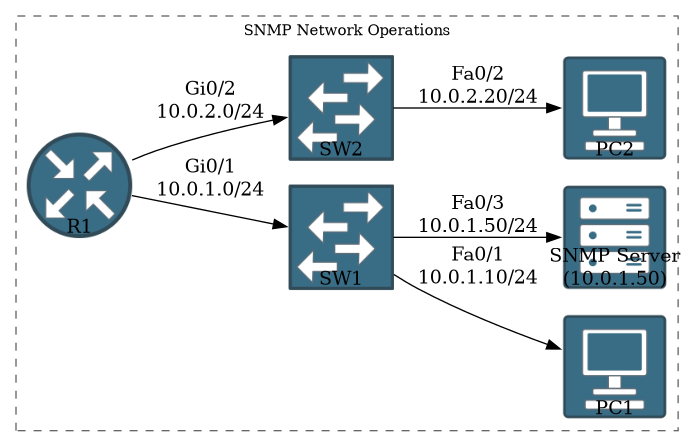
Examine the exhibit shown. Which device is responsible for monitoring and managing network devices using SNMP?
- A. R1
- B. SNMP Server Correct answer
- C. PC2
- D. SW1
The option 'C: SNMP Server' is correct because an SNMP server is specifically designed to monitor and manage network devices using the Simple Network Management Protocol (SNMP). The other options (A: R1, B: SW1, D: PC2) do not indicate that they are dedicated to SNMP management; they are likely routers or switches that may be monitored but are not the management entity itself.
What term is used to describe the framework that aids in network automation?
- A. NetOps Correct answer
- B. DevOps Correct answer
- C. SysOps
- D. SecOps
The term 'NetOps' is specifically used to describe network operations and automation, while 'DevOps' refers to a broader software development and IT operations collaboration. In the context of network automation, 'NetOps' is the more precise term, making the marked answer incorrect.
Free Study Guide
Read the free Cisco CCNA 200-301 v2.0 study guide: every exam topic explained in plain English, with diagrams, exam tips and the mistakes to avoid.
More Cisco Practice Exams
- Cisco CCST 100-150 Networking Practice Exam
- Cisco CCST 100-160 Cybersecurity Practice Exam
- Cisco CCNA 200-201 CCNACBR Practice Exam
- Cisco CCNA 200-301 Practice Exam
- Cisco CCNA 200-901 CCNAAUTO Practice Exam
- Cisco CCNP 300-410 ENARSI Practice Exam
- Cisco CCNP 300-710 SNCF Practice Exam
- Cisco CCNP 300-715 SISE Practice Exam
- Cisco CCNP 350-401 ENCOR Practice Exam
- Cisco CCNP 350-501 SPCOR Practice Exam
- Cisco CCNP 350-701 SCOR Practice Exam
Practice with realistic mock exams to prepare for your Cisco certification.