Cisco CCNA 200-301 Practice Exam
Cisco Certified Network Associate 200-301
The Cisco Certified Network Associate (CCNA) 200-301 certification validates foundational networking knowledge across four domains: Network Fundamentals, IP Connectivity, IP Services, and Security Fundamentals. It covers OSI and TCP/IP models, routing and switching, DHCP, NAT, QoS, IPv4/IPv6 addressing, VLANs, WAN technologies, and core security threats and mitigations. Candidates must demonstrate the ability to configure, verify, and troubleshoot networks. The exam consists of 100 questions over 120 minutes, with an 80% passing score.
Question bank updated : questions, answers, explanations and chapters.
Certification Overview
- Exam name: CCNA 200-301
- Vendor: Cisco
- Exam code: 200-301
- Duration: 120 minutes
- Total questions: about 100
- Our practice exam pass mark: 80%
Who Should Take This Exam?
Network Engineer, Systems Administrator, IT Support Specialist, Network Technician, Security Analyst, Technical Support Engineer, Infrastructure Engineer, Cloud Engineer
Prerequisites
Basic knowledge of networking concepts is recommended.
Topics Covered
- Network Fundamentals
- Network Access
- IP Connectivity
- IP Services
- Automation and Programmability
- Security Fundamentals
Question Types
- Multiple Choice (Single Answer)
- Multiple Choice (Multiple Answers)
- Drag and Drop
- Scenario-Based
CCNA 200-301 Practice Questions
Our question bank contains 1281+ practice questions for this certification. Sample questions from each exam chapter. Expand a question to see the answer choices. With full access, you get unlimited practice exams with randomised questions from our full question bank.
Network Fundamentals
Which statement accurately describes collision domains?
- A. All computers in the collision domain have the potential to have a frame collision. Correct answer
- B. All computers in the collision domain have the potential to receive layer 2 broadcast messages.
- C. All computers in the collision domain have the potential to receive layer 3 broadcast messages.
- D. All computers in the collision domain are set to 10 Mb/s full-duplex.
All computers in a collision domain can indeed experience frame collisions, which is a fundamental concept in networking.
What component functions as a distribution switch for the physical data center?
- A. Top of Rack switch
- B. End of Row switch Correct answer
- C. Core switch
- D. Virtual switch
The End of Row (EoR) switch functions as a distribution switch for the physical data center. In a typical three-tier data center architecture, EoR switches operate at the distribution/aggregation layer. They aggregate traffic from multiple Top of Rack (ToR) switches at the access layer and then connect upward to core switches. This placement allows EoR switches to distribute traffic efficiently between the access layer (individual server racks) and the core layer (data center backbone), making them the distribution component in the physical data center infrastructure.
When configuring a subnet, which two factors should be considered to ensure efficient IP address allocation?
- A. Number of devices Correct answer
- B. Geographical location
- C. Future growth Correct answer
- D. Current bandwidth
The number of devices is crucial for determining the size of the subnet needed. Future growth considerations are also important to ensure that the subnet can accommodate additional devices without requiring reconfiguration.
Based on the exhibit shown, which device is responsible for routing traffic between VLAN 10 and VLAN 20?
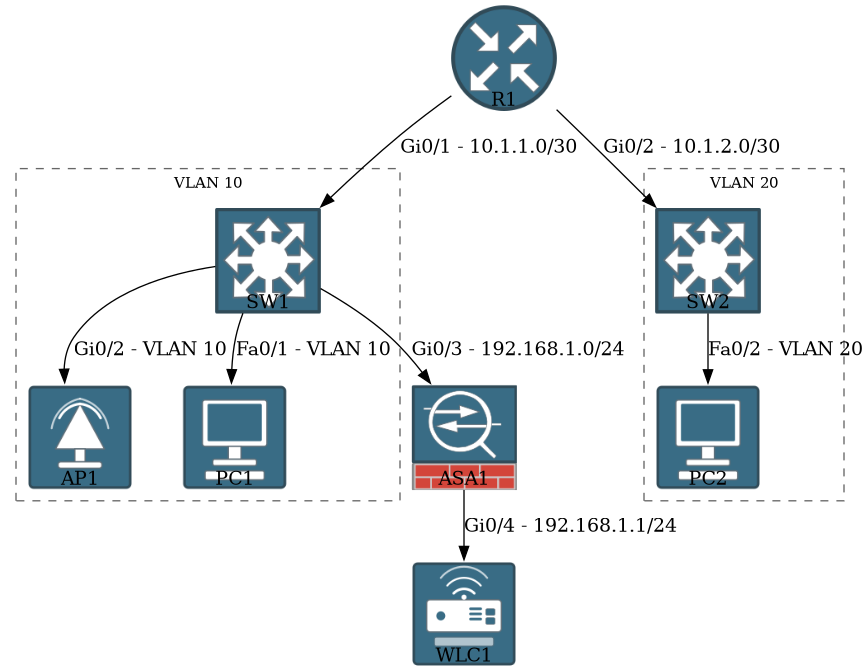
- A. ASA1
- B. R1 Correct answer
- C. SW2
- D. SW1
Option B, R1, is correct because routers are responsible for routing traffic between different VLANs. In a typical network setup, a router or a Layer 3 switch is used to route traffic between VLANs. Options D (SW1) and B (SW2) are likely Layer 2 switches, which do not perform routing functions. Option A (ASA1) refers to a firewall, which may have routing capabilities but is not typically the primary device for inter-VLAN routing in a standard setup. Therefore, R1 is the most appropriate choice for routing between VLAN 10 and VLAN 20.
Network Access
What term is used when multiple wireless access points (WAPs) cover the same SSID?
- A. Broadcast domain
- B. Basic service set
- C. Extended Service Set Correct answer
- D. Wireless mesh
An Extended Service Set (ESS) is the term for a group of access points that all use the same network name (SSID). This setup allows the wireless network to cover a much larger area than a single access point could, enabling users to move throughout a building while staying connected to the same network.
Which protocol enables a Lightweight AP (LWAP) to transmit data to the wired LAN?
- A. Spanning Tree Protocol (STP)
- B. Bridge Protocol Data Units (BPDUs)
- C. Orthogonal Frequency Division Multiplexing (OFDM)
- D. Control and Provisioning of Wireless Access Points (CAPWAP) Correct answer
Control and Provisioning of Wireless Access Points (CAPWAP) is the protocol used for communication between Lightweight Access Points (LWAP) and the wired LAN, allowing for the management and control of wireless access points.
To minimize network congestion, which two methods can be employed in a switched network?
- A. VLAN segmentation Correct answer
- B. Using a single broadcast domain
- C. Implementing Quality of Service (QoS) Correct answer
- D. Increasing the number of switches
VLAN segmentation helps to reduce broadcast traffic by creating separate logical networks. Implementing Quality of Service (QoS) allows prioritization of critical traffic, which can also help in managing congestion effectively.
Using the topology shown in the exhibit, which device is responsible for routing traffic between VLAN 10 and VLAN 20?
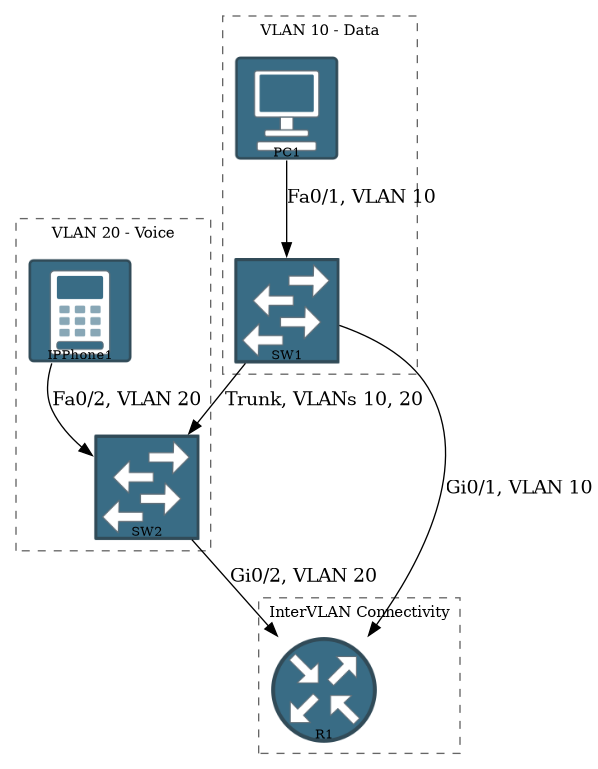
- A. IPPhone1
- B. SW1
- C. SW2
- D. R1 Correct answer
Option D, R1, is correct because routers are responsible for routing traffic between different VLANs. In a typical network setup, a router or a Layer 3 switch is used to facilitate communication between VLANs. Options B (SW1) and B (SW2) are likely Layer 2 switches, which do not route traffic between VLANs. Option A (IPPhone1) is an endpoint device and does not perform routing functions.
IP Connectivity
Why might you opt for Multiprotocol Label Switching (MPLS) as a connectivity choice?
- A. You need support for multicast packets.
- B. You need support for both IPv4 and IPv6 packets. Correct answer
- C. You need a high amount of bandwidth.
- D. You require encryption.
You choose MPLS because it is a "multiprotocol" technology that can carry different types of traffic, such as both IPv4 and IPv6, over the same network. By using labels to direct traffic, it allows a service provider to move your data efficiently regardless of which version of the IP protocol your business is using.
Which device is in charge of adding a label to a packet?
- A. Customer edge (CE) router
- B. Provider edge (PE) router Correct answer
- C. Customer premise switch
- D. Label switch routers (LSR)
The Provider edge (PE) router is the entry point to an MPLS network and is responsible for adding the first label to a customer's IP packet. This initial labeling allows the traffic to quickly traverse the service provider's core network using the highly efficient label switching process.
A company is experiencing intermittent connectivity issues across its network. Which two actions should the network administrator take to diagnose the problem?
- A. Check the routing tables for inconsistencies. Correct answer
- B. Verify the physical connections of network devices. Correct answer
- C. Reboot all network devices immediately.
- D. Replace all cables in the network.
Checking the routing tables helps identify any misconfigurations that could cause connectivity issues. Verifying physical connections ensures that all devices are properly connected, which is crucial before making any further changes. Rebooting devices and replacing cables should only be done after confirming that these are the issues.
IP Services
What protocol would you utilize to synchronize the time of the VM in the public cloud with an internal time source at your premises?
- A. DNS
- B. VPN
- C. rsync
- D. NTP Correct answer
NTP (Network Time Protocol) is the standard protocol used for synchronizing the clocks of computers over a network, making it the correct choice for synchronizing the time of a VM in the public cloud with an internal time source.
The person managing your DNS changed the entry for RouterB.You clear the DNS cache on RouterA and ping routerb.sybex.com from RouterA, but you still ping the original address as it was before the change.All other DNS addresses are working well, and the entry resolves correctly on your laptop. What's causing the issue?
- A. The router is configured to the wrong DNS server.
- B. RouterA has a host entry configured. Correct answer
- C. The DNS administrator made an error.
- D. The domain name of the router is incorrect.
RouterA likely has a static host entry configured using the `ip host` command. Static host entries on Cisco routers take precedence over DNS lookups. Even though the DNS was updated and the cache cleared, RouterA continues using its locally configured host entry for RouterB.sybex.com, which still points to the old IP address. This explains why other DNS queries work correctly (they don't have static entries) but RouterB resolves to the old address.
A company is experiencing issues with packet loss during high traffic periods. Which two methods can be implemented to improve network performance?
- A. Increase bandwidth on the affected links Correct answer
- B. Implement Quality of Service (QoS) policies Correct answer
- C. Disable all redundant links
- D. Reduce the number of active devices on the network
Increasing bandwidth on affected links can accommodate more traffic, while implementing QoS policies prioritizes critical traffic, both of which can significantly reduce packet loss during peak times.
Automation and Programmability
What's a reason to automate the configuration process for multiple routers?
- A. To increase the possibility for misconfiguration
- B. To create an outcome that can be reproduced Correct answer
- C. To decrease problems from the new configuration
- D. To allow you to do less work
Automating the configuration process for multiple routers helps ensure that the same configuration is applied consistently, which leads to reproducible outcomes. This reduces the likelihood of human error and misconfiguration, making network management more efficient and reliable.
What's the best method to configure a new static route on the existing 20 routers?
- A. Copy and paste scripts built in Notepad++ into each router.
- B. Copy and paste scripts built in Excel into each router.
- C. Create a Python script to configure each router. Correct answer
- D. Work with a partner so that both of you can double-check each other’s work and cut the time in half.
Using a Python script to configure each router is the most efficient and automated method, especially when dealing with multiple devices. This approach reduces human error and allows for consistent configuration across all routers, which is crucial in network management.
Using the output shown, which characteristic of the REST-based API configuration indicates that the API can perform all CRUD operations?
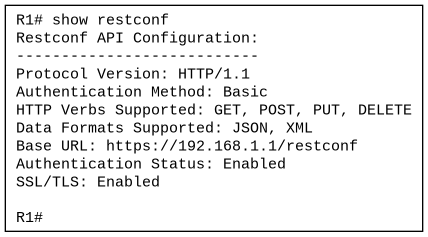
- A. The Protocol Version is HTTP/1.1.
- B. The authentication method is set to Basic.
- C. The Base URL is https://192.168.1.1/restconf.
- D. The HTTP Verbs Supported includes GET, POST, PUT, DELETE. Correct answer
Option D is correct because it explicitly states that the HTTP Verbs Supported includes GET, POST, PUT, DELETE, which are the essential operations for performing all CRUD (Create, Read, Update, Delete) actions in a RESTful API. The other options do not indicate the capability to perform CRUD operations: Option B discusses the authentication method, which does not relate to CRUD functionality; Option A mentions the protocol version, which is not directly tied to CRUD operations; and Option C provides a base URL, which also does not indicate CRUD capabilities.
Security Fundamentals
In a network with firewalls, which zone typically holds services that are Internet-facing?
- A. Outside zone
- B. Enterprise network zone
- C. Demilitarized zone Correct answer
- D. Inside zone
The demilitarized zone (DMZ) is the area in a network that typically holds services that are Internet-facing, allowing external access while providing a layer of security between the outside world and the internal network.
How does implementing port security on a switch enhance network security?
- A. By limiting the number of MAC addresses on a port Correct answer
- B. By enabling VLAN tagging
- C. By restricting access to specific IP addresses
- D. By preventing MAC address spoofing Correct answer
Limiting the number of MAC addresses on a port prevents unauthorized devices from connecting, while preventing MAC address spoofing enhances security by ensuring that only legitimate devices can communicate.
Based on the exhibit shown, which security concept is primarily addressed by the ASA1 firewall in this network topology?
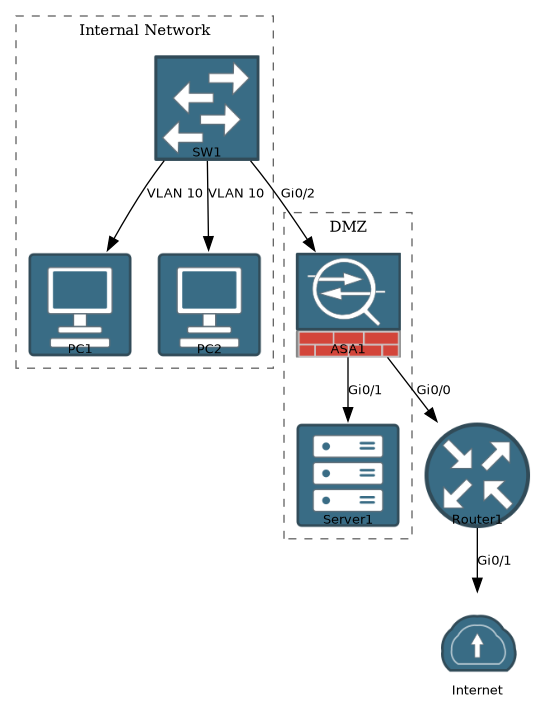
- A. Mitigating internal threats from SW1 to PC1 and PC2.
- B. Preventing unauthorized access between VLANs within the internal network.
- C. Mitigating external threats from the Internet to the DMZ and internal network. Correct answer
- D. Facilitating direct communication between the internal network and the Internet.
Option C is correct because firewalls, such as the ASA1, are primarily used to mitigate external threats from the Internet to both the DMZ and the internal network. This aligns with the fundamental role of a firewall in protecting internal resources from outside attacks. Option A is incorrect as it addresses internal threats, which are not the primary focus of a firewall. Option B is also incorrect because it pertains to VLAN access control, which is typically managed by switches rather than firewalls. Option D is misleading; while firewalls can facilitate communication, their primary role is to secure that communication rather than just facilitate it.
Free Study Guide
Read the free Cisco CCNA 200-301 study guide: every exam topic explained in plain English, with diagrams, exam tips and the mistakes to avoid.
More Cisco Practice Exams
- Cisco CCST 100-150 Networking Practice Exam
- Cisco CCST 100-160 Cybersecurity Practice Exam
- Cisco CCNA 200-201 CCNACBR Practice Exam
- Cisco CCNA 200-901 CCNAAUTO Practice Exam
- Cisco CCNP 300-410 ENARSI Practice Exam
- Cisco CCNP 300-710 SNCF Practice Exam
- Cisco CCNP 300-715 SISE Practice Exam
- Cisco CCNP 350-401 ENCOR Practice Exam
- Cisco CCNP 350-501 SPCOR Practice Exam
- Cisco CCNP 350-701 SCOR Practice Exam
Practise with realistic mock exams to prepare for your Cisco certification.