Cisco CCNP 350-501 SPCOR Practice Exam
Cisco Certified Network Professional Service Provider Core 350-501
The Cisco CCNP Service Provider (350-501 SPCOR) exam validates the ability to implement and operate core service provider network technologies, including routing protocols, segment routing, and multicast. Candidates are tested on network architecture, service provider services like QoS, network automation tools, and security principles for protecting service provider networks. The exam consists of 100 questions over 120 minutes, with an 80% passing score.
Question bank updated : questions, answers, explanations and chapters.
Certification Overview
- Exam name: CCNP 350-501 SPCOR
- Vendor: Cisco
- Exam code: 350-501
- Duration: 120 minutes
- Total questions: about 100
- Our practice exam pass mark: 80%
Who Should Take This Exam?
Network Engineer, Service Provider Engineer, Network Architect, Systems Engineer, Network Administrator, Solutions Architect, Technical Consultant, IT Manager
Prerequisites
Valid CCNA certification or equivalent networking experience
Topics Covered
- Architecture
- Networking
- MPLS and Segment Routing
- Services
- Automation and Assurance
Question Types
- Multiple Choice (Single Answer)
- Multiple Choice (Multiple Answers)
- Drag and Drop
- Scenario-Based
CCNP 350-501 SPCOR Practice Questions
Our question bank contains 738+ practice questions for this certification. Sample questions from each exam chapter. Expand a question to see the answer choices. With a subscription, you get unlimited practice exams with randomised questions from our full question bank.
Architecture
Which QoS model allows hosts to report their QoS needs to the network?
- A. CB-WFQ
- B. MQC
- C. DiffServ
- D. IntServ Correct answer
C is correct. The IntServ (Integrated Services) model allows hosts to signal their QoS requirements to the network using RSVP (Resource Reservation Protocol). Unlike DiffServ which classifies traffic into classes, IntServ provides per-flow guarantees by having hosts explicitly request bandwidth and QoS parameters.
The engineering team at a large ISP has been alerted that a customer network is experiencing high traffic congestion. After a discussion between the ISP and technical personnel at the customer site, the team agrees that traffic to the customer network that exceeds a specific threshold will be dropped. Which task must the engineer perform on the network to implement traffic policing changes?
- A. Enable Cisco Express Forwarding on the interfaces sending and receiving the packets.
- B. Set IP precedence values to take effect when traffic exceeds a given threshold. Correct answer
- C. Configure RSVP to reserve bandwidth on all interfaces when a path is congested.
- D. Enable Cisco Discovery Protocol on the interface sending the packets.
D is correct. Traffic policing uses IP precedence or DSCP values to classify traffic and takes action (marking or dropping) when traffic exceeds a configured threshold. This is the appropriate QoS mechanism when traffic exceeding a specific rate needs to be dropped to protect against congestion.
A network engineer is implementing a QoS policy for outbound management traffic classification and marking on a CPE device with these requirements: Management protocols must be marked with DSCP AF class 2 with low drop probability. Monitoring protocols must be marked with DSCP AF class 1 with low drop probability. All remaining traffic must be marked with a DSCP value of 0. Which configuration must the engineer implement to satisfy the requirements?
- A. policy-map cpe-mgmt-policy class management set ip dscp af23 class monitoring set ip dscp af13 class class-default set ip dscp default end
- B. policy-map cpe-mgmt-policy class management set ip dscp af21 class monitoring set ip dscp af11 class class-default set ip dscp af10 end
- C. policy-map cpe-mgmt-policy class management set ip dscp af23 class monitoring set ip dscp af13 class class-default set ip dscp af0 end
- D. policy-map cpe-mgmt-policy class management set ip dscp af21 class monitoring set ip dscp af11 class class-default set ip dscp default end Correct answer
A is correct. DSCP AF21 represents AF class 2 with low drop probability (the '1' in AF21). For remaining traffic with DSCP value 0, the 'default' keyword is used, as DSCP 0 equals the default per-hop behavior. Option B incorrectly uses 'af10' which is not a valid DSCP value.
You are configuring MPLS traffic-engineering tunnels in the core. Which two ways exist for the tunnel path across the core? (Choose two.)
- A. A zero bandwidth tunnel is not a valid option.
- B. Tunnel links inherit IGP metrics by default unless overridden. Correct answer
- C. Tunnels can be configured with dynamic path or explicitly defined path. Correct answer
- D. The dynamic path option is supported only with IS-IS.
- E. The bandwidth statement creates a "hard" reservation on the link.
B, E is correct. MPLS TE tunnels support two path options: dynamic (computed by CSPF using the TED) and explicit (manually defined hop-by-hop). Tunnel links also inherit IGP metrics by default, which can be overridden with the tunnel mpls traffic-eng path-option command.
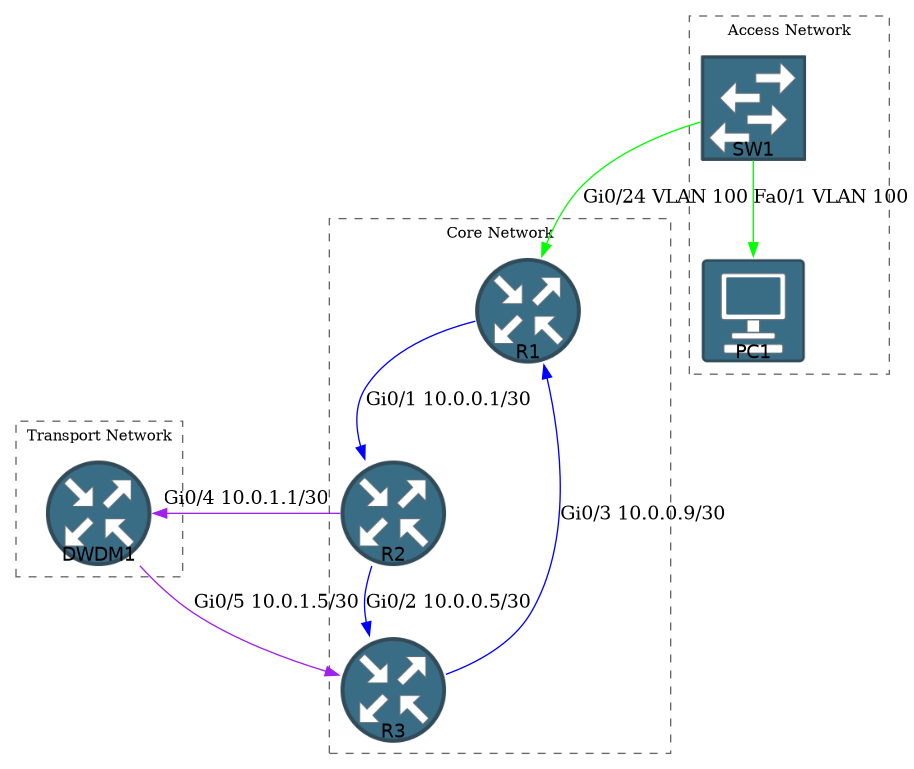
Using the exhibit shown, which transport technology is used to provide high-capacity links between the core routers in the service provider network?
- A. xDSL
- B. DOCSIS
- C. Metro Ethernet
- D. DWDM Correct answer
DWDM (Dense Wavelength Division Multiplexing) is a technology used to increase the capacity of fiber optic networks by allowing multiple wavelengths (channels) to be transmitted simultaneously over a single fiber. This makes it ideal for providing high-capacity links between core routers in a service provider network.
Networking
While implementing TTL security, you issue the PE(config-router-af)#neighbor 2.2.2.2 ttl-security hops 2 command. After you issue this command, which BGP packets does the PE accept?
- A. to 2.2.2.2, with a TTL of less than 253
- B. from 2.2.2.2, with a TTL of less than 2
- C. from 2.2.2.2, with a TTL of 253 or more Correct answer
- D. to 2.2.2.2, with a TTL of 2 or more
D is correct. When TTL security is configured with 'neighbor x.x.x.x ttl-security hops 2', the router only accepts BGP packets from that neighbor with a TTL of 253 or more (255 minus the configured hop count). This protects against spoofed BGP packets from remote attackers, as packets from distant sources will have lower TTL values.
An engineer is trying to implement BGP in a multihomed architecture. What must the engineer configure to influence inbound path selection?
- A. An access list to identify traffic and enable it on both of the provider-facing interfaces.
- B. An offset list to set the metric for routes received from neighboring autonomous systems.
- C. A route map with WEIGHT attribute to control the inbound traffic.
- D. A route map with AS_PATH attribute to control the inbound traffic. Correct answer
D is correct. To influence inbound path selection in a multihomed BGP architecture, an engineer should configure a route map with the AS_PATH attribute (AS path prepending). By prepending additional AS numbers to outbound BGP updates on one link, the path appears longer, causing remote ASes to prefer the other link for inbound traffic.
A network team has failed to implement IS-IS multitopology. What is the reason for it?
- A. The routing process did not support extended metrics. Correct answer
- B. The router did not have Cisco Discovery Protocol and Cisco Express Forwarding disabled.
- C. The routing process supported Level 1 only.
- D. The router did not support VRFs.
B is correct. IS-IS multitopology requires extended (wide) metrics to operate. The old-style narrow metrics (6-bit for interface, 10-bit for path) do not support the additional TLVs needed for multitopology. The routing process must be configured with 'metric-style wide' before multitopology can be enabled.
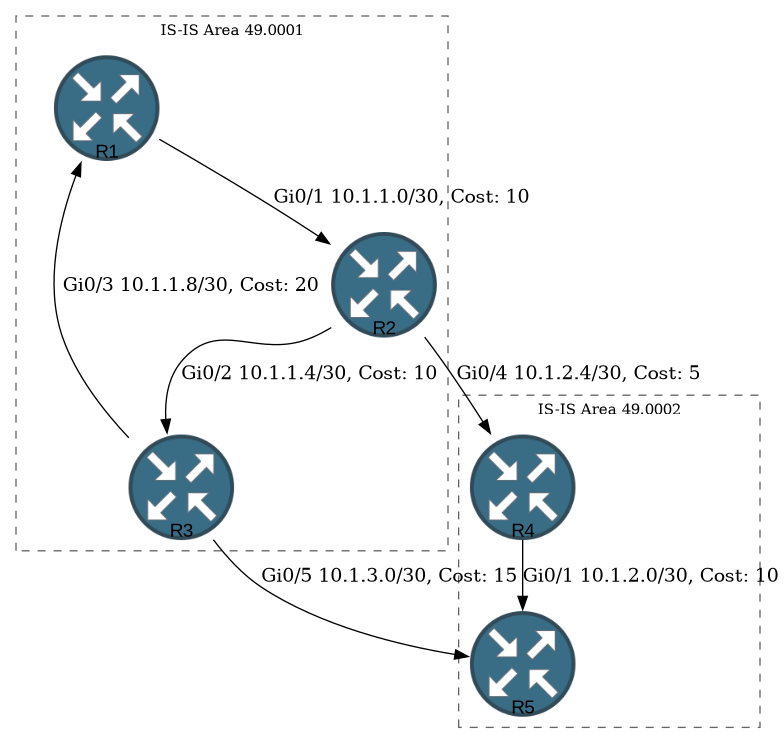
Examine the exhibit shown. Which router will have the lowest cost path to reach R5 from R1 using IS-IS metrics?
- A. R1 -> R2 -> R3 -> R5 with a total cost of 35
- B. R1 -> R3 -> R5 with a total cost of 35
- C. R1 -> R2 -> R4 -> R5 with a total cost of 25 Correct answer
- D. R1 -> R3 -> R2 -> R4 -> R5 with a total cost of 40
Option C, R1 -> R2 -> R4 -> R5 with a total cost of 25, has the lowest total cost compared to the other paths listed. The other options have higher total costs, making B the most efficient route to reach R5 from R1 using IS-IS metrics.
MPLS and Segment Routing
Which component is similar to an EVPN instance?
- A. VRF Correct answer
- B. IGP router ID
- C. router distinguisher
- D. MPLS label
D is correct. An EVPN instance (EVI) is conceptually similar to a VRF. Both define a routing domain that isolates customer traffic. The EVI contains MAC and IP routing information for a specific tenant, just as a VRF contains Layer 3 routing information.
Why do Cisco MPLS TE tunnels require a link-state routing protocol?
- A. The link-state database provides segmentation by area, which improves the path-selection process.
- B. Link-state routing protocols use SPF calculations that the tunnel endpoints leverage to implement the tunnel.
- C. The link-state database provides a data repository from which the tunnel endpoints can dynamically select a source ID.
- D. The tunnel endpoints use the link-state database to evaluate the entire topology and determine the best path. Correct answer
D is correct. MPLS TE tunnels require a link-state routing protocol (OSPF or IS-IS) because the tunnel headend needs a complete view of the network topology to compute constrained shortest paths. The link-state database provides this full topology view, enabling CSPF (Constrained Shortest Path First) calculations.
Which are two benefits of using segment routing over RSVP-TE for traffic engineering? (Choose two)
- A. Per-flow state is present only at the ingress node to the Segment routing-enabled network Correct answer
- B. Per-flow state is present at the ingress and egress node to the segment routing-enabled network
- C. Segment routing traffic engineering tunnels always follow the low-latency path
- D. ECMP-aware traffic engineering is natively supported by segment routing Correct answer
- E. Per-flow state is maintained on all nodes of the segment routing-enabled network
B, C is correct. Two key benefits of segment routing over RSVP-TE are: ECMP-aware traffic engineering is natively supported (D), meaning SR can load-balance across equal-cost paths without additional configuration; and per-flow state is present only at the ingress node (A), eliminating the need for per-flow state at every hop as required by RSVP-TE.
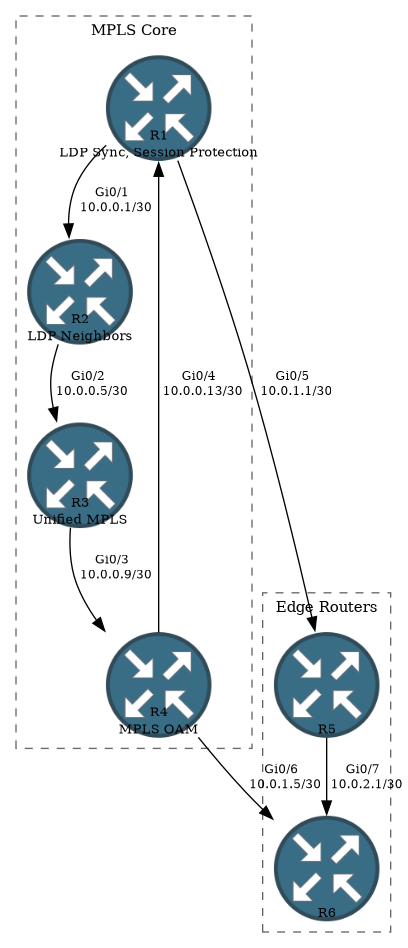
Using the exhibit shown, which router is responsible for handling MPLS Operations, Administration, and Maintenance (OAM) in the MPLS core network?
- A. R2
- B. R1
- C. R3
- D. R4 Correct answer
R4 is typically designated as the router responsible for handling MPLS Operations, Administration, and Maintenance (OAM) in the MPLS core network, as it is often the router that manages the MPLS control plane and OAM functions. This aligns with standard practices in MPLS network design where specific routers are tasked with OAM responsibilities.
Services
After you analyze your network environment, you decide to implement a full separation model for Internet access and MPLS L3VPN services. For which reason do you make this decision?
- A. It is easier to manage a system in which services are mixed.
- B. It requires only one edge router.
- C. It enables EGP and IGP to operate independently.
- D. It enables you to choose whether to separate or centralize each individual service. Correct answer
B is correct. A full separation model enables you to choose whether to separate or centralize each individual service independently. This provides maximum flexibility in deploying Internet access and MPLS L3VPN services, allowing different security policies, routing domains, and edge routers for each service based on business requirements.
Which protocol in the IPv6 stack does the MLD protocol use to carry its messages?
- A. IGMPv6
- B. DHCPv6
- C. NDP
- D. ICMPv6 Correct answer
- E. IGMP
E is correct. MLD (Multicast Listener Discovery) uses ICMPv6 to carry its messages. MLD is the IPv6 equivalent of IGMP for IPv4, and it operates as a sub-protocol of ICMPv6, using ICMPv6 message types 130-132 for MLDv1 and type 143 for MLDv2.
A network operator needs to implement PIM-SSM multicast configuration on a customer's network so that users in different domains are able to access and stream live traffic. Which two actions must the engineer perform on the network to make the streaming work? (Choose two.)
- A. Enable PIM dense mode on the device.
- B. Enable IGMP version 3 at the interface level. Correct answer
- C. Configure at least one MSDP peer on the network.
- D. Enable PIM sparse mode on the device. Correct answer
- E. Enable IGMP version 2 at the interface level.
A, C is correct. For PIM-SSM multicast to work, two actions are required: enable IGMPv3 at the interface level (B) because SSM requires IGMPv3 for source-specific group membership, and enable PIM sparse mode on the device (D) as PIM-SSM operates as a subset of PIM-SM. MSDP is not needed for SSM since sources are known to receivers.
Refer to the topology shown in the exhibit. Which statement best describes how Customer A’s VRF-A routes are exchanged between PE1 and PE2 across the MPLS core?
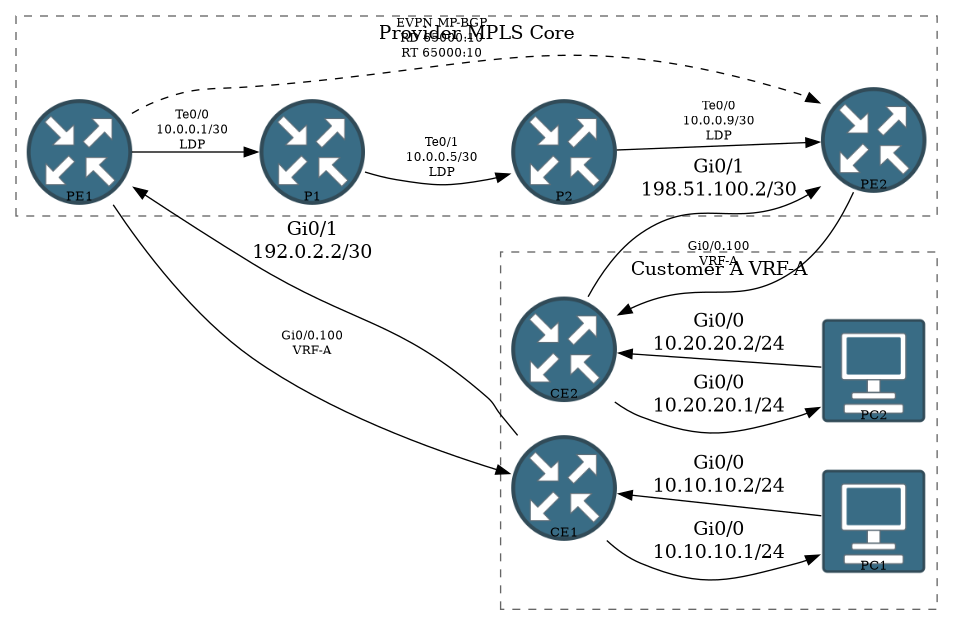
- A. PE1 and PE2 use EVPN MP-BGP with RD 65000:10 and RT 65000:10 as the VPN control plane to carry VRF-A Layer 3 VPN routes over the LDP-based MPLS core. Correct answer
- B. PE1 and PE2 use a Layer 2 EVPN service to transparently bridge CE1 and CE2, so VRF-A and IP routing are not needed on the PEs.
- C. PE1 and PE2 form an Inter-AS VPN by exchanging VRF-A routes with different route distinguishers and route targets on each PE.
- D. PE1 and PE2 use LDP directly to distribute VRF-A customer routes end to end, so no BGP VPN control plane is required.
Option A is correct. The exhibit's dashed overlay line between PE1 and PE2 is explicitly labeled 'EVPN MP-BGP, RD 65000:10, RT 65000:10,' confirming that VRF-A's Layer 3 VPN routes are carried by an EVPN MP-BGP control plane running over the LDP-signaled MPLS core (shown by the 'LDP' labels on the P1-P2 hops). LDP alone only distributes transport labels hop-by-hop and can't carry customer VPN routes end to end, no Layer 2 EVPN bridging service is shown here (VRF-A is an L3VPN), and the exhibit shows a single shared AS/RD scheme rather than the differing per-PE RDs/RTs an Inter-AS design would use.
Automation and Assurance
After a possible security breach, the network administrator of an ISP must verify the times that several different users logged into the network. Which command must the administrator enter to display the login time of each user that activated a session?
- A. show netconf-yang sessions
- B. show netconf-yang sessions detail Correct answer
- C. show netconf-yang datastores
- D. show platform software yang-management process
A is correct. The 'show netconf-yang sessions detail' command displays detailed NETCONF session information including the login time of each user who activated a session. The 'detail' keyword is required to display timestamp information; without it, only basic session data is shown.
An engineer is developing a configuration script to enable dial-out telemetry streams using gRPC on several new devices. TLS must be enabled. Which configuration must the engineer apply on the network?
- A. telemetry model-driven destination-group ciscotest address-family ipv4 192.168.1.0 port 57500 encoding self-describing-gpb protocol grpc commit
- B. telemetry model-driven destination-group DGroup1 address-family ipv4 172.0.0.0 port 5432 encoding self-describing-gpb protocol tcp commit
- C. telemetry model-driven destination-group ciscotest address-family ipv4 192.168.1.0 port 57500 encoding self-describing-gpb protocol grpc no-tls commit
- D. telemetry model-driven destination-group ciscotest address-family ipv4 192.168.1.0 port 57500 encoding self-describing-gpb protocol grpc tls-hostname ciscotest.com commit Correct answer
A is correct. When TLS is required for gRPC dial-out telemetry, the configuration must include 'protocol grpc tls-hostname' with the hostname for certificate validation. Option C with 'protocol grpc no-tls' explicitly disables TLS, which contradicts the TLS requirement.
SNMPv3 provides which three security features?(Choose three)
- A. DES 56-bit encryption Correct answer
- B. Message integrity Correct answer
- C. Private community information that is exchanged out-of-band
- D. Authentication that is based on MD5 or SHA algorithms Correct answer
- E. Encrypted user password
- F. Device hostname that is authenticated via AES algorithm
A, E, F is correct. SNMPv3 provides three key security features: DES 56-bit encryption for data confidentiality (A), message integrity to ensure data hasn't been tampered with (B), and authentication based on MD5 or SHA algorithms to verify the sender's identity (F).
Free Study Guide
Read the free Cisco CCNP 350-501 SPCOR study guide: every exam topic explained in plain English, with diagrams, exam tips and the mistakes to avoid.
More Cisco Practice Exams
- Cisco CCST 100-150 Networking Practice Exam
- Cisco CCST 100-160 Cybersecurity Practice Exam
- Cisco CCNA 200-201 CBROPS Practice Exam
- Cisco CCNA 200-301 Practice Exam
- Cisco CCNA 200-901 DEVASC Practice Exam
- Cisco CCNP 300-410 ENARSI Practice Exam
- Cisco CCNP 300-710 SNCF Practice Exam
- Cisco CCNP 300-715 SISE Practice Exam
- Cisco CCNP 350-401 ENCOR Practice Exam
- Cisco CCNP 350-701 SCOR Practice Exam
Practise with realistic mock exams to prepare for your Cisco certification.