Cisco CCST 100-150 Networking Practice Exam
Cisco Certified Support Technician Networking 100-150
The Cisco CCST 100-150 Networking certification validates entry-level knowledge of how networks operate and how to support them. The exam covers standards and concepts, addressing and subnet formats, endpoints and media types, infrastructure, diagnosing problems, and security. Candidates demonstrate knowledge of the OSI and TCP/IP models, common protocols, IPv4 and IPv6 addressing, cabling and wireless technologies, basic routing and switching, help desk troubleshooting, basic Cisco show commands, and home router wireless security. The exam consists of 50 questions over 50 minutes, with an 80% passing score.
749 questions in the bank
Question bank updated : questions, answers, explanations and chapters.
Certification Overview
- Exam name: CCST 100-150 Networking
- Vendor: Cisco
- Exam code: 100-150
- Duration: 50 minutes
- Total questions: about 50
- Our practice exam pass mark: 80%
Who Should Take This Exam?
IT support technician, Help desk technician, Network support technician, Junior network administrator, Field service technician, NOC technician, Desktop support specialist, Technical support engineer
Prerequisites
No formal prerequisites; basic computer literacy and introductory hands-on familiarity with Ethernet/Wi‑Fi networks, IP addressing, and common troubleshooting workflows are recommended.
Topics Covered
- Standards and Concepts
- Addressing and Subnet Formats
- Endpoints and Media Types
- Infrastructure
- Diagnosing Problems
- Security
Question Types
- Multiple Choice (Single Answer)
- Multiple Choice (Multiple Answers)
- Drag and Drop
- Scenario-Based
CCST 100-150 Networking Practice Questions
Our question bank contains 749+ practice questions for this certification. Sample questions from each exam chapter. Expand a question to see the answer choices. With full access, you get unlimited practice exams with randomized questions from our full question bank.
Standards and Concepts
Which layer of the OSI model is responsible for logical addressing and routing between different networks?
- A. Session layer
- B. Network layer Correct answer
- C. Data Link layer
- D. Transport layer
Option B, Network layer, is correct because it is the OSI layer responsible for logical (IP) addressing and determining the best path to route packets between different networks. Option C, the Data Link layer, handles local delivery using physical (MAC) addressing rather than routing between networks. Options C and D, Transport and Session, deal with end-to-end communication and dialogue control, not path selection.
In the TCP/IP model, which layer combines the functions of the OSI Physical and Data Link layers?
- A. Network Access (Link) layer Correct answer
- B. Application layer
- C. Transport layer
- D. Internet layer
Option A, the Network Access (Link) layer, is correct because the four-layer TCP/IP model condenses the OSI model's Physical and Data Link layers into this single layer. Option D, the Internet layer, corresponds to the OSI Network layer instead. Options B and D correspond to the OSI Transport and Application layers respectively, not the combined Physical/Data Link functions.
Which TWO protocol data units are correctly paired with their OSI layer? (Choose two)
- A. Packet - Network layer Correct answer
- B. Bit - Application layer
- C. Frame - Data Link layer Correct answer
- D. Segment - Physical layer
Options A and B are correct because Frame is the Data Link layer's protocol data unit and Packet is the Network layer's protocol data unit, both properly paired. Option D incorrectly pairs Segment with the Physical layer, when Segment actually belongs to the Transport layer. Option B incorrectly pairs Bit with the Application layer, when Bit is actually the Physical layer's unit.
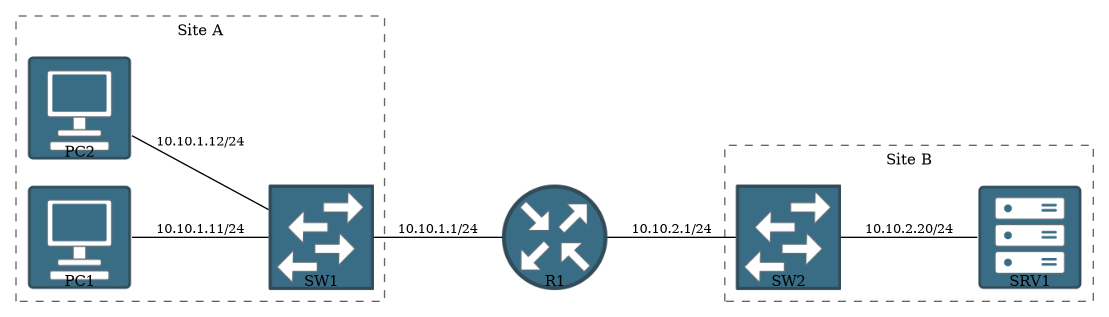
Examine the exhibit. Which device forwards traffic between Site A and Site B by examining the destination IP address?
- A. PC2
- B. SW2
- C. SW1
- D. R1 Correct answer
Option D, R1, is correct because it is the only device that sits between Site A and Site B, so it must examine the destination IP address to forward traffic between the two subnets. SW1 and SW2 only forward within their own site by MAC address, and PC2 is an end host, not a forwarding device.
Addressing and Subnet Formats
Which IPv4 address range is reserved for private use and not routable on the public internet?
- A. 203.0.113.0/24
- B. 8.8.8.0/24
- C. 1.1.1.0/24
- D. 192.168.0.0/16 Correct answer
Option D, 192.168.0.0/16, is correct because it is one of the RFC 1918 private address ranges reserved for internal use and not routable on the public internet. Options B, C, and D are all publicly routable address blocks, including well-known public DNS/documentation ranges, not private space.
What is the primary purpose of Network Address Translation (NAT)?
- A. To assign MAC addresses to devices
- B. To resolve domain names to IP addresses
- C. To encrypt traffic between hosts
- D. To translate private IP addresses to a public IP address for internet access Correct answer
Option D is correct because NAT's primary purpose is translating private, internal IP addresses to a public address so devices can access the internet. Option C, encryption, is a separate function NAT does not perform. Options C and D describe MAC address assignment and DNS resolution, unrelated to NAT's address translation role.
Which TWO of the following are valid private IPv4 address ranges under RFC 1918? (Choose two)
- A. 10.0.0.0/8 Correct answer
- B. 172.32.0.0/12
- C. 192.168.0.0/16 Correct answer
- D. 11.0.0.0/8
Options A and B are correct because 10.0.0.0/8 and 192.168.0.0/16 are both valid private IPv4 ranges defined by RFC 1918. Option B, 172.32.0.0/12, falls outside the actual private range, which only spans 172.16.0.0 through 172.31.255.255. Option D, 11.0.0.0/8, is a publicly routable range, not one of the RFC 1918 private blocks.
Refer to the exhibit. When PC1 sends traffic to the public server, which address does R1 present as the source on the Internet?

- A. 192.168.1.1
- B. 192.168.1.10
- C. 203.0.113.1
- D. 203.0.113.5 Correct answer
Option D, 203.0.113.5, is correct because that is R1's outside interface address, and NAT translates PC1's private 192.168.1.10 source address to this public address before the traffic leaves the office for the Internet. R1's inside address (192.168.1.1) and PC1's own address are private and never appear as the source once traffic crosses onto the public Internet.
Endpoints and Media Types
Which connector type is most commonly used to terminate twisted-pair copper Ethernet cables?
- A. SC
- B. RJ-11
- C. BNC
- D. RJ-45 Correct answer
Option D, RJ-45, is correct because it is the standard connector used to terminate twisted-pair copper Ethernet cabling. Option B, RJ-11, is used for telephone lines instead. Options C and D, BNC and SC, are used for coaxial and fiber optic connections respectively, not twisted-pair copper.
Which connector type is typically used to terminate a traditional telephone line?
- A. RJ-45
- B. RJ-11 Correct answer
- C. LC
- D. F-type
Option B, RJ-11, is correct because it is the standard connector used to terminate traditional telephone lines. Option A, RJ-45, is used for Ethernet networking instead. Options C and D, LC and F-type, are fiber and coaxial connectors, neither used for telephone lines.
Examine the exhibit. Which link most likely uses a fiber connector rather than RJ-45?

- A. PC1 to SW1
- B. None of these links
- C. R1 to ISP1 Correct answer
- D. SW1 to R1
Option C, R1 to ISP1, is correct because that link's description, a glass strand carrying signal 8 km, is a description of fiber-optic cabling, which uses fiber connectors rather than the RJ-45 connector used on the copper links shown elsewhere in the exhibit. The PC1-SW1 and SW1-R1 links are both explicitly described as copper, so they use RJ-45 connectors instead.
Infrastructure
Which port on a Cisco device is specifically used for out-of-band initial device configuration and management?
- A. Uplink Ethernet port
- B. Console port Correct answer
- C. USB storage port
- D. SFP port
Option B, Console port, is correct because it is specifically designed for out-of-band initial device configuration and management, independent of the network data path. Option C, a USB storage port, is used for loading files, not initial configuration access. Options C and D, uplink Ethernet and SFP ports, carry network data traffic rather than serving as the dedicated management access point.
Which device does a host use to send traffic destined for a network outside its own local subnet?
- A. A DNS server
- B. The default gateway Correct answer
- C. The DHCP server
- D. An NTP server
Option B, The default gateway, is correct because a host sends traffic destined for networks outside its own subnet to its default gateway, typically a router interface, for forwarding. Option A, a DNS server, resolves names to addresses but doesn't forward traffic. Options C and D, DHCP and NTP servers, handle address assignment and time synchronization, neither routing traffic to other networks.
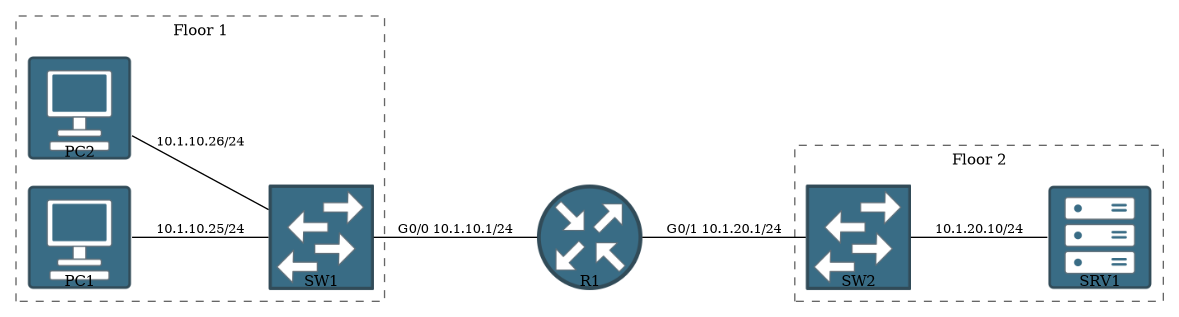
Using the exhibit, which default gateway address must be configured on PC1 so that it can reach SRV1?
- A. 10.1.20.1
- B. 10.1.10.26
- C. 10.1.10.1 Correct answer
- D. 10.1.20.10
Option C, 10.1.10.1, is correct because that is SW1's interface address on PC1's own subnet, which is exactly what a device configures as its default gateway. Option A (10.1.20.1) belongs to R1's other interface on SRV1's subnet, Option D (10.1.20.10) is SRV1 itself, and Option B (10.1.10.26) is PC2's address, none of which PC1 can use as its own gateway.
Diagnosing Problems
What file extension is commonly used to save a packet capture from Wireshark?
- A. .log only
- B. .json
- C. .docx
- D. .pcap Correct answer
Option D, .pcap, is correct because it is the commonly used file extension for saved Wireshark packet captures. Options B and C, .docx and .json, are unrelated document and data formats, not used for packet captures. Option A, .log only, describes a different, more generic logging format, not the standard packet capture extension.
Which command is used to test basic reachability to a remote host by sending ICMP echo requests?
- A. ipconfig
- B. nslookup
- C. netstat
- D. ping Correct answer
Option D, ping, is correct because it uses ICMP echo requests and replies to test basic reachability to a remote host. Option B, nslookup, performs DNS name resolution, not reachability testing. Options C and D, netstat and ipconfig, show connection statistics and local IP configuration, neither testing remote host reachability.
Which TWO of the following are core elements of effective help desk documentation? (Choose two)
- A. The technician's personal opinion of the user
- B. The user's unrelated past support history with other departments
- C. The steps taken and their results Correct answer
- D. A clear description of the reported symptom Correct answer
Options A and B are correct because a clear description of the reported symptom and the steps taken along with their results are both core elements of effective help desk documentation. Option A, a technician's personal opinion of the user, is inappropriate and unprofessional, not a documentation best practice. Option B, unrelated past support history with other departments, is irrelevant clutter that doesn't belong in documentation of the current issue.
Security
Which three properties together make up the CIA triad in foundational security concepts?
- A. Confidentiality, Installation, and Auditing
- B. Confidentiality, Integrity, and Availability Correct answer
- C. Connectivity, Identity, and Authentication
- D. Capacity, Integrity, and Access
Option B, Confidentiality, Integrity, and Availability, is correct because these three properties together make up the foundational CIA triad in security. Option C lists unrelated terms not forming this recognized security model. Options C and D mix in unrelated or fabricated terms, capacity and installation, that aren't part of the actual CIA triad.
Which type of malicious email attempts to trick a user into revealing sensitive information by impersonating a trustworthy source?
- A. DHCP relay
- B. VLAN trunking
- C. Phishing Correct answer
- D. NTP synchronization
Option C, Phishing, is correct because it specifically describes malicious emails that impersonate a trustworthy source to trick users into revealing sensitive information. Options B, C, and D describe unrelated networking protocols, NTP synchronization, DHCP relay, and VLAN trunking, none of which involve deceptive social engineering attacks.
Which TWO of the following are core functions performed by a firewall? (Choose two)
- A. Denying traffic that matches a block rule Correct answer
- B. Assigning DHCP leases to hosts
- C. Resolving DNS queries
- D. Permitting traffic that matches an allow rule Correct answer
Options A and B are correct because permitting traffic matching an allow rule, and denying traffic matching a block rule, are both core functions performed by a firewall. Option B, assigning DHCP leases, is a DHCP server function, not a firewall's role. Option C, resolving DNS queries, is a DNS server function, also unrelated to firewall filtering.
Free Study Guide
Read the free Cisco CCST 100-150 Networking study guide: every exam topic explained in plain English, with diagrams, exam tips and the mistakes to avoid.
More Cisco Practice Exams
- Cisco CCST 100-160 Cybersecurity Practice Exam
- Cisco CCNA 200-201 CCNACBR Practice Exam
- Cisco CCNA 200-301 Practice Exam
- Cisco CCNA 200-901 CCNAAUTO Practice Exam
- Cisco CCNP 300-410 ENARSI Practice Exam
- Cisco CCNP 300-710 SNCF Practice Exam
- Cisco CCNP 300-715 SISE Practice Exam
- Cisco CCNP 350-401 ENCOR Practice Exam
- Cisco CCNP 350-501 SPCOR Practice Exam
- Cisco CCNP 350-701 SCOR Practice Exam
Practice with realistic mock exams to prepare for your Cisco certification.