Cisco CCNA 200-901 CCNAAUTO Practice Exam
Cisco Certified Network Associate Automation 200-901
The Cisco CCNA 200-901 CCNAAUTO certification validates skills in automating networks using Cisco platforms. The exam covers software development and design, understanding and using APIs, Cisco platforms and development, application deployment and security, infrastructure and automation, and network fundamentals. Candidates demonstrate knowledge of JSON, XML and YAML, Git, REST API requests, Python scripting, Cisco platform APIs for Meraki, Catalyst Center and Webex, model-driven programmability with YANG, NETCONF and RESTCONF, containers, CI/CD, Ansible, and core networking concepts. The exam consists of 100 questions over 120 minutes, with an 80% passing score. The exam was formerly called DevNet Associate (200-901 DEVASC).
Exam version: v1.1
810 questions in the bank
Question bank updated : questions, answers, explanations and chapters.
Certification Overview
- Exam name: CCNA 200-901 CCNAAUTO
- Vendor: Cisco
- Exam code: 200-901
- Duration: 120 minutes
- Total questions: about 100
- Our practice exam pass mark: 80%
Who Should Take This Exam?
Network Automation Engineer, Software Developer, DevOps Engineer, Network Engineer, Site Reliability Engineer, Systems Administrator, Cloud Engineer, Application Developer
Prerequisites
No formal prerequisite. Cisco recommends basic Python skills, one or more years of hands-on experience developing or maintaining applications built on Cisco platforms, and an understanding of networking fundamentals.
Topics Covered
- Software Development and Design
- Understanding and Using APIs
- Cisco Platforms and Development
- Application Deployment and Security
- Infrastructure and Automation
- Network Fundamentals
Question Types
- Multiple Choice (Single Answer)
- Multiple Choice (Multiple Answers)
- Drag and Drop
- Scenario-Based
CCNA 200-901 CCNAAUTO Practice Questions
Our question bank contains 810+ practice questions for this certification. Sample questions from each exam chapter. Expand a question to see the answer choices. With full access, you get unlimited practice exams with randomized questions from our full question bank.
Software Development and Design
Which data format uses indentation rather than brackets or closing tags to show structure?
- A. YAML Correct answer
- B. XML
- C. JSON
- D. HTML
Option A is correct because YAML uses whitespace indentation to express nesting. JSON relies on braces and brackets, while XML and HTML use opening and closing tags.
Which of the following is a valid JSON document?
- A. {'name': 'R1', 'up': true}
- B. {name: "R1", up: true}
- C. {"name": "R1", "up": true} Correct answer
- D. {"name": "R1", "up": true,}
Option C is correct because JSON requires double-quoted keys and strings, and this document has valid syntax. Option A uses single quotes, B leaves the key unquoted, and D has a trailing comma, all of which JSON forbids.
Which characteristics apply to JSON? (Choose two.)
- A. Every element must have a closing tag
- B. It supports arrays as a native structure Correct answer
- C. It allows // comments in the document
- D. Object keys must be strings enclosed in double quotes Correct answer
Options B and D are correct because JSON has arrays as a native structure and requires object keys to be double-quoted strings. Closing tags belong to XML, and the JSON specification does not allow // comments.
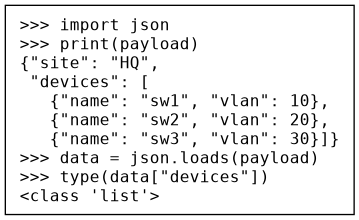
Refer to the output shown. Which expression returns the VLAN of sw3?
- A. data["devices"]["sw3"]["vlan"]
- B. data["vlan"][2]
- C. data["devices"][2]["vlan"] Correct answer
- D. data["devices"][3]["vlan"]
Option C is correct because the exhibit shows devices as a list of dictionaries, and sw3 is the third entry, which is index 2 because Python lists are zero-indexed. Option D uses index 3, which would raise an IndexError, and A and B treat the list as a dict keyed by device name or refer to a nonexistent top-level vlan key.
Understanding and Using APIs
Which HTTP method is typically used to retrieve a resource without modifying it?
- A. POST
- B. PUT
- C. GET Correct answer
- D. DELETE
Option C is correct because GET is the safe, read-only method for retrieving a resource. POST, PUT and DELETE all change server state (create, replace, remove).
Which HTTP method is normally used to create a new resource in a REST API?
- A. GET
- B. HEAD
- C. DELETE
- D. POST Correct answer
Option D is correct because POST submits a new resource to a collection endpoint, and the server assigns its identifier. GET and HEAD only read data, and DELETE removes a resource.
Which HTTP methods are normally used to change data on the server? (Choose two.)
- A. POST Correct answer
- B. HEAD
- C. DELETE Correct answer
- D. GET
Options A and C are correct because POST creates or submits data and DELETE removes a resource, both changing server state. HEAD and GET are read-only methods that only retrieve headers or representations.
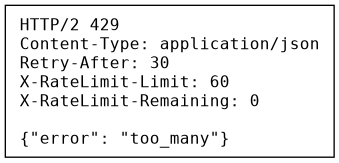
Using the response shown, what should the client do next?
- A. Request a new access token immediately
- B. Change the request method from GET to POST
- C. Wait at least 30 seconds, then retry the request Correct answer
- D. Retry immediately with a smaller request body
Option C is correct because the exhibit shows an HTTP 429 (Too Many Requests) response with Retry-After: 30 and X-RateLimit-Remaining: 0, so the client has used its quota and must wait at least 30 seconds before retrying. A new token, a different method or a smaller body would not clear a rate limit, and retrying immediately would just be rejected again.
Cisco Platforms and Development
Which Python package is the official SDK for the Meraki Dashboard API?
- A. merakisdk
- B. meraki Correct answer
- C. dashboardapi
- D. ciscomeraki
Option B is correct because the official Meraki Dashboard API Python library is published on PyPI as `meraki` (installed with `pip install meraki`). The other names are not the official SDK package.
Which Python SDK wraps the Cisco Catalyst Center REST APIs?
- A. ucsmsdk
- B. ncclient
- C. pyats
- D. dnacentersdk Correct answer
Option D is correct because `dnacentersdk` is the Python SDK for the Cisco Catalyst Center (formerly DNA Center) REST APIs. Option A (ucsmsdk) targets UCS Manager, B (ncclient) is a generic NETCONF client, and C (pyATS) is a test framework.
Which are advantages of using a Cisco SDK instead of raw REST calls? (Choose two.)
- A. Credentials are no longer needed
- B. REST endpoints are exposed as Python methods and objects Correct answer
- C. The code runs directly on the network device
- D. Authentication and pagination are handled by SDK methods Correct answer
Options B and D are correct because an SDK exposes REST endpoints as Python methods and objects and handles authentication and pagination for you. Credentials are still required, and SDK code runs on your workstation or server rather than on the network device.
Application Deployment and Security
What is edge computing?
- A. Storing all data in a single public cloud region
- B. Running applications only on end-user laptops
- C. Processing data close to where it is generated instead of in a distant central data center Correct answer
- D. Encrypting data at rest only
Option C is correct because edge computing moves processing close to the source of the data, such as sensors or branch sites. Storing everything in one cloud region is the opposite of edge, and encrypting data at rest is unrelated to where computation happens.
Which is a primary benefit of edge computing?
- A. Lower latency and less bandwidth consumed toward the cloud Correct answer
- B. Unlimited storage capacity
- C. Elimination of the need for local devices
- D. Automatic patching of all applications
Option A is correct because processing data locally cuts round-trip latency and reduces the volume sent over the WAN to the cloud. Edge does not give unlimited storage, remove local devices, or patch applications automatically.
Which are benefits of edge computing? (Choose two.)
- A. No need for security controls
- B. Less data sent to the central cloud Correct answer
- C. Lower latency for local processing Correct answer
- D. Unlimited compute capacity
Options B and C are correct because processing data at the edge sends less data to the central cloud and gives lower latency for local processing. Edge computing does not remove the need for security controls, and edge nodes have limited rather than unlimited capacity.
Infrastructure and Automation
Which data modeling language describes the structure and constraints of network device configuration in NETCONF and RESTCONF?
- A. OpenAPI Specification (OAS), used for REST API documentation
- B. MIB (Management Information Base), used with SNMP over UDP
- C. YANG Correct answer
- D. XML Schema Definition (XSD), used for web service contracts
Option C is correct because YANG (Yet Another Next Generation) is the data modeling language specifically designed to describe the structure, syntax, and constraints of configuration and operational data for NETCONF and RESTCONF. OpenAPI Specification is used for documenting REST APIs and is not a network device data model; MIB is used with SNMP and cannot represent the hierarchical configuration structures that YANG handles.
Which protocol transports YANG-modeled configuration data over HTTP/HTTPS and supports both JSON and XML encoding?
- A. gNMI, which uses gRPC as its transport with Protocol Buffer encoding
- B. RESTCONF Correct answer
- C. SNMP v3, which uses MIB trees over UDP with community-string authentication
- D. NETCONF, which uses SSH as its transport and encodes data in XML only
Option B is correct because RESTCONF is the protocol that runs over HTTP/HTTPS and supports both JSON and XML encoding of YANG-modeled data. NETCONF uses SSH as its transport and supports only XML encoding, while gNMI uses gRPC with Protocol Buffer encoding rather than HTTP.
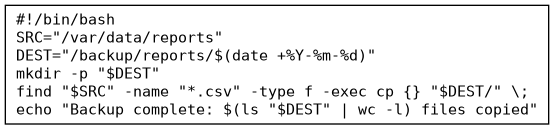
Based on the bash script shown, what does this script accomplish?
- A. Compresses all CSV files from /var/data/reports and saves a single archive to a date-stamped directory
- B. Copies all CSV files from /var/data/reports into a date-stamped backup directory Correct answer
- C. Moves all CSV files from /var/data/reports into a date-stamped backup directory, removing the originals
- D. Searches /var/data/reports for CSV files and replaces any existing backup copies in the destination with updated versions
Option B is correct because the script uses find with -exec cp to copy each matched CSV file to the destination directory; the originals in /var/data/reports are not removed. mkdir -p creates the date-stamped directory if it does not yet exist, and the final echo line reports the count of files copied. A move operation would require mv instead of cp.
Network Fundamentals
How many bits are in a MAC address?
- A. 32
- B. 48 Correct answer
- C. 64
- D. 128
Option B is correct because a MAC address is 48 bits (six bytes), usually written as 12 hexadecimal digits. 32 bits is the size of an IPv4 address, and 128 bits is an IPv6 address.
Which statements about VLANs are accurate? (Choose two.)
- A. A VLAN increases the link speed
- B. A VLAN forms a separate broadcast domain Correct answer
- C. A VLAN encrypts traffic between hosts
- D. Trunk links identify VLANs using 802.1Q tags Correct answer
Options B and D are correct because a VLAN creates a separate broadcast domain, and trunk links identify the VLAN of each frame with 802.1Q tags. VLANs do not increase link speed or encrypt traffic.
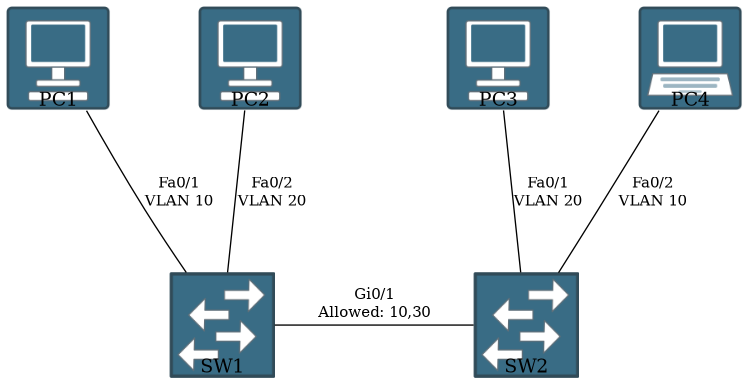
Refer to the exhibit. PC1 sends a broadcast frame. Which hosts receive it?
- A. PC4 only Correct answer
- B. PC2 and PC4
- C. PC3 and PC4
- D. PC2, PC3, and PC4
Option A is correct because a broadcast stays within its VLAN. PC1 is in VLAN 10, and the only other VLAN 10 host is PC4 on SW2, reached across the Gi0/1 trunk, which allows VLANs 10 and 30. PC2 and PC3 are in VLAN 20, so they do not receive the frame.
Free Study Guide
Read the free Cisco CCNA 200-901 CCNAAUTO study guide: every exam topic explained in plain English, with diagrams, exam tips and the mistakes to avoid.
More Cisco Practice Exams
- Cisco CCST 100-150 Networking Practice Exam
- Cisco CCST 100-160 Cybersecurity Practice Exam
- Cisco CCNA 200-201 CCNACBR Practice Exam
- Cisco CCNA 200-301 Practice Exam
- Cisco CCNP 300-410 ENARSI Practice Exam
- Cisco CCNP 300-710 SNCF Practice Exam
- Cisco CCNP 300-715 SISE Practice Exam
- Cisco CCNP 350-401 ENCOR Practice Exam
- Cisco CCNP 350-501 SPCOR Practice Exam
- Cisco CCNP 350-701 SCOR Practice Exam
Practice with realistic mock exams to prepare for your Cisco certification.