Cisco CCNP 350-701 SCOR Practice Exam
Cisco Certified Network Professional Security Core 350-701
The Cisco CCNP 350-701 SCOR certification validates skills in implementing and operating core Cisco security technologies. The exam covers security concepts, network security, cloud security, secure service edge, endpoint protection and detection, and network access, visibility, and enforcement. Candidates demonstrate knowledge of Cisco Secure Firewall, Secure Access, Secure Endpoint, Identity Services Engine, Duo, XDR, and Splunk, along with VPNs, zero trust, AI/LLM threats, and post-quantum cryptography. The exam consists of 100 questions over 120 minutes, with an 80% passing score.
Question bank updated : questions, answers, explanations and chapters.
Certification Overview
- Exam name: CCNP 350-701 SCOR
- Vendor: Cisco
- Exam code: 350-701
- Duration: 120 minutes
- Total questions: about 100
- Our practice exam pass mark: 80%
Who Should Take This Exam?
Security Analyst, Security Engineer, Incident Responder, Network Security Administrator, IT Security Manager, Cybersecurity Consultant
Prerequisites
Valid CCNA certification or equivalent networking experience.
Topics Covered
- Security Concepts
- Network Security
- Cloud Security
- Secure Service Edge
- Endpoint Protection and Detection
- Network Access, Visibility, and Enforcement
Question Types
- Multiple Choice (Single Answer)
- Multiple Choice (Multiple Answers)
- Drag and Drop
- Scenario-Based
CCNP 350-701 SCOR Practice Questions
Our question bank contains 841+ practice questions for this certification. Sample questions from each exam chapter. Expand a question to see the answer choices. With full access, you get unlimited practice exams with randomised questions from our full question bank.
Security Concepts
How does endpoint security enhance the overall security posture of an organization?
- A. It streamlines the incident response process to automatically perform digital forensics on the endpoint.
- B. It allows the organization to mitigate web-based attacks as long as the user is active in the domain.
- C. It allows the organization to detect and respond to threats at the edge of the network.
- D. It allows the organization to detect and mitigate threats that the perimeter security devices do not detect. Correct answer
Endpoint security enhances the overall security posture by detecting and mitigating threats that perimeter security devices do not detect, which is crucial for comprehensive security coverage.
What are two functions supported by TAXII?
- A. Exchange Correct answer
- B. Pull messaging Correct answer
- C. Binding
- D. Correlation
- E. Mitigating
TAXII (Trusted Automated eXchange of Indicator Information) supports functions such as Exchange and Pull messaging, which are essential for sharing threat intelligence.
Which encryption and authentication algorithm is used for data plane communication?
- A. AES-GCM Correct answer
- B. SHA-96
- C. AES-256
- D. SHA-384
AES-GCM is a widely accepted encryption and authentication algorithm used for data plane communication, making it the correct choice for this question.
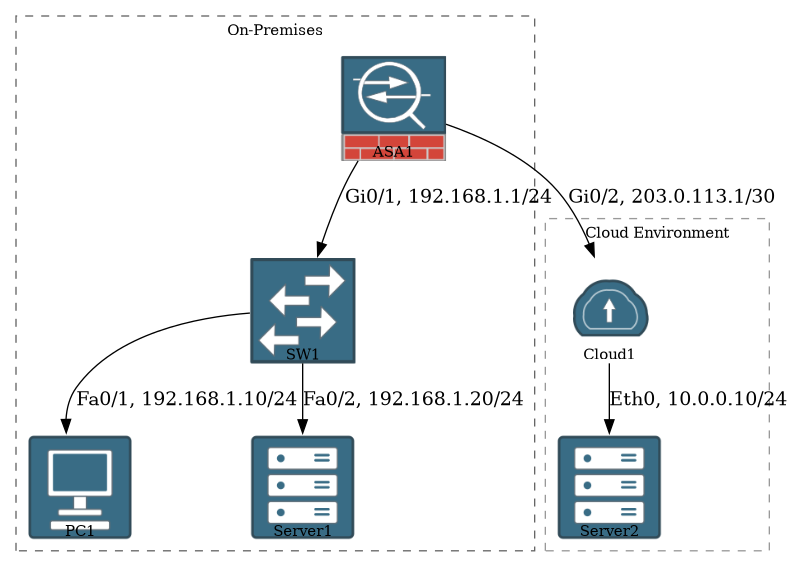
Based on the exhibit shown, which type of common threat can exploit the connection between ASA1 and Cloud1 due to potential exposure of IP addresses?
- A. Rootkit Installation
- B. SQL Injection
- C. Phishing Attack
- D. Man-in-the-Middle Attack Correct answer
A Man-in-the-Middle Attack is a common threat that can exploit the connection between ASA1 and Cloud1 by intercepting and potentially altering the communication between the two, especially if IP addresses are exposed. SQL Injection (B) and Rootkit Installation (A) are not directly related to the exposure of IP addresses in a network connection context. Phishing Attack (C) typically targets users rather than exploiting network connections directly. Therefore, C is the most relevant and correct option.
Network Security
What SNMPv3 configuration should be used to ensure the highest level of security?
- A. asa-host(config)#snmp-server group myv3 v3 priv asa-host(config)#snmp-server user andy myv3 auth sha cisco priv des ciscXXXXXXXX asa-host (config)#snmp-server host inside 10.255.254.1 version 3 andy
- B. asa-host(config)#snmp-server group myv3 v3 noauth asa-host(config)#snmp-server user andy myv3 auth sha cisco priv aes 256 ciscXXXXXXXX asa-host(config)#snmp-server host inside 10.255.254.1 version 3 andy
- C. asa-host(config)#snmpserver group myv3 v3 noauth asa-host(config)#snmp-server user andy myv3 auth sha cisco priv 3des ciscXXXXXXXX asa-host(config)#snmp-server host inside 10.255.254.1 version 3 andy
- D. asa-host(config)#snmp-server group myv3 v3 priv asa-host(config)#snmp-server user andy myv3 auth sha cisco priv aes 256 ciscXXXXXXXX asa-host (config)#snmp-server host inside 10.255.254.1 version 3 andy Correct answer
The configuration in option D uses SNMPv3 with both authentication (SHA) and encryption (AES 256), which provides the highest level of security as per SNMPv3 standards.
A mall wants separate management on a shared appliance for providing security services to customers. Which ASA deployment mode fulfills these requirements?
- A. routed mode
- B. transparent mode
- C. multiple context mode Correct answer
- D. multiple zone mode
Multiple context mode allows for separate management of security services on a shared appliance, which meets the requirements stated in the question.
What are two advantages of using Flexible NetFlow records?(Choose two)
- A. They allow the user to configure flow information to perform customized traffic identification Correct answer
- B. They provide attack prevention by dropping the traffic
- C. They provide accounting and billing enhancements
- D. They converge multiple accounting technologies into one accounting mechanism Correct answer
- E. They provide monitoring of a wider range of IP packet information from Layer 2 to 4
Flexible NetFlow records allow for customized traffic identification and can converge multiple accounting technologies into one mechanism, which are recognized advantages in the context of Cisco's security technologies.
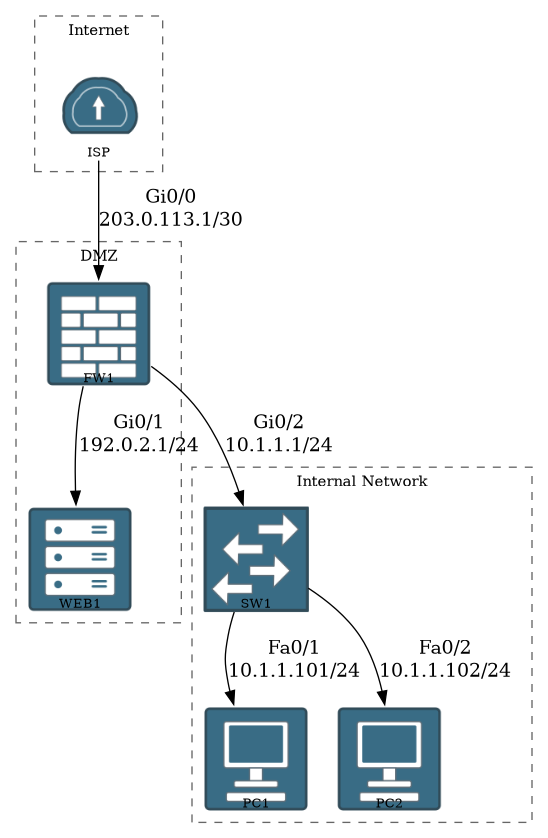
Examine the exhibit shown. Which network security solution is primarily responsible for controlling access between the Internet and the internal network, providing both intrusion prevention and firewall capabilities?
- A. ISP in the Internet
- B. WEB1 in the DMZ
- C. FW1 in the DMZ Correct answer
- D. SW1 in the Internal Network
Option C, 'FW1 in the DMZ', is correct because a firewall (FW1) is specifically designed to control access between different network segments, including the Internet and the internal network, while also providing intrusion prevention capabilities. The other options do not fulfill both roles: A (SW1 in the Internal Network) is a switch and does not provide firewall or intrusion prevention; B (WEB1 in the DMZ) is likely a web server, which does not control access; D (ISP in the Internet) refers to an Internet Service Provider, which does not provide direct control over access to the internal network.
Cloud Security
When assessing risks to cloud adoption, which deployment model is considered the most secure?
- A. Public Cloud
- B. Hybrid Cloud
- C. Community Cloud
- D. Private Cloud Correct answer
The Private Cloud model is considered the most secure deployment model for cloud adoption due to its dedicated resources and enhanced control over security measures.
An engineer has received a task to deploy a solution capable of securing cloud users, data, and applications. The requirement is to utilize the Cisco cloud native CASB and cloud cybersecurity platform. What solution should be implemented to fulfill these requirements?
- A. Cisco Umbrella
- B. Cisco Cloud Email Security
- C. Cisco NGFW
- D. Cisco Cloudlock Correct answer
Cisco Cloudlock is the Cisco cloud-native CASB solution designed to secure cloud users, data, and applications, making it the appropriate choice for the given requirements.
Examine the exhibit shown. Which cloud service model is implemented in the private cloud segment, considering the security devices and their roles?
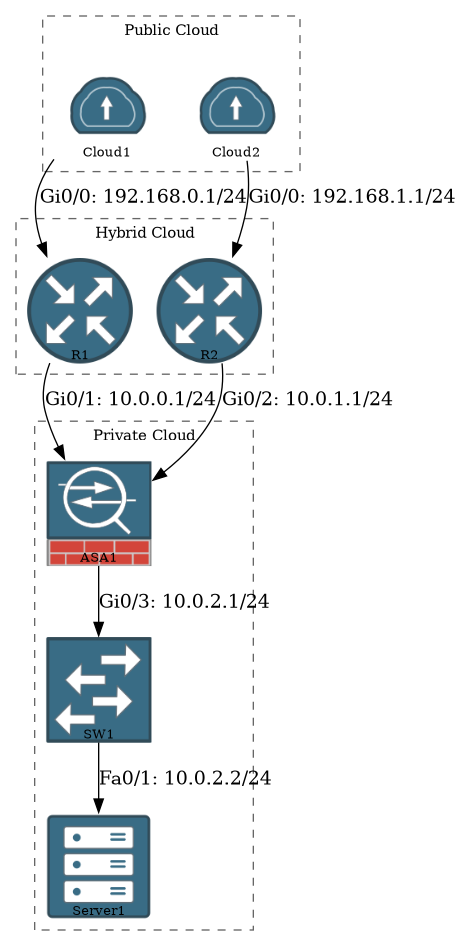
- A. IaaS (Infrastructure as a Service) Correct answer
- B. PaaS (Platform as a Service)
- C. FaaS (Function as a Service)
- D. SaaS (Software as a Service)
The option 'C: IaaS (Infrastructure as a Service)' is correct because IaaS provides virtualized computing resources over the internet, which aligns with the concept of a private cloud segment that typically offers infrastructure management and security devices. The other options are not correct because: 'A: SaaS' refers to software applications delivered over the internet, 'B: PaaS' refers to platforms for developing applications, and 'D: FaaS' refers to serverless computing, none of which specifically describe the infrastructure aspect of a private cloud.
Secure Service Edge
What action can one take to test whether traffic is being routed through the Cisco Umbrella network after configuring a new network identity in Cisco Umbrella?
- A. Ensure that the client computers are pointing to the on-premises DNS servers.
- B. Enable the Intelligent Proxy to validate that traffic is being routed correctly.
- C. Add the public IP address that the client computers are behind to a Core Identity.
- D. Browse to http://welcome.umbrella.com/ to validate that the new identity is working. Correct answer
Browsing to http://welcome.umbrella.com/ is a standard method to verify that traffic is being routed through the Cisco Umbrella network after configuring a new network identity.
An organization has observed a rise in malicious content downloads and plans to utilize Cisco Umbrella to stop this activity for suspicious domains while permitting regular web traffic. What action will achieve this goal?
- A. Set content settings to High
- B. Configure the intelligent proxy. Correct answer
- C. Use destination block lists.
- D. Configure application block lists.
The Umbrella intelligent proxy enables deep packet inspection and content analysis to distinguish between malicious and legitimate traffic on the same domains. It inspects actual content being downloaded to detect and block only the malicious payloads, while allowing legitimate web traffic to pass through—providing granular control beyond simple DNS blocking.
Refer to the exhibit shown. Which security feature should be implemented on ASA1 to ensure that web traffic from PC1 and PC2 is inspected for malware before reaching the internet?
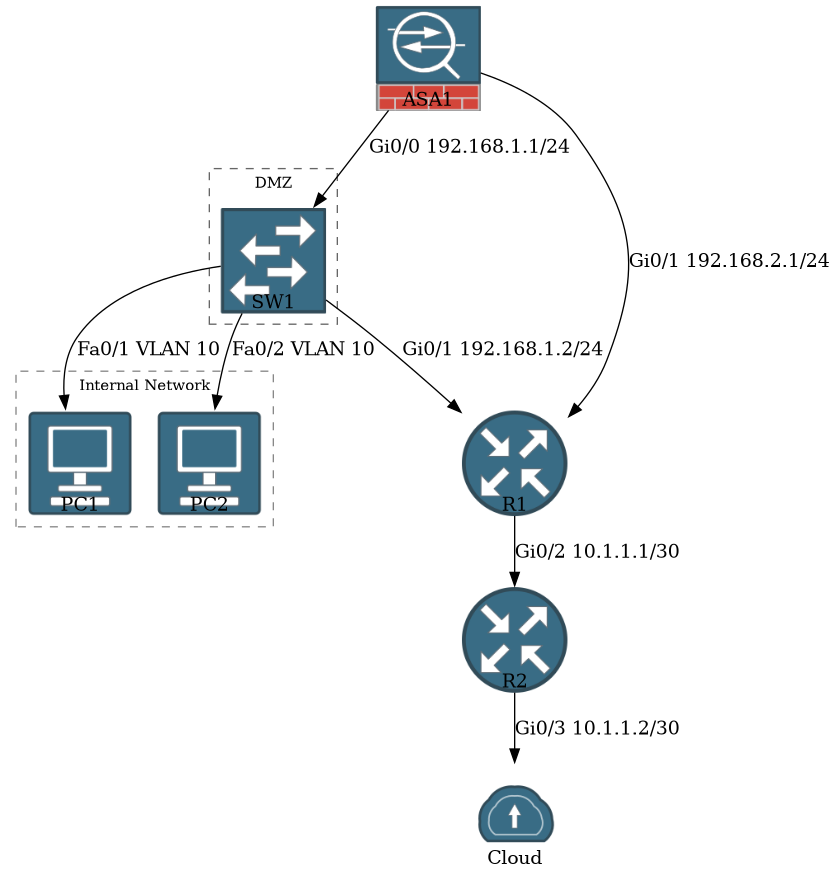
- A. Configure malware scanning on ASA1. Correct answer
- B. Enable URL filtering on SW1.
- C. Activate TLS decryption on PC1 and PC2.
- D. Implement block listing on R1.
Option A, 'Configure malware scanning on ASA1,' is correct because it directly addresses the need to inspect web traffic for malware before it reaches the internet. The ASA (Adaptive Security Appliance) is designed to provide security features such as malware scanning. The other options do not directly relate to inspecting web traffic for malware: Option B refers to URL filtering, which is not specifically for malware; Option D discusses block listing, which is not a malware inspection method; and Option C involves TLS decryption, which is not a direct method for malware scanning but rather a way to inspect encrypted traffic.
Endpoint Protection and Detection
What advantage does installing Cisco Secure Endpoint (formerly AMP for Endpoints) bring to a network?
- A. It provides operating system patches on the endpoints for security
- B. It provides flow-based visibility for the endpoints network connections
- C. It enables behavioral analysis to be used for the endpoints
- D. It protects endpoint systems through application control and real-time scanning Correct answer
Cisco Secure Endpoint provides protection through application control and real-time scanning, which is a key feature of the solution.
When should an organization opt for an Endpoint Detection and Response (EDR) solution instead of an Endpoint Protection Platform (EPP)?
- A. when there is a need for traditional anti-malware detection
- B. when there is no need to have the solution centrally managed
- C. when there is no firewall on the network
- D. when there is a need to have more advanced detection capabilities Correct answer
An Endpoint Detection and Response (EDR) solution is designed for advanced detection capabilities, which is a key differentiator from traditional Endpoint Protection Platforms (EPP).
What are two types of lists utilized within Cisco Secure Endpoint (formerly AMP for Endpoints) Outbreak Control?
- A. blocked ports
- B. simple custom detections Correct answer
- C. command and control
- D. allowed applications Correct answer
- E. URL
Cisco Secure Endpoint Outbreak Control uses **simple custom detections** to rapidly deploy custom signatures against emerging threats, and **allowed applications** whitelists to restrict execution to only trusted binaries. Together they contain outbreaks by blocking malware while permitting legitimate software.
Network Access, Visibility, and Enforcement
Which two engines are included in Cognitive Threat Analytics for detection and analytics?
- A. data exfiltration Correct answer
- B. command and control communication Correct answer
- C. intelligent proxy
- D. snort
- E. URL categorization
Cognitive Threat Analytics includes engines for detecting data exfiltration and command and control communication, which are critical for identifying security threats.
What makes implementing MFA important within an organization?
- A. To prevent man-in-the-middle attacks from being successful
- B. To prevent DoS attacks from being successful.
- C. To prevent brute force attacks from being successful. Correct answer
- D. To prevent phishing attacks from being successful.
Implementing MFA is crucial in preventing brute force attacks, as it adds an additional layer of security beyond just passwords, making it significantly harder for attackers to gain unauthorized access.
What method is employed to distribute certificates and configure the supplicant on mobile devices for accessing network resources?
- A. BYOD onboarding Correct answer
- B. Simple Certificate Enrollment Protocol
- C. Client provisioning
- D. MAC authentication bypass
BYOD (Bring Your Own Device) onboarding automates certificate distribution and supplicant installation on personally-owned mobile devices. It provisions employees' devices with the necessary 802.1X credentials and security clients to enable seamless network authentication without manual per-device configuration, streamlining mobile access for BYOD programs.
Free Study Guide
Read the free Cisco CCNP 350-701 SCOR study guide: every exam topic explained in plain English, with diagrams, exam tips and the mistakes to avoid.
More Cisco Practice Exams
- Cisco CCST 100-150 Networking Practice Exam
- Cisco CCST 100-160 Cybersecurity Practice Exam
- Cisco CCNA 200-201 CCNACBR Practice Exam
- Cisco CCNA 200-301 Practice Exam
- Cisco CCNA 200-901 CCNAAUTO Practice Exam
- Cisco CCNP 300-410 ENARSI Practice Exam
- Cisco CCNP 300-710 SNCF Practice Exam
- Cisco CCNP 300-715 SISE Practice Exam
- Cisco CCNP 350-401 ENCOR Practice Exam
- Cisco CCNP 350-501 SPCOR Practice Exam
Practise with realistic mock exams to prepare for your Cisco certification.