Juniper JNCIS-SP JN0-364 Practice Exam
Service Provider Routing and Switching, Specialist (JNCIS-SP) JN0-364
The Juniper JNCIS-SP JN0-364 exam validates basic knowledge of routing and switching technologies and related platform configuration and troubleshooting in Junos OS, and it is the specialist-level certification in Juniper's service provider routing and switching track. It covers ten areas: protocol independent routing, OSPF, IS-IS, BGP, Layer 2 bridging and VLANs, spanning tree, MPLS, IPv6, tunnels, and high availability. This practice exam uses single-answer and multiple-answer questions, with Junos CLI output, configuration and topology exhibits.
860 questions in the bank
Question bank updated : questions, answers, explanations and chapters.
Certification Overview
- Exam name: JNCIS-SP JN0-364
- Vendor: Juniper
- Exam code: JN0-364
- Duration: 90 minutes
- Total questions: about 65
- Our practice exam pass mark: 80%
Who Should Take This Exam?
Network Engineer, Service Provider Network Engineer, Routing and Switching Engineer, MPLS Engineer, Network Administrator, NOC Engineer, and JNCIA-Junos holders moving to the specialist level
Prerequisites
Juniper requires the JNCIA-Junos certification as a prerequisite for JNCIS-SP.
Topics Covered
- Protocol-Independent Routing
- OSPF
- IS-IS
- BGP
- Layer 2 Bridging or VLANs
- Spanning-Tree Protocols
- MPLS
- IPv6
- Tunnels
- High Availability
Question Types
- Multiple Choice (Single Answer)
- Multiple Choice (Multiple Answers)
- Scenario-Based
JNCIS-SP JN0-364 Practice Questions
Our question bank contains 860+ practice questions for this certification. Sample questions from each exam chapter. Expand a question to see the answer choices. With full access, you get unlimited practice exams with randomized questions from our full question bank.
Protocol-Independent Routing
A router has two equal-cost OSPF paths to 10.50.0.0/16 but forwards all flows over one next hop. The engineer has already created policy-statement LB-ALL with the action 'then load-balance per-packet'. Which configuration applies the policy so that flows are spread across both next hops?
- A. set protocols bgp group INTERNAL multipath
- B. set protocols ospf import LB-ALL
- C. set routing-options forwarding-table export LB-ALL Correct answer
- D. set protocols ospf export LB-ALL
Option C is correct because a load-balance policy takes effect only when it is exported from the routing table to the forwarding table, which is done with forwarding-table export. Options B and D are OSPF import and export policies, which control what OSPF accepts or advertises and never touch forwarding-table installation. Option A enables BGP multipath, which is irrelevant to OSPF routes.
What is the default route preference of a static route on a Junos router?
- A. 5 Correct answer
- B. 10
- C. 130
- D. 170
Option A is correct because a static route has a default route preference of 5. Option B (10) is the OSPF internal preference, option C (130) is the aggregate preference and option D (170) is the BGP preference.
OSPF
What decides which router becomes the DR when two OSPF routers with equal interface priorities join a broadcast segment at the same moment?
- A. The lowest interface IP address
- B. The highest interface cost
- C. The highest router ID Correct answer
- D. The lowest router ID
Option C is correct because when interface priorities are equal, OSPF breaks the tie with the highest router ID, and that router becomes the DR. Option D reverses the rule. Option A is not used for the election, and interface cost plays no part in it (option B).
Which operational command displays the OSPF link-state database on a Junos device?
- A. show route protocol ospf
- B. show ospf database Correct answer
- C. show ospf neighbor
- D. show ospf route
Option B is correct because show ospf database lists the link-state database, with the LSAs grouped by type. Show ospf neighbor lists adjacencies, show ospf route lists the OSPF routes computed from the database, and show route protocol ospf lists the OSPF routes in the routing table.
IS-IS
R1, R2 and R3 share an Ethernet LAN running IS-IS Level 2, all with the default interface priority, and R2 is the DIS. R4 then joins the LAN with a higher priority configured. What happens on the LAN?
- A. R4 preempts R2 and becomes the DIS Correct answer
- B. R4 becomes the DIS after the hold time of R2 expires
- C. R2 stays the DIS until its adjacency fails
- D. R4 becomes the backup DIS
Option A is correct because IS-IS DIS election is preemptive: the router with the highest interface priority becomes the DIS, so when R4 joins with a higher priority it takes over from R2 and a new pseudonode is created. Options B and C describe a non-preemptive election, which is how OSPF behaves, not IS-IS. Option D is wrong because IS-IS has no backup DIS.
Based on the topology shown, which router sets the attached (ATT) bit in the Level 1 LSP it originates?
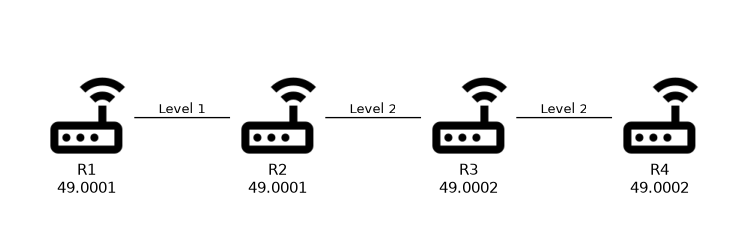
- A. R2 Correct answer
- B. R1
- C. R3
- D. R4
Option A, R2, is correct because it is the Level 1/Level 2 router with a Level 1 adjacency to R1 and a Level 2 adjacency to R3 in a different area, so it sets the attached bit in its Level 1 LSP. R1 is Level 1-only and R4 reaches only R3 in its own area. R3 runs only Level 2 on its links, so no Level 1 LSP from it is used.
BGP
A Junos router receives two BGP paths to 172.16.0.0/16 with equal local preference, AS path length and origin. Path 1 comes from iBGP peer 192.0.2.1: first AS 65010, MED 50, IGP metric to the next hop 2. Path 2 comes from eBGP peer 192.0.2.9: first AS 65020, MED 200, IGP metric to the next hop 20. Which path is selected, and why?
- A. Path 1, because it has the lower MED
- B. Path 2, because eBGP is preferred over iBGP Correct answer
- C. Path 1, because its next hop has the lower IGP metric
- D. Path 2, because its peer has the higher router ID
Option B is correct because the first three tie-breakers are equal, and MED is compared only between paths from the same neighboring AS by default. Here the first AS values differ (65010 and 65020), so MED is skipped, and the next step prefers the EBGP path over the IBGP path. Options A and C are wrong because MED is not compared and the IGP metric step comes after the EBGP preference. Option D is wrong because the router ID is a late tie-breaker that is never reached.
Each router peers with its neighbors over the link addresses shown, and no routing policy is configured. What does R4 record for 10.1.0.0/16?
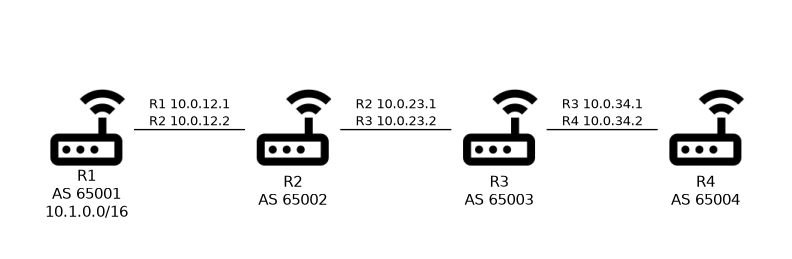
- A. AS path 65003 65002 65001, next hop 10.0.12.1
- B. AS path 65001 65002 65003, next hop 10.0.34.1
- C. AS path 65001, next hop 10.0.34.1
- D. AS path 65003 65002 65001, next hop 10.0.34.1 Correct answer
Option D is correct because each EBGP router prepends its own AS when it advertises the route, so R4 sees 65003 65002 65001, with the origin AS 65001 last. Each EBGP router also sets the next hop to its own address on the link, so R4's next hop is R3's address on the shared link, 10.0.34.1. The other options reverse the AS path order (B), omit the intermediate ASes (C), or keep an address from a link R4 does not share (A).
Layer 2 Bridging or VLANs
A provider bridges traffic for several customers whose sites all use VLAN 100 internally. Which approach keeps the customers separate across the provider network while their own VLAN IDs stay unchanged inside the frames?
- A. Push an outer service VLAN tag on each customer port Correct answer
- B. Trunk every customer port with vlan-id-list all
- C. Translate each customer's VLAN 100 to a unique ID
- D. Assign each customer a different native VLAN ID
Option A is correct because pushing an outer service VLAN tag on each customer port (Q-in-Q, or dot1q tunneling) keeps customers separate while their inner VLAN 100 tags pass through unchanged. Option B is wrong because trunking all VLANs on the ports would merge the customers, all of whom use VLAN 100. Option C is wrong because translating the VLAN ID changes the customer's own tag. Option D is wrong because a native VLAN only affects untagged frames.
Refer to the topology shown. A provider bridges this customer with S-VLAN 500, and PE2 uses a normal customer-facing port toward CE2. A frame from CE1 in customer VLAN 200 crosses the provider network. Which tag stack does the segment marked with a question mark carry?
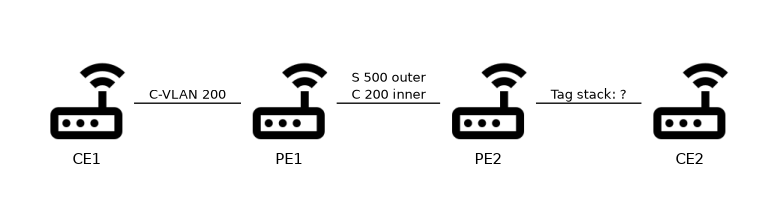
- A. Two tags: S-VLAN 500 outer, C-VLAN 200 inner
- B. Two tags: C-VLAN 200 outer, S-VLAN 500 inner
- C. One tag: C-VLAN 200 Correct answer
- D. One tag: S-VLAN 500
Option C is correct because PE2 uses a normal customer-facing port toward CE2, so it pops the S-VLAN 500 outer tag before forwarding. Only the customer's own C-VLAN 200 tag remains on the PE2-CE2 segment. Options A and B describe a double-tagged frame, which exists only on the provider core link between PE1 and PE2, and option D would leak the provider's service tag to the customer.
Spanning-Tree Protocols
In RSTP, which port role moves to forwarding within moments of the root port failing, because the port already receives better BPDUs from another switch?
- A. Disabled
- B. Alternate Correct answer
- C. Designated
- D. Backup
Option B is correct because an alternate port already receives superior BPDUs from another switch, so RSTP can move it to forwarding almost at once when the root port fails. Option A is wrong because a disabled port takes no part in spanning tree. Option C is wrong because a designated port forwards toward the segment and is not a replacement for the root port. Option D is wrong because a backup port provides redundancy to a designated port on the same switch, not to the root port.
Based on the output shown, why is ge-0/0/2.0 an alternate port rather than a backup port?
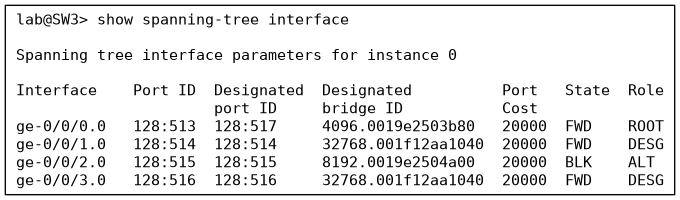
- A. Its designated bridge ID belongs to another switch, 8192.0019e2504a00, so the port hears a better BPDU from a neighbor Correct answer
- B. It is configured as an edge port, so it blocks until it has received a BPDU from the neighbor
- C. Its port ID 128:515 is higher than 128:514, so it loses the tie against ge-0/0/1.0 on this switch
- D. Its port cost is higher than the cost of the root port, which forces it into the blocking state
Option A is correct because the designated bridge ID on ge-0/0/2.0 (8192.0019e2504a00) differs from this switch's own bridge ID, which the DESG ports show as 32768.001f12aa1040. The port hears a better BPDU from another switch, so it is an alternate port; a backup port would hear a better BPDU from this same switch. Option B is wrong because the exhibit gives no sign of an edge port. Option C describes a tie-break between ports on one switch, which is the backup case. Option D is wrong because all four ports have a cost of 20000.
MPLS
Which two statements about RSVP signaling of an LSP on Junos devices are correct? (Choose two.)
- A. Resv messages carry label assignments from the egress toward the ingress router Correct answer
- B. Path messages are sent from the egress router toward the ingress router
- C. Label bindings are distributed with UDP hellos sent to 224.0.0.2
- D. Transit interfaces must be enabled under the [edit protocols rsvp] hierarchy Correct answer
Options A and D are correct because Resv messages travel from the egress back toward the ingress and carry the label assignments, and every interface the LSP crosses must be listed under [edit protocols rsvp]. Option B is wrong because Path messages travel from the ingress toward the egress. Option C is wrong because label distribution through UDP hellos to 224.0.0.2 describes LDP discovery, not RSVP, which uses raw IP protocol 46 messages.
On R1, show ldp neighbor lists R2, yet show ldp session is empty. R2 has no route to R1's loopback address, which R1 uses as its LDP transport address. What resolves the problem?
- A. Add the core interface under protocols rsvp
- B. Enable strict-targeted-hellos on R2
- C. Configure a longer hello-interval on R1
- D. Advertise the loopback of R1 in the IGP Correct answer
Option D is correct because LDP discovers neighbors with UDP hellos, but the session runs over TCP to the transport address, which here is R1's loopback. R2 can only reach that address if the IGP advertises it. Option A is wrong because RSVP is not involved in LDP sessions. Option B is wrong because strict-targeted-hellos only limits which targeted hellos are accepted. Option C is wrong because a longer hello interval does not give R2 a route to the transport address.
IPv6
A service provider wants to run OSPF for its IPv6 prefixes on a Junos router. Under which configuration hierarchy is the protocol enabled?
- A. [edit protocols ospf]
- B. [edit protocols ripng]
- C. [edit protocols isis]
- D. [edit protocols ospf3] Correct answer
Option D is correct because OSPF for IPv6 is OSPFv3, which Junos enables under [edit protocols ospf3]. Option A is wrong because [edit protocols ospf] runs OSPFv2 for IPv4. Option B is wrong because ripng is a different protocol, RIP for IPv6. Option C is wrong because isis is a different protocol, although it can carry IPv6 routes.
Two Junos routers share an Ethernet link and both run ospf3 on it. Which two values must match on both interfaces before the routers form an OSPFv3 adjacency? (Choose two.)
- A. Interface metric
- B. Area type (stub or normal) Correct answer
- C. Router ID
- D. Area ID Correct answer
Options B and D are correct. OSPFv3 neighbors must agree on the area ID carried in the hello and on the area type (the stub flag in the options field), otherwise the hello is rejected and no adjacency forms. Option A is wrong because the interface metric is a local cost and may differ between the two ends. Option C is wrong because each router needs a unique router ID; identical router IDs would break the adjacency rather than allow it.
Tunnels
An engineer on an MX Series router configures set interfaces gr-0/0/10 unit 0 tunnel source 10.1.1.1 destination 10.2.2.2, but no gr-0/0/10 interface appears in show interfaces terse. Which configuration is missing?
- A. set protocols mpls interface gr-0/0/10.0
- B. set firewall family inet filter GRE term 1 from protocol gre
- C. set chassis fpc 0 pic 0 tunnel-services Correct answer
- D. set routing-options static route 10.2.2.2/32 next-hop 10.1.1.2
Option C is correct because on MX Series routers a gr interface only exists after tunnel-services is enabled under the chassis fpc and pic hierarchy, which makes the router create the tunnel interface. Option A is wrong because enabling MPLS on an interface does not create it. Option B is wrong because a firewall filter matches traffic and does not create interfaces. Option D is wrong because a static route is irrelevant to the interface not being listed.
R1 forwards a packet out of a gr- interface. Which two steps does R1 perform on it? (Choose two.)
- A. Uses the overlay address of the gr- unit as the source address of the outer header
- B. Prepends a GRE header whose Protocol Type matches the payload, then adds the outer IPv4 header Correct answer
- C. Looks up the tunnel destination address in the routing table to choose the outgoing physical interface Correct answer
- D. Copies the inner destination address into the outer header so that provider routers deliver it to the end host
Options B and C are correct because the router builds the GRE header from the payload type, adds the outer IPv4 header, and then routes that outer packet by looking up the tunnel destination address in the routing table to choose the physical outgoing interface. Option A is wrong because the outer source address is the configured tunnel source, not the overlay address of the gr- unit. Option D is wrong because the outer destination is the tunnel destination, which is the far tunnel endpoint; the inner destination stays inside the payload and the provider routers never use it.
High Availability
Which two requirements apply when nonstop active routing (NSR) is configured on a Junos router with two Routing Engines? (Choose two.)
- A. Neighboring routers must be configured as graceful restart helpers
- B. Graceful Routing Engine switchover must be enabled on the router Correct answer
- C. Configuration commits must be synchronized between the two Routing Engines Correct answer
- D. The new primary Routing Engine must rebuild its adjacencies after switchover
Options B and C are correct because NSR depends on graceful Routing Engine switchover being enabled, and the configuration must be synchronized between both Routing Engines with commit synchronize. Option A is wrong because NSR is transparent to neighbors, which do not need to act as graceful restart helpers. Option D is wrong because with NSR the backup Routing Engine already holds the protocol state, so adjacencies are not rebuilt after the switchover.
What does an aggregated Ethernet interface such as ae0 provide on a Junos router?
- A. A software interface that stays up independent of any physical port and serves as a router ID
- B. One logical interface that bundles member links for more bandwidth and redundancy Correct answer
- C. A virtual interface that tunnels packets between two routers across an IP transport network
- D. A logical unit on one physical port that tags frames with a VLAN ID for a single customer
Option B is correct because an aggregated Ethernet interface such as ae0 is one logical interface that bundles several member links, giving more bandwidth and redundancy if a member fails. Option A describes the loopback interface lo0, which stays up independent of physical ports and is commonly the source of the router ID. Option C describes a tunnel interface such as gr-, and option D describes a VLAN-tagged logical unit on a single physical port.
Free Study Guide
Read the free Juniper JNCIS-SP JN0-364 study guide: every exam topic explained in plain English, with diagrams, exam tips and the mistakes to avoid.
More Juniper Practice Exams
Practice with realistic mock exams to prepare for your Juniper certification.