Juniper JNCIS-ENT JN0-352 Practice Exam
Enterprise Routing and Switching, Specialist (JNCIS-ENT) JN0-352
The Juniper JNCIS-ENT JN0-352 exam validates beginner to intermediate knowledge of routing and switching implementations in Junos OS, and it is the specialist-level certification in Juniper's enterprise routing and switching track. It covers nine areas: Layer 2 switching and VLANs, spanning tree, Layer 2 security, protocol independent routing, OSPF, IS-IS, BGP, tunnels, and high availability. This practice exam uses single-answer and multiple-answer questions, with Junos CLI output, configuration and topology exhibits.
846 questions in the bank
Question bank updated : questions, answers, explanations and chapters.
Certification Overview
- Exam name: JNCIS-ENT JN0-352
- Vendor: Juniper
- Exam code: JN0-352
- Duration: 90 minutes
- Total questions: about 65
- Our practice exam pass mark: 80%
Who Should Take This Exam?
Network Engineer, Enterprise Network Engineer, Routing and Switching Engineer, Network Administrator, NOC Engineer, Network Support Engineer, and JNCIA-Junos holders moving to the specialist level
Prerequisites
Juniper requires the JNCIA-Junos certification as a prerequisite for JNCIS-ENT.
Topics Covered
- Layer 2 Switching or VLANs
- Spanning Tree
- Layer 2 Security
- Protocol Independent Routing
- OSPF
- IS-IS
- BGP
- Tunnels
- High Availability
Question Types
- Multiple Choice (Single Answer)
- Multiple Choice (Multiple Answers)
- Scenario-Based
JNCIS-ENT JN0-352 Practice Questions
Our question bank contains 846+ practice questions for this certification. Sample questions from each exam chapter. Expand a question to see the answer choices. With full access, you get unlimited practice exams with randomized questions from our full question bank.
Layer 2 Switching or VLANs
Hosts in VLAN sales (ID 20) on an ELS-based EX switch cannot reach their gateway, 10.1.20.1/24, which is assigned to irb.20. Which statement ties the VLAN to that Layer 3 interface?
- A. set vlans sales l3-interface irb.20 Correct answer
- B. set interfaces irb unit 20 family ethernet-switching vlan members sales
- C. set vlans sales routing-interface irb.20
- D. set vlans sales l3-interface vlan.20
Option A is correct because on an ELS-based EX switch the VLAN is bound to its Layer 3 interface with set vlans sales l3-interface irb.20, which makes irb.20 the gateway for that VLAN. Option B puts the VLAN under the irb unit, which is not how an irb unit is tied to a VLAN. Option C uses routing-interface, a statement from the older non-ELS syntax. Option D names vlan.20, a Layer 3 interface that does not exist here because the gateway is irb.20.
When an EX Series switch builds its Ethernet switching table, which frame field supplies each learned entry?
- A. Source IP address
- B. Destination MAC address
- C. EtherType value
- D. Source MAC address Correct answer
Option D is correct because a switch learns by reading the source MAC address of each arriving frame and recording it against the ingress port and VLAN. Option A is wrong because the Ethernet switching table holds no IP addresses (IP-to-MAC mappings are in the ARP table). Option B is wrong because the destination MAC is only used to look up where to forward the frame. Option C is wrong because EtherType identifies the payload protocol and plays no part in learning.
Which two statements about the Ethernet switching table of an EX Series switch are true? (Choose two.)
- A. Dynamic entries are stored in the committed configuration
- B. Entries record the VLAN together with the learning port Correct answer
- C. Entries are filled from the destination address of each frame
- D. Dynamic entries expire when no frames arrive within the aging time Correct answer
Options B and D are correct because each entry ties a MAC address to a VLAN and the port that learned it, and dynamic entries are removed when the address is not seen within the aging time. Option A is wrong because learned entries live in the switching table at run time and not in the configuration. Option C is wrong because the table is filled from the source address of each frame; the destination address is what is looked up.
Spanning Tree
Switch B has a root port toward the root bridge. A second link, to a different switch, also offers a path to the root, and RSTP leaves that port in the discarding state. What role does the second port hold?
- A. Designated port
- B. Root port
- C. Alternate port Correct answer
- D. Backup port
Option C is correct because a port that offers a second path to the root, on a link to a different switch, becomes an alternate port and sits in the discarding state until the root port fails. A designated port (A) forwards toward the segment away from the root, and a root port (B) is the single best path, which this switch already has. A backup port (D) exists only when two ports of the same switch connect to the same segment, not to a different switch.
Which two mechanisms let RSTP converge faster than classic STP after a link change? (Choose two.)
- A. Every port waits through listening and learning for a full forward delay
- B. Edge ports move straight to forwarding without a handshake Correct answer
- C. Point-to-point links use a proposal and agreement exchange to unblock designated ports Correct answer
- D. A topology change is sent to the root with TCN BPDUs before MAC entries are flushed
Options B and C are correct. Edge ports go straight to forwarding because they cannot create a loop, and on point-to-point links the proposal and agreement handshake lets a designated port move to forwarding without waiting for timers. Option A describes classic STP, which waits through listening and learning for a full forward delay, and option D describes classic STP topology change reporting with TCN BPDUs sent toward the root, which RSTP replaces by flooding the change from the switch that detects it.
What problem does STP solve in a switched network that has redundant links?
- A. Duplicate VLAN IDs on connected switches
- B. Unequal load sharing across parallel trunks
- C. Exhaustion of the MAC address table
- D. Layer 2 forwarding loops and broadcast storms Correct answer
Option D is correct because redundant Layer 2 links form loops, and Ethernet frames have no TTL, so broadcasts circulate forever and cause storms. STP blocks the redundant ports to leave a loop-free tree. Duplicate VLAN IDs (A) are not a loop issue, unequal load sharing (B) is something STP does not fix since it blocks links rather than balancing them, and MAC table exhaustion (C) is a side effect of loops, not the problem STP is designed to solve.
Layer 2 Security
Which statement shuts down an edge-configured RSTP port when it receives a BPDU?
- A. set protocols rstp interface ge-0/0/1 bpdu-timeout-action block
- B. set protocols layer2-control bpdu-block disable-timeout 60
- C. set protocols rstp bpdu-block-on-edge Correct answer
- D. set protocols rstp interface ge-0/0/1 no-root-port
Option C is correct because bpdu-block-on-edge under protocols rstp enables BPDU protection: an edge port that receives a BPDU is shut down. Option A is a loop-protection style timeout action, not BPDU protection. Option B sets how long a blocked port stays disabled but does not turn the protection on. Option D prevents the port from becoming a root port; it does not shut it down.
A network engineer is planning firewall filters on an EX switch running ELS. Which set names the three Layer 2 filter types by where they are bound?
- A. Ingress, egress, and transit filters
- B. Port, VLAN, and router filters Correct answer
- C. Interface, bridge-domain, and loopback filters
- D. Port, zone, and policy filters
Option B is correct because ELS Layer 2 filters are classified by where they bind: port filters on an interface, VLAN filters on a VLAN, and router filters on the irb unit. Option A names directions, not binding points. Option C uses terms that are not Junos Layer 2 filter types. Option D uses SRX security terms, not EX switch filter types.
Protocol Independent Routing
A policy named lb contains then load-balance per-packet and is attached with set protocols ospf export lb. Equal-cost OSPF routes still install only one next hop in the forwarding table. Which statement fixes this?
- A. set protocols ospf import lb
- B. set forwarding-options hash-key family inet layer-3
- C. set protocols bgp group ext multipath
- D. set routing-options forwarding-table export lb Correct answer
Option D is correct because the load-balance per-packet action in a policy only reaches the forwarding table when that policy is exported with set routing-options forwarding-table export lb. Option A uses an OSPF import policy, which filters routes entering the routing table and never sets forwarding next-hop behavior. Option B changes the hash key used to pick a path but does not install more than one next hop. Option C enables BGP multipath, which is unrelated to equal-cost OSPF routes.
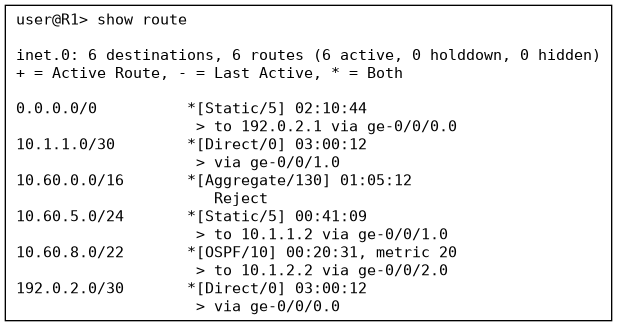
Using the routing table shown, how does R1 forward a packet destined to 10.60.9.1?
- A. To 192.0.2.1 out ge-0/0/0.0
- B. To 10.1.2.2 out ge-0/0/2.0 Correct answer
- C. It matches the aggregate route and is rejected
- D. To 10.1.1.2 out ge-0/0/1.0
Option B is correct because the longest matching prefix wins, and 10.60.9.1 falls inside 10.60.8.0/22 (10.60.8.0 to 10.60.11.255), which points to 10.1.2.2 out ge-0/0/2.0. Option A is the default route, a shorter match. Option C is the /16 aggregate, which is also a shorter match. Option D is the static 10.60.5.0/24, which covers 10.60.5.x only.
OSPF
Area 1 is configured as a stub area on its ABR and on all internal routers. The design now calls for the internal routers to receive only a default route from the ABR instead of inter-area summaries. What change achieves this?
- A. Configure no-summaries under the interface statement of area 1 on the ABR
- B. Configure default-metric under the stub statement on the internal routers
- C. Replace stub with nssa under area 1 on the ABR only
- D. Configure no-summaries under the stub statement on the ABR Correct answer
Option D is correct because no-summaries belongs under the stub statement on the ABR, which then sends only a default route into area 1. Option A is wrong because no-summaries is not an interface-level setting. Option B is wrong because default-metric is set on the ABR, not on internal routers. Option C is wrong because converting to an NSSA changes the area type and does not reduce the routes to a default.
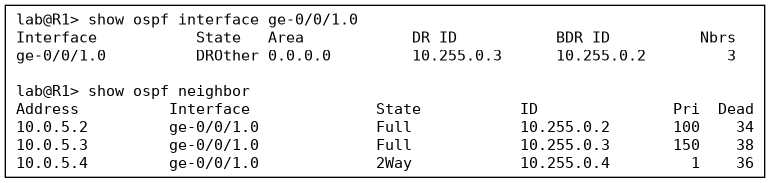
Refer to the output shown. Which IP address does the DR use on the segment attached to ge-0/0/1.0?
- A. 10.255.0.3
- B. 10.0.5.3 Correct answer
- C. 10.0.5.4
- D. 10.0.5.2
Option B is correct because the DR ID column of show ospf interface holds a router ID, 10.255.0.3, and show ospf neighbor maps that router ID to its interface address on the segment, 10.0.5.3. Option A fails because it is the router ID, not an address on the segment. Option C fails because that neighbor, 10.255.0.4, is only in 2Way and is not the DR. Option D is the BDR's address, since 10.255.0.2 is the BDR ID.
IS-IS
Which statement describes how a designated intermediate system is chosen on a broadcast IS-IS segment?
- A. Highest priority wins, lowest MAC address breaks ties, no backup DIS
- B. Highest priority wins, highest system ID breaks ties, no backup DIS
- C. Highest priority wins, highest MAC address breaks ties, a backup DIS is elected
- D. Highest priority wins, highest MAC address breaks ties, no backup DIS Correct answer
Option D is correct because IS-IS elects the DIS by highest interface priority, breaks a tie with the highest MAC address (SNPA), and has no backup DIS, so a failed DIS triggers a fresh election. Option A reverses the tie-break to lowest MAC. Option B uses the system ID, which is not the tie-breaker. Option C claims a backup DIS, which exists in OSPF (BDR) but not in IS-IS.
Refer to the output shown. Which statement about the adjacencies of R1 is correct?

- A. R2 and R5 each hold a Level 1 adjacency with R1
- B. R2 and R3 share ge-0/0/0.0 as one broadcast segment
- C. R4 forms a Level 2 adjacency over ge-0/0/2.0
- D. R3 is reached over ge-0/0/1.0 at both Level 1 and Level 2 Correct answer
Option D is correct because ge-0/0/1.0 lists R3 twice, once at L 1 and once at L 2, so R3 is a Level 1 and Level 2 neighbor on that interface. Option A fails because R2 and R5 appear only at Level 2. Option B fails because R2 is on ge-0/0/0.0 and R3 is on ge-0/0/1.0, so they are different links. Option C fails because R4 is listed at Level 1 only.
BGP
Router PE1 in AS 65100 learns 10.9.0.0/16 from an EBGP peer at 192.0.2.1 on an external link. PE1's IBGP peers show the route as hidden because the protocol next hop is unresolved, and 192.0.2.0/24 is not in the IGP. Which change makes the route usable?
- A. Configure advertise-inactive under the IBGP group on PE1
- B. Apply an export policy with next-hop self to the IBGP group on PE1 Correct answer
- C. Raise local-preference in an import policy on the IBGP peers
- D. Configure multihop under the IBGP group on PE1
Option B is correct because the IBGP peers cannot resolve the protocol next hop 192.0.2.1, which is outside the IGP, so they hide the route. An export policy with next-hop self on the IBGP group makes PE1 advertise itself as the next hop, which the IGP can resolve. Option A, advertise-inactive, only controls advertising inactive routes. Option C, a higher local preference, does not make an unresolvable next hop usable. Option D, multihop, applies to EBGP sessions between non-adjacent peers and does not touch next-hop resolution.
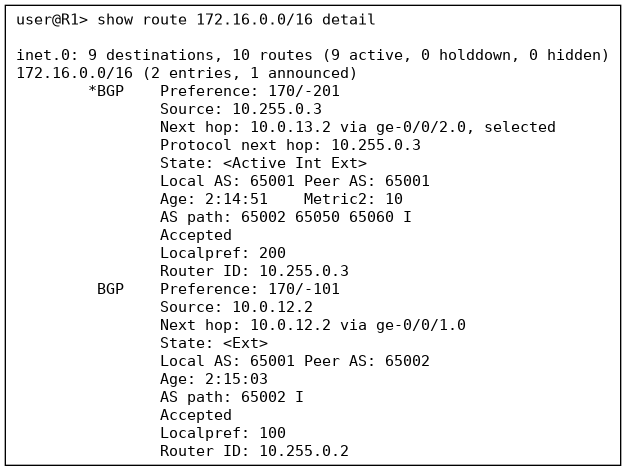
Based on the output shown, why is the path learned from 10.0.12.2 not the active route to 172.16.0.0/16?
- A. Its local preference is lower than that of the other path Correct answer
- B. IBGP-learned paths are preferred over EBGP-learned paths
- C. Its AS path is longer than the AS path of the other path
- D. Its protocol next hop is unresolved in inet.0
Option A is correct because the exhibit shows the path from 10.0.12.2 with Localpref 100 and the path from 10.255.0.3 with Localpref 200, and the higher local preference wins before any other tie-breaker (the active route shows Preference 170/-201 against 170/-101). Option B is wrong because the active path is the IBGP one, but local preference decided the choice, not a general IBGP-over-EBGP rule, which comes later in the order. Option C is wrong because the active path has the longer AS path (three extra AS numbers against one). Option D is wrong because the path from 10.0.12.2 is a directly connected EBGP next hop that is reachable via ge-0/0/1.0.
Tunnels
This router, 192.0.2.1, must reach 198.51.100.1 through an IP-IP tunnel. Which statement defines the tunnel endpoints correctly?
- A. set interfaces ip-0/0/0 unit 0 tunnel source 192.0.2.1 destination 198.51.100.1 Correct answer
- B. set interfaces gr-0/0/0 unit 0 tunnel source 192.0.2.1 destination 198.51.100.1
- C. set interfaces ip-0/0/0 tunnel source 192.0.2.1 destination 198.51.100.1
- D. set interfaces ip-0/0/0 unit 0 tunnel source 198.51.100.1 destination 192.0.2.1
Option A is correct because an IP-IP tunnel uses an ip- interface, the tunnel source and destination go under unit 0 tunnel, and the source must be this router's own address (192.0.2.1). Option B uses gr-, which builds a GRE tunnel, not IP-IP. Option C places the tunnel statement on the interface instead of on a logical unit, which Junos does not accept. Option D swaps source and destination, so the router would use the peer's address as its own source.
Which two purposes does a GRE tunnel between two sites serve across a provider network? (Choose two.)
- A. Join private address ranges the provider does not route Correct answer
- B. Carry OSPF hellos across a transit that drops multicast Correct answer
- C. Reserve bandwidth for the tunnel in the provider core
- D. Encrypt the inner payload with a negotiated key
Options A and B are correct because GRE wraps private-address packets in outer packets between public endpoints, and it turns multicast such as OSPF hellos into unicast the provider forwards. Option C is wrong because a GRE tunnel is carried as ordinary traffic and reserves no bandwidth. Option D is wrong because GRE has no encryption, which needs IPsec.
High Availability
Which statements are required before Junos will commit nonstop-routing on a router with two Routing Engines?
- A. chassis redundancy routing-engine 0 master and system commit synchronize
- B. protocols bfd and routing-options graceful-restart
- C. routing-options graceful-restart and chassis redundancy failover on-loss-of-keepalives
- D. chassis redundancy graceful-switchover and system commit synchronize Correct answer
Option D is correct because nonstop routing runs on the backup Routing Engine only when graceful switchover is enabled under chassis redundancy, and Junos requires system commit synchronize so both Routing Engines hold the same configuration. Option A names a master selection and the synchronize statement, but choosing a master Routing Engine is not a prerequisite. Option B pairs BFD and graceful restart, which are separate resiliency features that NSR does not depend on. Option C also relies on graceful restart and a failover-on-loss setting, neither of which satisfies the NSR commit check.
Which two statements about VRRP on Junos devices are true? (Choose two.)
- A. The router with the highest priority becomes master of the group Correct answer
- B. The router with the lowest priority becomes master, with ties settled by the lowest address
- C. Preemption is off until preempt is configured, so a returning higher-priority router stays backup
- D. A router whose interface address equals the virtual address runs at priority 255 Correct answer
Options A and D are correct. VRRP elects the router with the highest priority as master, and a router that owns the virtual IP address (the interface address equals the virtual address) runs at priority 255 so it always wins. Option B reverses the election: the lowest priority never wins, and ties are settled by the higher primary address. Option C is wrong because preemption is on by default in Junos, so a returning higher-priority router takes mastership back unless no-preempt is configured.
Free Study Guide
Read the free Juniper JNCIS-ENT JN0-352 study guide: every exam topic explained in plain English, with diagrams, exam tips and the mistakes to avoid.
More Juniper Practice Exams
Practice with realistic mock exams to prepare for your Juniper certification.