Juniper JNCIA-SEC JN0-232 Practice Exam
Security, Associate (JNCIA-SEC) JN0-232
The Juniper JNCIA-SEC JN0-232 exam validates beginner to intermediate knowledge of Junos OS security on SRX Series devices, and it is the associate-level certification in Juniper's security track. It covers six areas: SRX Series devices, Junos OS security objects such as zones and screens, security policies, network address translation, content security, and monitoring and troubleshooting. This practice exam uses single-answer and multiple-answer questions, with SRX CLI output, configuration and topology exhibits.
658 questions in the bank
Question bank updated : questions, answers, explanations and chapters.
Certification Overview
- Exam name: JNCIA-SEC JN0-232
- Vendor: Juniper
- Exam code: JN0-232
- Duration: 90 minutes
- Total questions: about 65
- Our practice exam pass mark: 80%
Who Should Take This Exam?
Network Security Engineer, Firewall Administrator, Network Engineer, Security Analyst, Network Administrator, NOC Engineer, SOC Analyst, and students starting a security career on Juniper SRX devices
Prerequisites
No formal prerequisite; Juniper recommends the Introduction to Juniper Security course.
Topics Covered
- SRX Series Services Gateways
- Junos OS Security Objects
- Security Policies
- Network Address Translation
- Content Security
- Monitoring and Troubleshooting
Question Types
- Multiple Choice (Single Answer)
- Multiple Choice (Multiple Answers)
- Scenario-Based
JNCIA-SEC JN0-232 Practice Questions
Our question bank contains 658+ practice questions for this certification. Sample questions from each exam chapter. Expand a question to see the answer choices. With full access, you get unlimited practice exams with randomized questions from our full question bank.
SRX Series Services Gateways
Which two statements describe how an SRX Series device processes a new session? (Choose two.)
- A. The first packet of a flow is matched against the policies, and a session is created if one permits it. Correct answer
- B. Return traffic for a permitted session needs its own policy from the destination zone to the source zone.
- C. Each packet in an established session is compared with the policy list from the top before it is forwarded.
- D. Later packets of the same flow match the session table entry and skip the policy lookup. Correct answer
Options A and D are correct because the first packet of a flow is matched against the security policies and, if one permits it, a session is created; later packets of the flow match the session table entry and skip the policy lookup. Option B is wrong because return traffic of a permitted session is covered by the same session and needs no policy of its own. Option C is wrong because established packets are not compared with the policy list again.
Established sessions through an SRX keep passing traffic while a CLI session on the same device responds slowly under heavy Routing Engine load. Which Junos design feature explains this?
- A. Separation of the control plane and forwarding plane Correct answer
- B. Inheritance of settings through apply-groups
- C. Separation of the candidate and active configurations
- D. Separation of operational mode and configuration mode
Option A is correct because Junos separates the control plane (the Routing Engine, which serves the CLI) from the forwarding plane (the Packet Forwarding Engine, which forwards established sessions), so heavy Routing Engine load does not stop traffic that is already being forwarded. Options B, C and D describe configuration features that have no effect on how packets are forwarded.
Before opening a support case, an engineer must record the part numbers, hardware revisions and serial numbers of the installed components on an SRX. Which operational command provides that inventory?
- A. show system storage
- B. show chassis environment
- C. show chassis routing-engine
- D. show chassis hardware Correct answer
Option D is correct because show chassis hardware lists the installed components with their part numbers, revisions and serial numbers. Option A reports storage use, option B reports environmental readings such as temperatures and fans, and option C reports Routing Engine status, so none of them gives the full component inventory.
Based on the output shown, which interface received the first packet of session 20113?
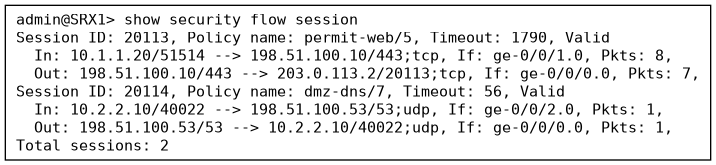
- A. ge-0/0/1.0 Correct answer
- B. ge-0/0/0.0
- C. ge-0/0/2.0
- D. fxp0.0
Option A is correct because the In line of session 20113 shows its first packet arriving with If: ge-0/0/1.0. Option B (ge-0/0/0.0) appears on the Out line of that session, and options C and D do not appear for session 20113 at all.
Junos OS Security Objects
A host in the trust zone pings the address of the SRX interface assigned to that zone. No host-inbound-traffic is configured for the zone or the interface. What happens to the ping?
- A. It is dropped until a trust to trust security policy permits it
- B. It is answered because the interface belongs to the trust zone
- C. It is answered because ping is a default host-inbound service
- D. It is dropped until ping is enabled as a host-inbound service Correct answer
Option D is correct because a zone accepts traffic addressed to the SRX itself only for the services and protocols listed under host-inbound-traffic, and none is configured here, so the ping is dropped until ping is enabled as a host-inbound system service. Option A is wrong because a security policy does not govern traffic addressed to an interface of the device. Options B and C are wrong because zone membership alone does not permit it and ping is not enabled by default.
A single security policy permits junos-ftp from the trust zone to the untrust zone, and no policy mentions the FTP data port. Why do FTP data transfers still work?
- A. The default security policy permits related sessions from untrust
- B. The FTP ALG opens a pinhole for the negotiated data session Correct answer
- C. A source NAT rule set translates the data port to port 21
- D. The junos-ftp application includes the dynamic data port range
Option B is correct because the FTP ALG inspects the control session on port 21, learns the negotiated data port and opens a pinhole for the data session, so no policy for the data port is needed. Option C is wrong because NAT does not translate the data port to port 21. Option D is wrong because the junos-ftp application matches the control port, not a dynamic data port range. Option A is wrong because the data session is handled by the ALG, not by a default policy.
A new security zone is being defined. Which two items does an administrator configure inside it? (Choose two.)
- A. The logical interfaces bound to the zone Correct answer
- B. The custom applications that policies match
- C. The screen profile that checks arriving packets Correct answer
- D. The source NAT pool that translates zone traffic
Options A and C are correct because the logical interfaces of a zone and the screen profile applied to it are both configured inside the security zone. Custom applications are defined under applications and matched in policies, and a source NAT pool is configured under NAT, so options B and D are not zone settings.
The interfaces ge-0/0/0.0, ge-0/0/1.0 and ge-0/0/2.0 are bound to the zones untrust, trust and dmz in that order. Which zone pair does a session from SRV1 to ISP1 cross?
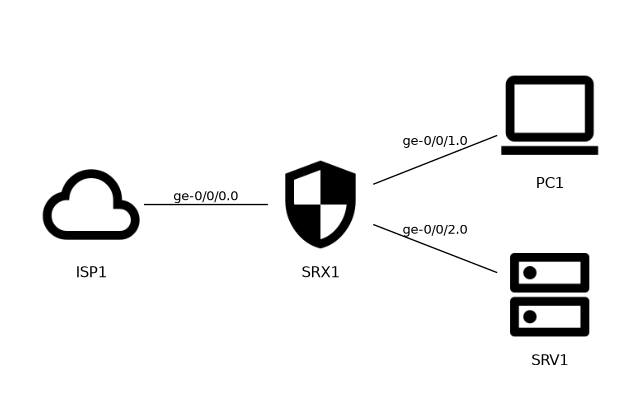
- A. From zone trust to zone untrust
- B. From zone untrust to zone dmz
- C. From zone dmz to zone trust
- D. From zone dmz to zone untrust Correct answer
Option D is correct. In the exhibit SRV1 connects to SRX1 through ge-0/0/2.0, which is in the dmz zone, and ISP1 connects through ge-0/0/0.0, which is in the untrust zone. A session from SRV1 to ISP1 therefore enters in the dmz zone and leaves in the untrust zone. Options A, B and C name zone pairs that involve the trust zone, where PC1 sits, or run in the wrong direction.
Security Policies
Trust users cannot browse the internet through an SRX. The from-zone trust to-zone untrust policy list has deny-all (match any, deny) above permit-web (match junos-http, permit). What change restores web access?
- A. Move permit-web above deny-all in the policy list Correct answer
- B. Copy permit-web into the untrust to trust zone context
- C. Set the default policy to permit-all for the zone pair
- D. Add the untrust zone to the host-inbound-traffic list
Option A is correct because policies in a zone-pair list are evaluated from the top and the first match decides the action, so deny-all above permit-web blocks every session before permit-web is reached. Moving permit-web above deny-all fixes the order. Option B changes the wrong direction, option C would open far more than web, and option D controls traffic to the device itself, not transit sessions.
Which match criterion do unified security policies add to the standard conditions in order to act on the Layer 7 application detected by application identification?
- A. match source-identity
- B. match destination-address
- C. match dynamic-application Correct answer
- D. match application
Option C is correct because unified security policies add the match dynamic-application condition, which lets a policy act on the Layer 7 application that application identification detected. Option D, match application, is a standard port-based condition that unified policies did not introduce. Options A and B are also standard match conditions and do not refer to the detected application.
A trust host at 10.1.20.15 starts an HTTPS session to an internet server. Which policy decides the action for that session?
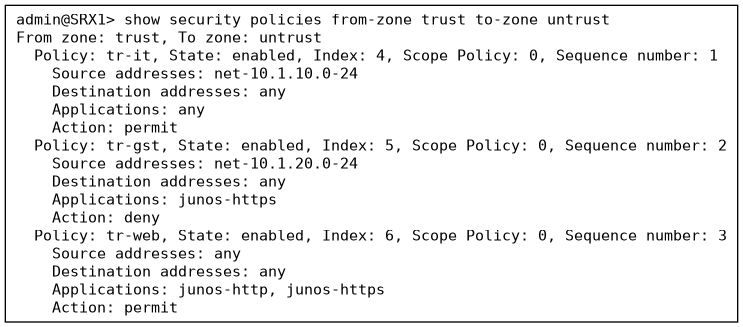
- A. tr-it
- B. No policy matches, so the default deny applies
- C. tr-gst Correct answer
- D. tr-web
Option C, tr-gst, is correct. The exhibit lists the trust to untrust policies in sequence: tr-it matches only source net-10.1.10.0-24, so 10.1.20.15 does not match it, and tr-gst is the first policy whose source net-10.1.20.0-24 and application junos-https fit the session. The first match decides, and tr-gst has Action: deny, so tr-web at sequence 3 is never reached. Option B is wrong because a policy does match.
Network Address Translation
A branch SRX has one internet-facing interface with a single public address and no spare address range. Which source NAT rule action should the rule set use for the trust hosts?
- A. source-nat pool
- B. source-nat interface Correct answer
- C. source-nat off
- D. destination-nat pool
Option B is correct because the source-nat interface action translates the trust hosts to the egress interface address, which suits a branch SRX with a single public address. Option A needs a pool of spare addresses that this branch does not have, option C (off) leaves the source address untranslated, and option D is a destination NAT action that does not translate the source.
A destination NAT rule translates 203.0.113.10 on the untrust side to the web server 192.168.10.20 in the trust zone. Which security policy permits untrust users to reach the server?
- A. from-zone untrust to-zone trust, destination address 203.0.113.10
- B. from-zone trust to-zone untrust, destination address 192.168.10.20
- C. from-zone untrust to-zone trust, destination address 192.168.10.20 Correct answer
- D. from-zone untrust to-zone untrust, destination address 203.0.113.10
Option C is correct because destination NAT is applied before the security policy lookup, so the policy must match the translated address 192.168.10.20 and the zone pair untrust to trust. Options A and D use the public address or the wrong zone pair, and option B describes the opposite traffic direction.
Source NAT exists only for from-zone trust to-zone untrust (interface action). Which source addresses does the internet host see from PC1 and SRV1?
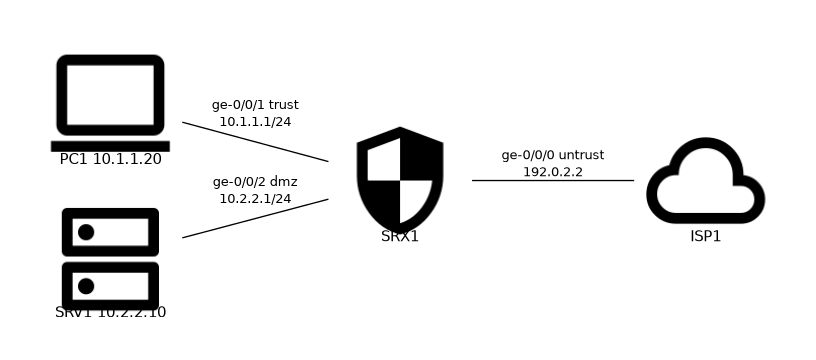
- A. PC1 192.0.2.2, SRV1 192.0.2.2
- B. PC1 10.1.1.20, SRV1 10.2.2.10
- C. PC1 10.1.1.20, SRV1 192.0.2.2
- D. PC1 192.0.2.2, SRV1 10.2.2.10 Correct answer
Option D is correct because the exhibit shows PC1 (10.1.1.20) in the trust zone on ge-0/0/1 and SRV1 (10.2.2.10) in the dmz zone on ge-0/0/2, and the internet side is ge-0/0/0 in untrust with 192.0.2.2. The source NAT rule set exists only from trust to untrust with the interface action, so PC1 is translated to 192.0.2.2, while the dmz to untrust traffic from SRV1 matches no source NAT rule and keeps 10.2.2.10. Options A and C wrongly translate SRV1, and options B and C leave PC1 untranslated.
Content Security
Which Content Security feature intercepts HTTP and HTTPS requests and sends them to the ThreatSeeker Cloud for URL categorization?
- A. Websense redirect web filtering
- B. Content filtering
- C. Juniper Enhanced web filtering Correct answer
- D. Local web filtering
Option C is correct because Juniper Enhanced web filtering (EWF) sends the requested URL to the ThreatSeeker Cloud, which returns a category and site reputation that the SRX uses to permit or block. Websense redirect web filtering (A) sends requests to an external Websense URL filtering server instead, local web filtering (D) decides with lists held on the SRX, and content filtering (B) works on MIME types, extensions and protocol commands, not URL categories.
An administrator wants an SRX to scan HTTP downloads from the untrust zone for malware. Which two items must be configured? (Choose two.)
- A. The UTM policy attached to the permit action of the matching security policy Correct answer
- B. A screen profile with the tcp port-scan option applied to the untrust zone
- C. An anti-virus feature profile referenced by a UTM policy Correct answer
- D. The HTTP ALG enabled under the security alg hierarchy
Options A and C are correct because malware scanning needs an anti-virus feature profile, that profile must be referenced by a UTM policy, and the UTM policy must be attached to the permit action of the security policy that matches the traffic. A screen profile with port-scan protection (B) detects reconnaissance, not malware in downloads, and enabling the HTTP ALG (D) is not what triggers anti-virus scanning.
Local, redirect and enhanced are the three web filtering methods. Which one decides using only lists on the SRX itself, with no external server or cloud query?
- A. Redirect web filtering
- B. Server-based antispam filtering
- C. Local web filtering Correct answer
- D. Enhanced web filtering
Option C is correct because local web filtering analyses requests on the SRX against user-defined allowlists and blocklists, with no license, external server or cloud query. Redirect (A) uses an external Websense server and enhanced (D) queries the ThreatSeeker Cloud, while server-based antispam (B) is an email feature, not a web filtering method.
Monitoring and Troubleshooting
An administrator must find out which security policy the SRX would apply to TCP traffic from 10.1.1.5 in the trust zone to 203.0.113.9 port 80 in the untrust zone, without sending any traffic. Which command does this?
- A. show security flow session
- B. show security policies hit-count
- C. show security flow statistics
- D. show security match-policies Correct answer
Option D is correct because show security match-policies takes a source zone, destination zone, addresses, port and protocol and reports the policy the SRX would apply, without any traffic being sent. Options A and C show live sessions and flow counters, which need real traffic, and option B shows hit counts of policies that already matched traffic.
An administrator needs to confirm which interfaces are bound to the dmz security zone. Which command shows this?
- A. show interfaces terse
- B. show security screen ids-option dmz-screen
- C. show security zones dmz Correct answer
- D. show security flow statistics
Option C is correct because show security zones dmz lists the zone's details, including the interfaces bound to it. Option A shows interface state and addresses but not zone membership, option B shows a screen profile, and option D shows flow counters.
An administrator ran clear security policies hit-count during a maintenance window. Which two statements describe the result? (Choose two.)
- A. The hit counters of the policies restart from zero Correct answer
- B. The sessions that the policies created are deleted
- C. The policies move to the inactive state until the next commit
- D. Sessions already in the session table keep forwarding traffic Correct answer
Options A and D are correct because clearing the hit count only resets the counters of the policies to zero, and sessions that are already in the session table keep forwarding. It does not delete sessions and does not change the state of any policy.
Free Study Guide
Read the free Juniper JNCIA-SEC JN0-232 study guide: every exam topic explained in plain English, with diagrams, exam tips and the mistakes to avoid.
More Juniper Practice Exams
Practice with realistic mock exams to prepare for your Juniper certification.