Juniper JNCIA-Junos JN0-106 Practice Exam
Junos, Associate (JNCIA-Junos) JN0-106
The Juniper JNCIA-Junos JN0-106 exam validates beginner to intermediate knowledge of networking and of Junos OS, and it is the baseline certification for Juniper's enterprise and service provider routing and switching tracks. It covers seven areas: networking fundamentals, Junos OS fundamentals, user interfaces, configuration basics, operational monitoring and maintenance, routing fundamentals, and routing policy and firewall filters, based on Junos OS 21.2. This practice exam uses single-answer and multiple-answer questions, with Junos CLI output, configuration and topology exhibits.
1,155 questions in the bank
Question bank updated : questions, answers, explanations and chapters.
Certification Overview
- Exam name: JNCIA-Junos JN0-106
- Vendor: Juniper
- Exam code: JN0-106
- Duration: 90 minutes
- Total questions: about 65
- Our practice exam pass mark: 80%
Who Should Take This Exam?
Network Engineer, Junior Network Engineer, Network Administrator, Network Support Technician, NOC Engineer, Systems Engineer, IT Infrastructure Engineer, and students starting a networking career on Juniper devices
Prerequisites
No formal prerequisite; Juniper recommends the Networking Technology Foundations and Introduction to the Junos Operating System courses.
Topics Covered
- Networking Fundamentals
- Junos OS Fundamentals
- User Interfaces
- Configuration Basics
- Operational Monitoring and Maintenance
- Routing Fundamentals
- Routing Policy and Firewall Filters
Question Types
- Multiple Choice (Single Answer)
- Multiple Choice (Multiple Answers)
- Scenario-Based
JNCIA-Junos JN0-106 Practice Questions
Our question bank contains 1155+ practice questions for this certification. Sample questions from each exam chapter. Expand a question to see the answer choices. With full access, you get unlimited practice exams with randomized questions from our full question bank.
Networking Fundamentals
What does the subnet mask of an IPv4 address do?
- A. It identifies the gateway a host uses to leave its subnet
- B. It marks which bits identify the network and which the host Correct answer
- C. It maps an IP address to the MAC address of the next hop
- D. It sets the range of addresses a DHCP server may lease
Option B is correct because the subnet mask is a bit pattern that separates the network portion of an IPv4 address from the host portion, which lets a device decide whether a destination is local or must go through a router. The default gateway (A) is a separate setting, ARP (C) maps IP to MAC, and DHCP lease ranges (D) are defined on the DHCP server, not by the mask.
A Layer 2 switch has eight hosts attached, each to its own full-duplex port, and all ports belong to one VLAN. How many collision domains and broadcast domains exist?
- A. Eight collision domains and eight broadcast domains
- B. Eight collision domains and one broadcast domain Correct answer
- C. One collision domain and one broadcast domain
- D. One collision domain and eight broadcast domains
Option B is correct because every switch port is its own collision domain, so eight hosts on eight full-duplex ports give eight collision domains. A switch does not separate ports within a VLAN for broadcasts, so all ports in one VLAN form a single broadcast domain. Options with eight broadcast domains or one collision domain confuse switch behaviour with hub or VLAN behaviour.
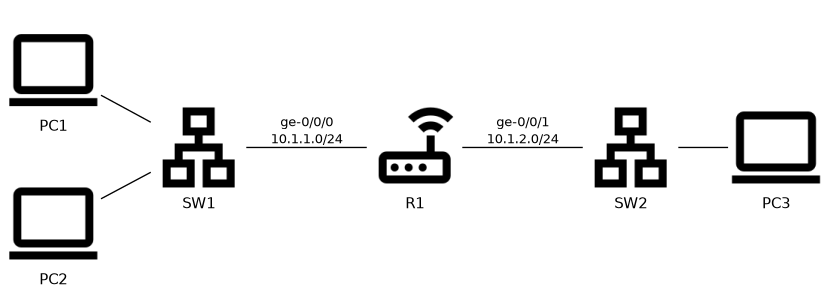
Based on the topology shown, each switch uses one VLAN. Which hosts receive an Ethernet broadcast sent by PC1?
- A. No other host
- B. PC2 only Correct answer
- C. PC2 and PC3
- D. PC3 only
Option B is correct because the exhibit shows PC1 and PC2 on SW1, and SW1 floods a broadcast to every other port in its VLAN, so PC2 receives it. SW1 reaches R1 on a separate subnet (10.1.1.0/24), and a router does not forward Ethernet broadcasts, so PC3 behind SW2 on 10.1.2.0/24 never sees it. Option A ignores PC2, which shares the switch, and options C and D wrongly send the broadcast across the router.
Junos OS Fundamentals
On a Junos device, which component runs rpd and the other control-plane processes?
- A. The Packet Forwarding Engine
- B. The Routing Engine Correct answer
- C. The Flexible PIC Concentrator
- D. The Switch Control Board
Option B is correct because the Routing Engine is the control-plane component that runs rpd and the other Junos processes. The Packet Forwarding Engine forwards packets in hardware, and the FPC and switch control board are chassis hardware, not the host of the control-plane processes.
Routing protocols run and routing tables are built on which component of a Junos router?
- A. Physical Interface Card
- B. Packet Forwarding Engine
- C. Switch fabric
- D. Routing Engine Correct answer
Option D is correct because the Routing Engine runs the routing protocols and builds the routing tables. The PFE forwards traffic using the resulting forwarding table, and the PIC and switch fabric only carry or switch packets.
PC1 runs ping 10.0.12.1. Based on the topology shown, how does R1 treat these echo requests?

- A. It passes them to the Routing Engine as exception traffic Correct answer
- B. It forwards them on toward R2 as transit traffic
- C. It discards them because 10.0.12.1 is on a different subnet
- D. It forwards them to R2, which answers the echo requests
Option A is correct because 10.0.12.1 is R1's own address on the R1-R2 link, so the echo requests are addressed to R1 itself. Traffic destined to the router is handed to the Routing Engine as exception traffic. Options B and D describe transit forwarding toward R2, and option C is wrong because the address is on a directly connected subnet.
User Interfaces
Which command moves a user from operational mode into configuration mode?
- A. cli
- B. start shell
- C. edit
- D. configure Correct answer
Option D is correct because configure is the operational mode command that enters configuration mode. Option A, cli, starts the CLI from the shell, option B, start shell, leaves the CLI for the Unix shell, and option C, edit, is a configuration mode command that moves between hierarchy levels.
After editing several hierarchy levels without committing, an engineer decides to abandon every pending change so that the candidate configuration matches the active one. Which configuration-mode command does this?
- A. delete
- B. rollback 1
- C. load factory-default
- D. rollback 0 Correct answer
Option D is correct because rollback 0 replaces the candidate configuration with the active configuration, which discards every uncommitted change. Option B, rollback 1, loads the previously committed configuration, which may differ from the active one. Option A, delete, removes only the named statement, and option C, load factory-default, replaces the whole configuration with the factory settings.
From configuration mode, which two commands write the candidate configuration to a file in /var/tmp? (Choose two.)
- A. run request system configuration rescue save
- B. load override /var/tmp/cfg-backup
- C. show | save /var/tmp/cfg-backup Correct answer
- D. save /var/tmp/cfg-backup Correct answer
Options C and D are correct because both show | save and save write the candidate configuration to the named file from configuration mode. Option A saves the rescue configuration to its fixed rescue location, not to a file you name in /var/tmp, and option B loads a file into the candidate rather than writing one.
Configuration Basics
A help desk engineer must clear interface counters and run ping and traceroute, but must not be able to change the configuration. Which predefined login class meets the requirement?
- A. unauthorized
- B. operator Correct answer
- C. read-only
- D. super-user
Option B is correct because the predefined operator class carries the clear, network, reset, trace and view permissions, which cover clearing counters, ping and traceroute without any configuration rights. Option A (unauthorized) has no permissions, option C (read-only) can only view, and option D (super-user) can change the configuration.
Which two ways can a user be authenticated when logging in to a Junos device? (Choose two.)
- A. A RADIUS server Correct answer
- B. An SNMP community string
- C. A local user account with an encrypted password Correct answer
- D. An NTP authentication key
Options A and C are correct because a Junos device can authenticate a login against a RADIUS server or against a local user account that has a password configured. An SNMP community string only controls SNMP access to the device, and an NTP authentication key only validates time sources, so neither of those logs a user in.
Which interface name identifies the loopback interface on a Junos device?
- A. lo0 Correct answer
- B. fxp0
- C. irb
- D. me0
Option A is correct because lo0 is the loopback interface on a Junos device. Option B (fxp0) and option D (me0) are management interfaces, and option C (irb) is the integrated routing and bridging interface.
Operational Monitoring and Maintenance
A lost root password must be recovered through the console. How does the administrator begin?
- A. Boot from the alternate Junos partition and delete the root user
- B. Enter configuration mode and run load factory-default from the console
- C. Load the rescue configuration with rollback rescue after booting normally
- D. Interrupt the boot process and boot into single-user mode Correct answer
Option D is correct because the root password is recovered by interrupting the boot process and booting into single-user mode, which gives console access to reset the password. Option A is wrong because booting the alternate partition does not remove the root account, and deleting root is not the recovery method. Option B is wrong because configuration mode requires logging in, which the administrator cannot do. Option C is wrong for the same reason, since rollback rescue also needs a login.
An engineer wants exactly five echo requests sent to 10.1.1.2, with the command stopping by itself afterwards. Which command does this?
- A. ping 10.1.1.2 count 5 Correct answer
- B. ping 10.1.1.2 ttl 5
- C. ping 10.1.1.2 size 5
- D. ping 10.1.1.2 wait 5
Option A is correct because the count option sets how many echo requests ping sends, and the command ends by itself after that many. Option B (ttl) sets the time-to-live of the packets, Option C (size) sets the payload size, and Option D (wait) sets the interval between requests, so none of them limits the number of requests.
Component temperature readings appear in the output of two of these commands. Which ones? (Choose two.)
- A. show chassis alarms
- B. show chassis hardware
- C. show chassis routing-engine Correct answer
- D. show chassis environment Correct answer
Options C and D are correct because show chassis routing-engine and show chassis environment both include temperature readings. Show chassis alarms lists active alarms and show chassis hardware lists the installed components, and neither reports temperatures.
Routing Fundamentals
A router learns the same prefix from OSPF (internal), IS-IS Level 2, RIP and BGP. With default preference values, which route becomes the active route?
- A. The IS-IS Level 2 route
- B. The OSPF internal route Correct answer
- C. The RIP route
- D. The BGP route
Option B is correct because Junos picks the route with the lowest preference value, and the defaults are OSPF internal 10, IS-IS Level 2 18, RIP 100 and BGP 170. The IS-IS Level 2, RIP and BGP routes all have higher values, so they stay inactive for the same prefix.
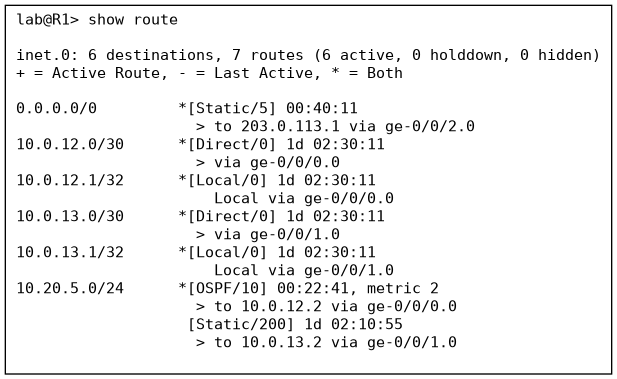
Examine the output shown. Why is the static route to 10.20.5.0/24 not used to forward traffic?
- A. Its next hop is not directly connected
- B. The OSPF metric of 2 is lower than its metric
- C. Its preference value is higher than the OSPF route's Correct answer
- D. The static default route overrides it
Option C is correct because in the exhibit the OSPF route for 10.20.5.0/24 has preference 10 and is marked active with the asterisk, while the static route shows Static/200. Junos compares preference first and the lower value wins, so the static route is held back. The OSPF metric of 2 is not compared to the static route, and the static default route 0.0.0.0/0 is only used when no more specific route exists.
Select the two functions that the Packet Forwarding Engine performs on transit traffic without help from the Routing Engine. (Choose two.)
- A. Rewriting the Layer 2 header for the egress interface Correct answer
- B. Running the shortest path first calculation for OSPF
- C. Applying a configured firewall filter to the traffic Correct answer
- D. Choosing the active route among protocols by preference
Options A and C are correct because the Packet Forwarding Engine rewrites the Layer 2 header for the egress interface and applies firewall filters to transit traffic on its own. Running the OSPF shortest path first calculation and choosing the active route by preference are Routing Engine tasks done by rpd.
Routing Policy and Firewall Filters
An OSPF export policy chain applies BLOCK-DOCS, which rejects 192.0.2.0/24, then STATIC-TO-OSPF, whose only term has from protocol static and then metric 50. No static routes reach OSPF neighbors. Which change exports all other static routes and nothing else?
- A. Change then metric 50 to then next policy in the STATIC-TO-OSPF term
- B. Add a final BLOCK-DOCS term with then accept and no from condition
- C. Reverse the chain so STATIC-TO-OSPF is evaluated before BLOCK-DOCS
- D. Add then accept to the STATIC-TO-OSPF term after the metric action Correct answer
Option D is correct because STATIC-TO-OSPF has only a metric action, which is not a terminating action, so matching static routes fall out of the chain and are not exported. Adding then accept to that term exports every static route that BLOCK-DOCS did not reject. Option A would not accept anything, Option B would also export non-static routes, and Option C would let STATIC-TO-OSPF act on 192.0.2.0/24 before it is blocked.
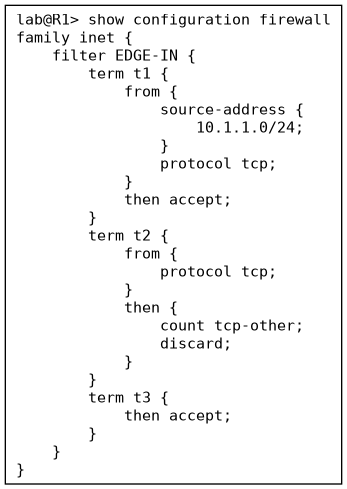
Examine the configuration shown. A TCP packet from 10.1.2.50 to port 22 is evaluated by the filter. What happens to it?
- A. It is accepted by term t1
- B. It is rejected with an ICMP unreachable message
- C. It is counted and silently discarded Correct answer
- D. It is accepted by term t3
Option C is correct because the packet from 10.1.2.50 does not match term t1, which requires a source address in 10.1.1.0/24. It does match term t2, which matches any TCP packet, so t2 counts it in tcp-other and discards it silently. Term t3 is never reached, and discard sends no ICMP unreachable message, so Option B is wrong.
Free Study Guide
Read the free Juniper JNCIA-Junos JN0-106 study guide: every exam topic explained in plain English, with diagrams, exam tips and the mistakes to avoid.
More Juniper Practice Exams
Practice with realistic mock exams to prepare for your Juniper certification.