Juniper JNCIA-MistAI JN0-253 Practice Exam
Mist AI, Associate (JNCIA-MistAI) JN0-253
The Juniper JNCIA-MistAI JN0-253 exam verifies a basic understanding of WLAN and Mist AI technology, features and functionality, and it is the associate-level certification in Juniper's Mist AI track. It covers seven areas: Mist cloud fundamentals, configuration basics, network operations and management, monitoring and analytics, the Marvis Virtual Network Assistant, location-based services, and Mist cloud operations. This practice exam uses single-answer and multiple-answer questions, with exhibits drawn from Mist portal views such as SLE breakdowns, device lists and firmware settings.
668 questions in the bank
Question bank updated : questions, answers, explanations and chapters.
Certification Overview
- Exam name: JNCIA-MistAI JN0-253
- Vendor: Juniper
- Exam code: JN0-253
- Duration: 90 minutes
- Total questions: about 65
- Our practice exam pass mark: 80%
Who Should Take This Exam?
Wireless Network Engineer, Network Engineer, WLAN Administrator, Network Administrator, NOC Engineer, Network Support Engineer, IT Support Specialist
Prerequisites
No formal prerequisite. Juniper recommends the Introduction to Juniper Mist AI course.
Topics Covered
- Juniper Mist Cloud Fundamentals
- Juniper Mist Configuration Basics
- Juniper Mist Network Operations and Management
- Juniper Mist Monitoring and Analytics
- Marvis Virtual Network Assistant
- Location-based Services
- Juniper Mist Cloud Operations
Question Types
- Multiple Choice (Single Answer)
- Multiple Choice (Multiple Answers)
- Scenario-Based
JNCIA-MistAI JN0-253 Practice Questions
Our question bank contains 668+ practice questions for this certification. Sample questions from each exam chapter. Expand a question to see the answer choices. With full access, you get unlimited practice exams with randomized questions from our full question bank.
Juniper Mist Cloud Fundamentals
Which data source does Mist AI learn from to establish what normal looks like for a site?
- A. Signature files downloaded from a threat feed
- B. Telemetry from devices and clients sent to the cloud Correct answer
- C. Syslog files exported to an on-premises server
- D. Thresholds that an administrator sets for each site
Option B is correct because Mist APs and devices stream telemetry about every client's experience to the cloud, and the AI learns each site's normal behaviour from it. Threat-feed signatures, exported syslog files and fixed administrator thresholds are not how Mist AI builds its baseline.
A hospital wants to see the position of tagged infusion pumps on a floor plan using its existing Mist APs. Which Juniper Mist capability fits this use case?
- A. WAN Assurance
- B. Access Assurance
- C. Wired Assurance
- D. vBLE location services Correct answer
Option D is correct because vBLE location services use the BLE antenna array in the existing Mist APs to locate BLE tags and show them on the floor plan. WAN, Access and Wired Assurance cover the WAN, network access control and switches, not asset location.
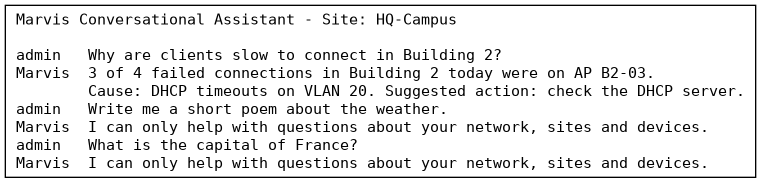
Which type of AI does the Marvis behavior shown best illustrate?
- A. Reinforcement learning from human rewards
- B. Generative AI that writes open-ended content
- C. Narrow AI built for one domain Correct answer
- D. General AI that handles any topic
Option C is correct because the exhibit shows Marvis answering network questions and refusing a poem and a general-knowledge question, which is narrow AI built for one domain. Option D is wrong because general AI would handle any topic, and option B is wrong because Marvis does not write open-ended content on request. Option A is wrong because the exhibit shows no learning from human rewards.
Juniper Mist Configuration Basics
An organization wants its administrators to sign in to the Mist portal with credentials from the company identity provider. Which authentication method supports this?
- A. Device activation code
- B. Organization API token
- C. SAML-based single sign-on Correct answer
- D. RadSec certificate authentication
Option C is correct. SAML-based single sign-on lets administrators authenticate through the company identity provider, which Mist supports through any SAML 2.0 provider. A device activation code only onboards devices, an organization API token is for automation, and RadSec secures RADIUS transport rather than portal logins.
In the Mist portal, which page lists the claimed devices of an organization and lets an administrator assign selected ones to a site?
- A. Monitor > Insights
- B. Organization > Admin > Audit Logs
- C. Organization > Admin > Site Configuration
- D. Organization > Admin > Inventory Correct answer
Option D is correct. The Inventory page under Organization > Admin lists claimed devices and lets an administrator assign selected ones to a site. Insights shows monitoring data, Audit Logs records administrator actions, and Site Configuration manages the sites themselves.
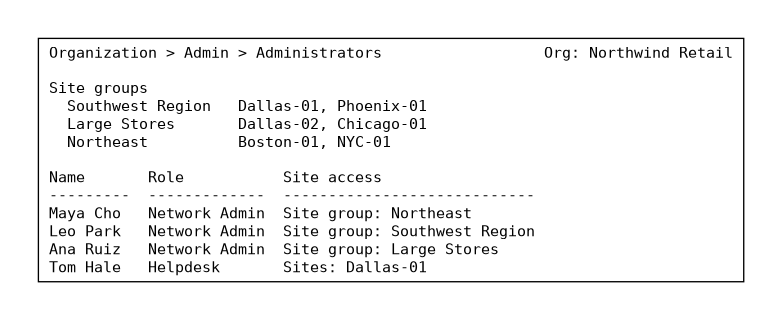
Refer to the Administrators page shown. A fault is reported at Dallas-02. Which administrator can open that site in the portal?
- A. Ana Ruiz Correct answer
- B. Leo Park
- C. Tom Hale
- D. Maya Cho
Option A, Ana Ruiz, is correct because Dallas-02 belongs to the Large Stores site group and Ana Ruiz is a Network Admin with access to that site group. Leo Park covers Southwest Region (Dallas-01 and Phoenix-01), Maya Cho covers Northeast, and Tom Hale is limited to Dallas-01, so none of them can open Dallas-02.
Juniper Mist Network Operations and Management
Which two service level expectation (SLE) metrics belong to Juniper Mist WAN Assurance? (Choose two.)
- A. Switch Health
- B. WAN Edge Health Correct answer
- C. Successful Connect
- D. Application Health Correct answer
The two WAN Assurance SLEs are WAN Edge Health and Application Health. Switch Health belongs to Wired Assurance and Successful Connect belongs to Wi-Fi Assurance, so neither applies to WAN.
Which Mist Wired Assurance element applies a saved set of settings, such as VLAN and PoE, to selected switch ports?
- A. Port profile Correct answer
- B. RF template
- C. WLAN template
- D. Device profile
A port profile is the Wired Assurance object that stores settings such as VLAN and PoE and applies them to selected switch ports. RF templates and WLAN templates are wireless constructs, and a device profile applies settings to whole devices rather than to ports.
Which Juniper Mist Wi-Fi SLE reports the seconds that pass between a client sending an association packet and being able to move data?
- A. Time to Connect Correct answer
- B. Successful Connects
- C. Coverage
- D. Roaming
Time to Connect reports how long a client takes from sending its association packet until it can pass data. Successful Connects reports whether connections succeed, not how long they take, and Coverage and Roaming measure signal strength and roam quality.
Juniper Mist Monitoring and Analytics
An administrator opens the Time to Connect SLE for a site and wants to know which stage of the connection process contributes most to failures. Which part of the SLE view provides this?
- A. Alerts raised for the site
- B. Classifiers in the SLE drill-down Correct answer
- C. Entries in the site audit log
- D. Rows in the inventory list
The classifiers in the SLE drill-down are correct because the Time to Connect SLE breaks failures into stages such as association, authentication and DHCP, and shows the share each one contributes. Alerts, the audit log and the inventory list do not break a connection failure down by stage.
A client at a branch site fails to complete 802.1X association. The administrator wants to inspect the frames exchanged over the air without visiting the site. What should be used?
- A. The site audit log
- B. A Marvis Minis validation report
- C. The Time to Connect SLE
- D. A packet capture from the portal Correct answer
A packet capture from the portal is correct because Mist can capture the wireless frames exchanged over the air, so the 802.1X exchange can be inspected remotely, and the file opens in Wireshark. The audit log records administrator changes, and the Time to Connect SLE only reports which stage failed without showing frames. A Marvis Minis report validates services, not frames on the air.
Which two sub-classifiers sit under the AP Disconnected classifier of the AP Health SLE? (Choose two.)
- A. Ethernet Errors
- B. Site Down Correct answer
- C. Speed Mismatch
- D. Switch Down Correct answer
Options Site Down and Switch Down are correct because the AP Disconnected classifier splits into Switch Down, Site Down, AP Unreachable and AP Reboot. Ethernet Errors and Speed Mismatch are sub-classifiers of the separate Ethernet classifier.
Marvis Virtual Network Assistant
How does an administrator interact with the Marvis conversational assistant?
- A. By choosing options from the inventory page
- B. By typing questions in plain language Correct answer
- C. By entering commands in a switch shell
- D. By sending JSON payloads to a webhook
Option B is correct because the Marvis conversational assistant takes typed questions and statements in plain language and turns them into diagnostic actions. It needs no specific commands. The inventory page, a switch shell and webhook JSON payloads are not how administrators interact with it.
An administrator needs only the number of disconnected access points, not their names. Which Marvis query type returns that?
- A. RANK
- B. LIST
- C. COUNT Correct answer
- D. TROUBLESHOOT
Option C, COUNT, is correct because COUNT aggregates the matching items into a single number. LIST would return the access points by name, RANK orders results by a metric, and TROUBLESHOOT analyzes root causes.
Which two categories appear on the Marvis Actions dashboard? (Choose two.)
- A. Location
- B. Layer 1 Correct answer
- C. Security Correct answer
- D. Premium Analytics
The correct categories are Layer 1 and Security. The Marvis Actions dashboard groups issues into Clients, Layer 1, Connectivity, Wireless, Wired, WAN, Data Center/Application and Security. Location and Premium Analytics are not dashboard categories.
Location-based Services
A warehouse wants asset visibility for Bluetooth tags with Mist vBLE. What receives the tag advertisements and feeds the location to the cloud?
- A. A Mist Edge appliance placed in each rack
- B. The BLE antenna array built into Mist APs Correct answer
- C. Gateway devices connected to the access switches
- D. Battery-powered beacons mounted at each aisle end
Option B is correct because Mist APs contain a built-in vBLE antenna array that listens for tag advertisements and passes the readings to the Mist cloud, where the location is computed. A Mist Edge appliance (A) and gateways (C) are not part of this path, and battery-powered beacons (D) are the transmitters, not the receivers.
A hospital wants to locate wheelchairs and other medical equipment on its floorplans. Which two Mist items support this? (Choose two.)
- A. The Mist SDK installed inside each wheelchair
- B. A super beacon from the AP's ninth omni beam
- C. BLE beacon tags attached to the equipment Correct answer
- D. The located assets drawn in Live View Correct answer
Options C and D are correct. BLE beacon tags attached to the equipment are what the APs hear, and the located assets are then shown on the floorplan in Live View. Option A is wrong because the Mist SDK runs in a mobile app, not in equipment, and option B is wrong because the ninth-beam super beacon is an App Wakeup feature for phones, not asset tracking.
Forklifts carry BLE tags that must show in Live View. Based on the summary shown, which pair of sites can locate them now?

- A. Warehouse-1 and Clinic-East Correct answer
- B. Retail-Mall and Clinic-East
- C. Retail-Mall and Depot-West
- D. Warehouse-1 and Retail-Mall
Option A is correct. Only Warehouse-1 and Clinic-East show Asset Visibility as Enabled, so their APs listen for BLE tags and can place the forklifts in Live View. Retail-Mall and Depot-West have Asset Visibility disabled, so the pairs in options B, C and D include a site that cannot locate tags.
Juniper Mist Cloud Operations
A script needs to call the Mist REST API to list the sites of an organization. Which credential does the script present to authenticate?
- A. A SAML assertion
- B. A RadSec certificate
- C. A claim code
- D. An API token Correct answer
Option D is correct because the Mist REST API authenticates a script with an API token sent in the Authorization header. A SAML assertion is used for portal single sign-on, a RadSec certificate secures RADIUS transport, and a claim code is only used to add devices to an organization.
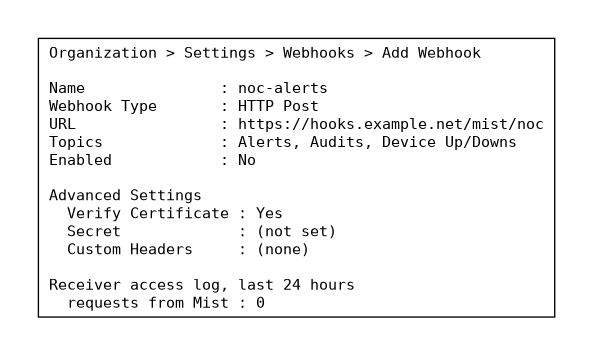
Why does the receiver in the panel shown get no events from Mist?
- A. Custom Headers is empty
- B. The Enabled setting is No Correct answer
- C. The Webhook Type is HTTP Post
- D. The Secret field is not set
Option B is correct because the exhibit shows Enabled : No, so Mist sends nothing and the receiver log shows 0 requests. A webhook that is switched off sends no events whatever its other settings are. An empty Custom Headers list, a missing Secret and the HTTP Post type are all valid and do not stop delivery.
Free Study Guide
Read the free Juniper JNCIA-MistAI JN0-253 study guide: every exam topic explained in plain English, with diagrams, exam tips and the mistakes to avoid.
More Juniper Practice Exams
Practice with realistic mock exams to prepare for your Juniper certification.