Juniper JNCIP-ENT JN0-650 Practice Exam
Enterprise Routing and Switching, Professional (JNCIP-ENT) JN0-650
The Juniper JNCIP-ENT JN0-650 exam is the professional-level certification in Juniper's enterprise routing and switching track, aimed at experienced networking professionals with advanced Junos OS knowledge. It covers eight areas: interior gateway protocols, BGP, IP multicast, Ethernet switching and spanning tree, Layer 2 authentication and access control, IP telephony features, class of service, and EVPN. This practice exam uses single-answer and multiple-answer questions, with Junos CLI output, configuration and topology exhibits.
858 questions in the bank
Question bank updated : questions, answers, explanations and chapters.
Certification Overview
- Exam name: JNCIP-ENT JN0-650
- Vendor: Juniper
- Exam code: JN0-650
- Duration: 90 minutes
- Total questions: about 65
- Our practice exam pass mark: 80%
Who Should Take This Exam?
Senior Network Engineer, Enterprise Network Engineer, Routing and Switching Engineer, Campus Network Engineer, Data Center Network Engineer, Network Architect, and JNCIS-ENT holders moving to the professional level
Prerequisites
Juniper requires the JNCIS-ENT certification as a prerequisite for JNCIP-ENT.
Topics Covered
- Interior Gateway Protocols
- BGP
- IP Multicast
- Ethernet Switching and Spanning Tree
- Layer 2 Authentication and Access Control
- IP Telephony Features
- Class of Service
- EVPN
Question Types
- Multiple Choice (Single Answer)
- Multiple Choice (Multiple Answers)
- Scenario-Based
JNCIP-ENT JN0-650 Practice Questions
Our question bank contains 858+ practice questions for this certification. Sample questions from each exam chapter. Expand a question to see the answer choices. With full access, you get unlimited practice exams with randomized questions from our full question bank.
Interior Gateway Protocols
Refer to the output. R1 and R2 connect over a Gigabit Ethernet link with OSPF enabled in area 0 on both ends, but the adjacency does not come up. user@R1> show ospf neighbor Address Interface State ID Pri Dead 10.1.12.2 ge-0/0/1.0 ExStart 10.255.0.2 128 37 Which condition is the most likely cause?
- A. The interface MTU differs between R1 and R2 Correct answer
- B. The hello intervals differ between R1 and R2
- C. The area IDs on the two interfaces differ
- D. Both routers have the interface priority set to 0
Option A is correct because two OSPF neighbors that disagree on the interface MTU cannot complete the database description exchange that follows ExStart, so the adjacency stalls in ExStart (or cycles between ExStart and Exchange) even though hellos are being received. Option B is wrong because mismatched hello intervals stop the neighbor from ever reaching 2-Way, so it would not be listed in ExStart. Option C is wrong because an area ID mismatch makes the routers discard each other's hellos, so no neighbor entry would appear. Option D is wrong because priority 0 only removes a router from the DR/BDR election, and the exhibit shows priority 128 for the neighbor.
R3 sits in area 2. An ASBR in area 0 exports a static route into OSPF, and R3 installs it as shown. Security requires that R3 no longer install 172.16.5.0/24, while R3 keeps every other OSPF route and its own OSPF advertisements unchanged. user@R3> show route 172.16.5.0/24 inet.0: 14 destinations, 14 routes (14 active, 0 holddown, 0 hidden) + = Active Route, - = Last Active, * = Both 172.16.5.0/24 *[OSPF/150] 00:12:41, metric 20, tag 0 > to 10.1.23.2 via ge-0/0/1.0 Which change meets the requirement?
- A. Add an OSPF import policy on R3 that rejects 172.16.5.0/24 Correct answer
- B. Configure area-range 172.16.5.0/24 restrict on the ABR
- C. Set the OSPF external preference on R3 to 200
- D. Add an OSPF export policy on R3 that rejects 172.16.5.0/24
Option A is correct because the route is an OSPF external route (OSPF/150), and an OSPF import policy on R3 is applied to external routes before they are installed in the routing table, so rejecting 172.16.5.0/24 keeps it out of R3 while all other routes stay. Option B is wrong because area-range with restrict suppresses the summarization of intra-area routes at an ABR and does not act on a Type 5 external route. Option C is wrong because changing the external preference to 200 only changes how the route ranks against other protocols, and it would still be installed. Option D is wrong because an export policy controls what R3 itself advertises into OSPF, not which routes it installs, and the requirement says R3's own advertisements stay unchanged.
A Level 2 IS-IS backbone runs Junos defaults on every router. A WAN link needs a cost of 5000, which is above the default maximum, so R1 is configured with wide-metrics-only at Level 2. R7 is a legacy router that understands only the original narrow metric TLVs. Which two statements are true after the change? (Choose two.)
- A. R1 generates only the extended TLVs at Level 2, so R7 no longer learns R1's links and prefixes Correct answer
- B. The total path metric that SPF can compute stays limited to 1023 on R1
- C. R1 can now use interface metrics up to 16,777,215 at Level 2 Correct answer
- D. R1 still generates both the narrow and the extended TLVs, so R7 is not affected
Options A and C are correct. wide-metrics-only at Level 2 makes R1 originate only the extended (wide) TLVs, which a narrow-only router such as R7 cannot parse, so R7 loses R1's links and prefixes, and the wide format lifts the interface metric limit to 16,777,215. Option B is wrong because the 1023 path limit belongs to the narrow format and no longer applies once wide metrics are used. Option D is wrong because wide-metrics-only suppresses the narrow TLVs; sending both is what the default behaviour does.
BGP
AS 65010 is dual-homed. R1 peers with ISP-A (AS 65100) over EBGP, R2 peers with ISP-B (AS 65200) over EBGP, and R1 and R2 share an IBGP session. Both providers advertise a default route and receive the enterprise prefixes, and no BGP policy is applied yet. The design requires traffic in both directions to use the ISP-A link, with ISP-B as the backup. Which two configuration changes achieve this? (Choose two.)
- A. Apply an export policy on R1 toward ISP-A that sets local-preference 200, so ISP-A prefers the path through R1 for return traffic
- B. Apply an import policy on R1 that sets local-preference 200 on routes received from ISP-A, so R1 and R2 both prefer the path through R1 Correct answer
- C. Apply an export policy on R2 toward ISP-B that prepends the local AS number to the advertised prefixes, so the path through R2 looks longer Correct answer
- D. Apply an import policy on R2 that sets a MED of 500 on routes received from ISP-B, so both routers rank them below the routes from ISP-A
Options B and C are correct because a higher local preference set on routes learned from ISP-A makes R1 prefer them and is carried over IBGP so R2 follows R1 for outbound traffic, while prepending the local AS on R2's advertisements to ISP-B lengthens that path and steers inbound traffic to the ISP-A link. Option A fails because LOCAL_PREF is never advertised to EBGP peers, so ISP-A cannot see it. Option D fails because MED is only compared between paths from the same neighbouring AS, and ISP-A and ISP-B are different ASes.
R1 in AS 65001 learns 203.0.113.0/24 from two peers. Every BGP attribute that R1 compares before the tie-breakers is shown below. Path 1: from 10.0.12.2 (EBGP, AS 65010, router ID 10.255.1.2), local preference 100, AS path 65010 I, MED 0, IGP metric to next hop 30 Path 2: from 10.0.0.3 (IBGP, router ID 10.255.0.3), local preference 100, AS path 65010 I, MED 0, IGP metric to next hop 10 R1 selects Path 1 as the active route. Which comparison decides the selection?
- A. EBGP routes are preferred over IBGP routes Correct answer
- B. Lower IGP metric to the BGP next hop
- C. Lower BGP router ID of the advertising peer
- D. Lower MED advertised by the peer
Option A is correct because local preference, AS path length, origin and MED are all equal for the two paths, and the next step in the Junos path selection order is to prefer an EBGP route over an IBGP route, which selects Path 1 before the IGP metric is looked at. Option B is wrong because the lower IGP metric would favor Path 2 (10 against 30), but that comparison comes after the EBGP-over-IBGP step. Option C is wrong because the router ID is a later tie-breaker and is not reached. Option D is wrong because both paths have MED 0, so MED does not separate them.
Three IBGP peers R1, R2 and R3 in AS 65001 peer over loopbacks, and R1 has multipath enabled in its IBGP group. R2 and R3 both advertise 192.0.2.0/24, learned from the same EBGP neighbor AS, with identical attributes. R1's IGP metric to R2's next hop is 10 and to R3's next hop is 20, and R1 installs only the R2 path. Which change lets R1 install both paths?
- A. Add multiple-as to the multipath statement on R1
- B. Set a higher local preference on the path through R3
- C. Lower the router ID of R3 below the router ID of R2
- D. Make the IGP cost from R1 to the two BGP next hops equal Correct answer
Option D is correct because BGP multipath only ties paths that are equal through the decision process up to the IGP metric to the next hop, and here R1's metric of 10 to R2 versus 20 to R3 breaks the tie before router ID is ever considered. Making the two IGP costs equal lets R1 install both paths. Option A is wrong because multiple-as only relaxes the requirement that the neighbouring AS match, and both paths already come from the same neighbouring AS. Option B is wrong because raising local preference on R3's path would make R3 the single best path rather than creating a tie. Option C is wrong because the router ID is a late tiebreaker that is never reached while the IGP metrics differ.
IP Multicast
R2 is the last-hop router for the SSM channel (10.10.10.5, 232.1.1.1). The stream reaches R2 only through R1 on ge-0/0/1, but R2 sends its PIM join toward R4 on ge-0/0/3 and the stream is never forwarded. R2 has no routes in inet.2 and no rib groups. user@R2> show route 10.10.10.5 inet.0: 11 destinations, 12 routes (11 active, 0 holddown, 0 hidden) + = Active Route, - = Last Active, * = Both 10.10.10.0/24 *[Static/5] 00:36:12 > to 10.1.24.4 via ge-0/0/3.0 [OSPF/10] 00:36:05, metric 2 > to 10.1.12.1 via ge-0/0/1.0 Which change makes R2 send its join toward R1?
- A. Enable IGMP version 3 on the receiver-facing interface of R2
- B. Configure the static route with a preference value higher than 10 Correct answer
- C. Configure a static rendezvous point for 232.1.1.1 on router R2
- D. Lower the OSPF metric of the route on ge-0/0/1 to a value below 2
Option B is correct because the active route is the one with the lowest preference, so the static route (preference 5) beats OSPF (preference 10), and PIM uses the active route to the source in inet.0 to pick the RPF interface, which here points toward R4. Giving the static route a preference value higher than 10 makes the OSPF route active, so the RPF interface and the join move to ge-0/0/1 toward R1. Option A is wrong because the IGMP version does not influence the RPF lookup toward the source. Option C is wrong because an SSM channel in the 232/8 range does not use an RP. Option D is wrong because the OSPF metric is only compared inside OSPF and never decides between a static route and an OSPF route; preference does.
After migrating the campus IGP from OSPF to IS-IS, an engineer removes OSPF from all routers and leaves PIM sparse mode untouched on every interface. Receivers of 239.5.5.5 still get the stream once IS-IS converges. What explains why PIM needed no change?
- A. PIM uses the unicast routing table for its RPF lookups, whichever protocol built the routes Correct answer
- B. IS-IS carries multicast group membership in its link-state PDUs once PIM is enabled on the interface
- C. PIM keeps a dedicated multicast routing table that is populated by RP announcements, not by the IGP
- D. PIM sparse mode learns the topology from its own hello exchange and rebuilds the paths without the IGP
Option A is correct because PIM does not run its own topology protocol: it performs RPF lookups in the unicast routing table (inet.0 by default), so any IGP that fills that table, OSPF or IS-IS, serves it equally. Option B describes group membership flooding in link-state PDUs, which is MOSPF behaviour and not something IS-IS does. Option C is wrong because RP announcements only tell routers which RP serves a group, and the RPF check still uses unicast routes. Option D is wrong because PIM hellos only form neighbour adjacencies and carry no topology.
An enterprise assigns group addresses for two services. Campus video must stay inside the organization, and a partner's single encoder at 10.30.1.10 feeds receivers that send IGMPv3 channel joins with no RP involved. Which two allocations fit? (Choose two.)
- A. Use 232.0.0.0/8 for the partner feed Correct answer
- B. Use 239.0.0.0/8 for the partner feed, which Junos treats as SSM by default
- C. Use 239.192.0.0/16 for the campus video groups Correct answer
- D. Use 224.0.0.0/24 for the campus video groups
Options A and C are correct. 232.0.0.0/8 is the SSM range, which suits a single partner source and IGMPv3 channel joins with no RP, and 239.192.0.0/16 sits in the administratively scoped 239.0.0.0/8 block that is meant to stay inside the organization. Option B is wrong because Junos treats 232.0.0.0/8 as the default SSM range, not 239.0.0.0/8. Option D is wrong because 224.0.0.0/24 is the link-local control block (for example 224.0.0.5 and 224.0.0.13), which routers never forward, so it cannot carry campus video across the network.
Ethernet Switching and Spanning Tree
SW1 and SW2 are joined by a trunk and both run MSTP with configuration name CAMPUS and revision level 1. SW1 maps VLAN 20 to MSTI 1, while SW2 leaves VLAN 20 in the CIST (instance 0). What is the result for the trunk between them?
- A. They stay in one region and SW2 adopts the mapping from SW1
- B. They fall back to VSTP on the trunk
- C. They form two MST regions joined at a boundary Correct answer
- D. They stay in one region but VLAN 20 is blocked on SW2 only
Option C is correct because an MST region is defined by its configuration name, revision level and the VLAN-to-instance mapping, so a different mapping of VLAN 20 on SW2 makes the two switches members of different regions, and the trunk between them becomes a region boundary where they interoperate through the CIST. Option A is wrong because MSTP does not copy a mapping from a neighbor, so the configurations stay different. Option B is wrong because VSTP is a separately configured protocol and is not a fallback for MSTP. Option D is wrong because with a differing mapping the switches are not in one region, and nothing blocks VLAN 20 on one side only.
An EX switch carries a private VLAN with one isolated secondary VLAN and two community secondary VLANs. H1 and H2 are on isolated ports, H3 and H4 are on community-A ports, H5 is on a community-B port, and the gateway is on a promiscuous port. Which pair of hosts can exchange traffic directly through the switch?
- A. H1 and H2
- B. H3 and H4 Correct answer
- C. H2 and H3
- D. H4 and H5
Option B is correct because H3 and H4 are in the same community VLAN, and community ports can talk to each other and to the promiscuous port. Option A is wrong because isolated ports cannot exchange traffic with each other, only with the promiscuous port. Option C is wrong because an isolated port cannot reach a community port. Option D is wrong because H4 and H5 are in different communities, and separate communities cannot reach each other directly.
On SW1 the trunk ge-0/0/47 is configured with vlan members all, and on SW2 the trunk ge-0/0/47 is configured with vlan members [ v10 v20 ]. Both switches define v10, v20 and v30, MVRP is not configured, and hosts in v30 on the two switches cannot reach each other. Which two statements are true? (Choose two.)
- A. SW1 sends v30 frames on the trunk, and SW2 does not accept them because its trunk is not a member of v30 Correct answer
- B. SW2 learns v30 on the trunk through dynamic VLAN registration after SW1 sends the first v30 frame
- C. A VLAN v40 added later on SW1 is carried by its trunk without any change to the interface configuration Correct answer
- D. SW1 stops carrying v10 and v20 because its member list differs from the list configured on SW2
Options A and C are correct. With vlan members all on SW1, the trunk is a member of v30 and sends v30 frames, but SW2 lists only v10 and v20, so its trunk is not a member of v30 and it discards those frames; this is why the v30 hosts cannot talk. Because all is a wildcard, a VLAN v40 created later on SW1 is carried with no interface change. Option B is wrong because dynamic VLAN registration needs MVRP, which is not configured here. Option D is wrong because the member list on one end never changes what the other end carries; each trunk filters on its own list.
Layer 2 Authentication and Access Control
A laptop acting as an 802.1X supplicant connects to an EX switch port configured under protocols dot1x authenticator. Which protocol carries the supplicant's authentication frames between the laptop and the switch port?
- A. TACACS+
- B. RADIUS
- C. LLDP-MED
- D. EAPOL Correct answer
Option D is correct because EAPOL (EAP over LAN) is the protocol between the 802.1X supplicant and the authenticator port, and it carries the authentication exchange from the laptop to the switch. Option B is wrong because RADIUS is used between the switch and the authentication server, not between the laptop and the switch. Option A is wrong because TACACS+ is used for device administration AAA, not for the supplicant exchange. Option C is wrong because LLDP-MED is a discovery protocol for endpoint devices and does not carry authentication frames.
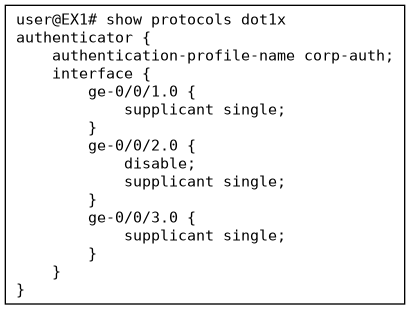
Examine the configuration shown. Users on ge-0/0/1 and ge-0/0/3 are challenged as designed, but a laptop on ge-0/0/2 is admitted without any 802.1X exchange. RADIUS is reachable and the access profile is correct. Which change restores authentication on ge-0/0/2?
- A. Set server-fail deny on ge-0/0/2.0
- B. Set transmit-period 5 on ge-0/0/2.0
- C. Change the supplicant mode of ge-0/0/2.0 to multiple
- D. Delete the disable statement under interface ge-0/0/2.0 Correct answer
Option D is correct because the exhibit shows a disable statement under ge-0/0/2.0, and disable turns 802.1X authentication off on that interface, so the laptop is admitted without any exchange while ge-0/0/1 and ge-0/0/3 are challenged. Deleting it re-enables the authenticator on the port. Server-fail deny, transmit-period and the supplicant mode only matter on a port where 802.1X is running, so none of them restores authentication here.
IP Telephony Features
A voice engineer wants IP phones on EX access ports to learn the voice VLAN ID, 802.1p priority and DSCP value automatically over LLDP-MED. Which LLDP-MED TLV does the switch use to advertise these values?
- A. Network Policy Correct answer
- B. Inventory Management
- C. Extended Power-via-MDI
- D. Location Identification
Option A is correct because the Network Policy TLV advertises the voice VLAN ID, the 802.1p priority and the DSCP value that the phone should use. Option B is wrong because Inventory Management carries hardware and software details of the endpoint, such as serial number and firmware. Option C is wrong because Extended Power-via-MDI carries PoE power negotiation information. Option D is wrong because Location Identification carries physical location data such as civic address or coordinates, for use in emergency calls.
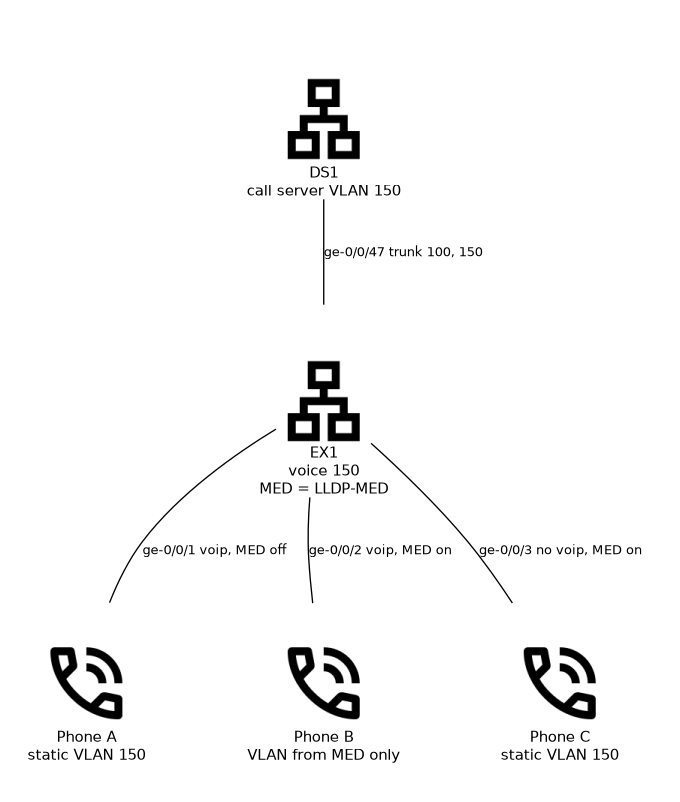
Refer to the exhibit. Phones A and C were given VLAN 150 by hand, and phone B takes its VLAN from LLDP-MED. Which phone cannot reach the call server on DS1?
- A. Phone A, because LLDP-MED is off on ge-0/0/1 and the phone cannot learn VLAN 150
- B. Phone C, because ge-0/0/3 has no voip statement to accept its tagged voice frames Correct answer
- C. Phone B, because ge-0/0/47 does not carry the voice VLAN to DS1
- D. Phone B, because a phone that learns VLAN 150 from LLDP-MED must also be set by hand
Option B is correct. Phone C has VLAN 150 set by hand and sends tagged voice frames, but ge-0/0/3 has no voip statement to accept them, so it cannot reach the call server. Option A is wrong because phone A has VLAN 150 set by hand and its port has a voip statement, so it does not depend on LLDP-MED. Option C is wrong because the ge-0/0/47 trunk carries VLAN 150 to DS1. Option D is wrong because a phone that learns its VLAN from LLDP-MED needs no manual setting.
Class of Service
Interface ge-0/0/1 on a Junos router already uses a DSCP BA classifier, so incoming packets get a forwarding class from their DSCP bits. class-of-service { interfaces { ge-0/0/1 { unit 0 { classifiers { dscp DSCP-BA; } } } } } Traffic sourced from 10.1.1.0/24 must now be placed in the best-effort class on this interface regardless of its DSCP marking, and every other source must keep the class its DSCP selects. Which change meets the requirement?
- A. Remap the ef code point to forwarding class best-effort in the DSCP-BA classifier bound to ge-0/0/1 for all traffic
- B. Apply an input firewall filter on ge-0/0/1 that matches source address 10.1.1.0/24 and sets forwarding-class best-effort Correct answer
- C. Replace the DSCP classifier on ge-0/0/1 with an IEEE 802.1p classifier that maps the default code point to best-effort
- D. Bind a DSCP rewrite rule to ge-0/0/1 that re-marks outgoing packets from 10.1.1.0/24 as 000000 for the best-effort class
Option B is correct because a multifield classifier configured as an input firewall filter on the logical interface can match the source address 10.1.1.0/24 and set the forwarding class, and when it conflicts with the BA classifier the multifield classifier overrides it for the matched traffic, while all other sources keep the class their DSCP selects. Option A is wrong because remapping the ef code point in the classifier changes the class for every source that sends that marking and does not single out 10.1.1.0/24. Option C is wrong because replacing the DSCP classifier removes DSCP-based classification for all other sources too. Option D is wrong because a rewrite rule changes markings on egress and does not change the forwarding class assigned on ingress.
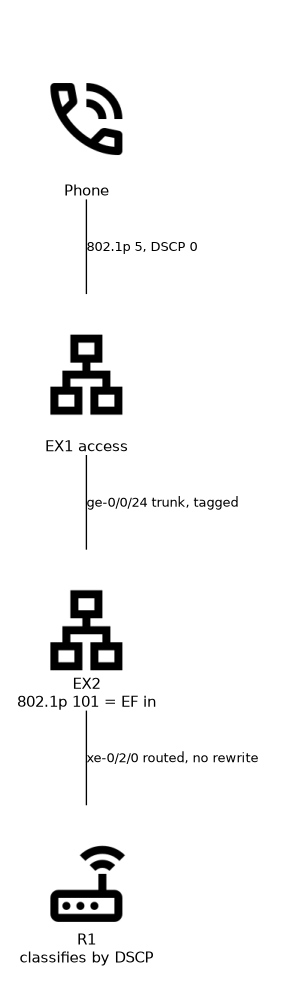
Refer to the exhibit. Voice from the phone reaches R1 classified as best-effort, although EX2 places it in expedited-forwarding. Which change corrects the marking that R1 sees?
- A. Bind a DSCP classifier to ge-0/0/24 on EX2 so that the phone voice is classified by its DSCP value
- B. Bind a DSCP rewrite rule that writes 101110 for expedited-forwarding to the EX2-facing interface on R1
- C. Bind an ieee-802.1 rewrite rule that writes 101 for expedited-forwarding to xe-0/2/0 unit 0 on EX2
- D. Bind a DSCP rewrite rule that writes 101110 for expedited-forwarding to xe-0/2/0 unit 0 on EX2 Correct answer
Option D is correct. The exhibit shows the phone voice arriving at EX2 with 802.1p 5 and DSCP 0, EX2 classifies it as expedited-forwarding from the 802.1p value, but the link xe-0/2/0 toward R1 has no rewrite, so the packet leaves with DSCP 0 and R1, which classifies by DSCP, sees best-effort. A DSCP rewrite rule writing 101110 for expedited-forwarding on xe-0/2/0 unit 0 of EX2 fixes the marking on that link. Option A is wrong because a DSCP classifier on ge-0/0/24 would read DSCP 0 and make it worse. Option B is wrong because a rule on R1 acts on traffic R1 sends, not on what it receives. Option C is wrong because an 802.1p rewrite changes the Layer 2 tag, while R1 reads the DSCP.
EVPN
A new leaf switch is added to an EVPN-VXLAN fabric that uses ingress replication, and its VTEP is configured for VNI 100. Which EVPN route type does it advertise so that the other VTEPs add it to their BUM flood list for VNI 100?
- A. Type 3 (inclusive multicast) Correct answer
- B. Type 1 (Ethernet auto-discovery)
- C. Type 5 (IP prefix)
- D. Type 2 (MAC/IP advertisement)
Option A is correct because the Type 3 inclusive multicast Ethernet tag route is what a VTEP advertises per VNI to tell the other VTEPs it takes part in BUM traffic for that VNI, and with ingress replication the other VTEPs build their flood lists from these routes. Option B is wrong because Type 1 auto-discovery routes are used for multihoming functions such as fast convergence and split horizon. Option C is wrong because Type 5 routes advertise IP prefixes. Option D is wrong because Type 2 routes advertise MAC and MAC/IP bindings of learned hosts, not membership in the flood list.
Refer to the exhibit. The EVPN BGP sessions between LEAF1 and LEAF2 are established and both loopbacks are reachable through SPINE1, but H1 cannot reach H2 at Layer 2. Which change restores connectivity?
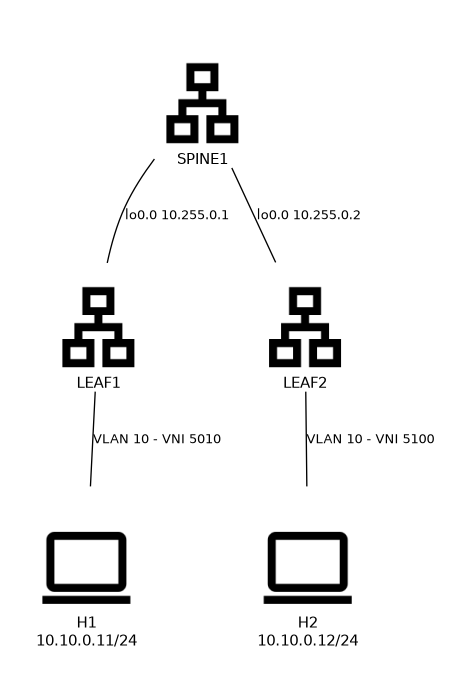
- A. Change the VLAN 10 mapping on LEAF2 to VNI 5010 Correct answer
- B. Configure the same route distinguisher for VLAN 10 on LEAF1 and LEAF2
- C. Enable ingress replication on LEAF1 toward the loopback 10.255.0.2
- D. Configure the same ESI on the H1-facing and H2-facing interfaces
Option A is correct because the exhibit shows VLAN 10 mapped to VNI 5010 on LEAF1 but VNI 5100 on LEAF2, and the VNI is the identifier that carries a Layer 2 segment across the VXLAN overlay, so the two leaves treat the traffic as different segments even though BGP and the loopbacks are fine. Option B fails because route distinguishers are per-device values that do not have to match. Option C fails because ingress replication only affects how BUM traffic is flooded, not VNI matching. Option D fails because an ESI describes multihoming to one host and the hosts here are on separate leaves.
Free Study Guide
Read the free Juniper JNCIP-ENT JN0-650 study guide: every exam topic explained in plain English, with diagrams, exam tips and the mistakes to avoid.
More Juniper Practice Exams
Practice with realistic mock exams to prepare for your Juniper certification.