Agile Frameworks/Methodologies · Topic 3 of 4
Agile Frameworks Compared (Scrum, XP, Kanban and SAFe)
CAPM agile frameworks compared: Scrum roles, events and artifacts, Extreme Programming practices, Kanban principles and SAFe for scaling agile.
- 4 min
- Includes a diagram
- Scrum: Product Owner, Scrum Master, Developers; sprint events; product backlog, sprint backlog, increment.
- XP: pair programming, TDD, continuous integration, refactoring, small releases.
- Kanban: visualize, limit WIP, pull, manage flow, explicit policies.
What it is
Agile is a mindset; frameworks put it into practice. CAPM expects you to tell the main ones apart by their components: Scrum (roles, events, artifacts), Extreme Programming (XP) (engineering practices), Kanban (flow and work in progress limits) and the Scaled Agile Framework (SAFe) (agile across many teams).
How it works
Scrum
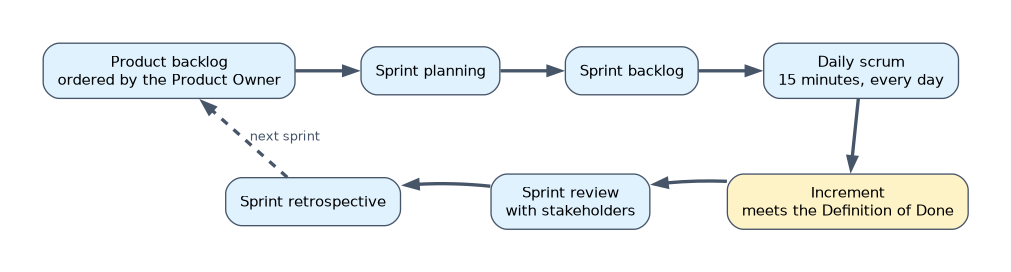 Scrum delivers work in sprints of one month or less.
| Component | Elements |
|---|---|
| Roles (accountabilities) | Product Owner (maximizes value, orders the product backlog), Scrum Master (helps the team use Scrum and causes the removal of impediments), Developers (build the increment) |
| Events | Sprint, sprint planning, daily scrum (15 minutes), sprint review, sprint retrospective |
| Artifacts | Product backlog, sprint backlog, increment |
The team is self-managing and cross-functional. The Definition of Done describes when work is complete.
Extreme Programming (XP)
XP focuses on software engineering excellence and close customer contact.
| Practice | Meaning |
|---|---|
| Pair programming | Two developers work at one workstation |
| Test-driven development (TDD) | Write the test before the code |
| Continuous integration | Integrate and test code frequently, many times a day |
| Refactoring | Improve code structure without changing behavior |
| Small releases | Release working software often |
| Collective code ownership | Anyone can improve any part of the code |
| Simple design | Build only what is needed now |
| Sustainable pace | Avoid long periods of overtime |
| Whole team or on-site customer | The customer works closely with the team |
Kanban
Kanban manages a continuous flow of work rather than fixed iterations.
| Principle or practice | Meaning |
|---|---|
| Visualize the work | A Kanban board shows columns such as To do, In progress, Done |
| Limit work in progress (WIP) | Cap the number of items in a column to reduce multitasking and expose bottlenecks |
| Pull system | New work is pulled when capacity frees up, not pushed |
| Manage flow | Measure and improve lead time and cycle time |
| Make policies explicit | Agree and show rules such as what "done" means for each column |
Lead time runs from request to delivery; cycle time from start of work to delivery.
SAFe
The Scaled Agile Framework (SAFe) coordinates many agile teams working on one large solution. Teams are grouped into an Agile Release Train (ART) that plans together in regular PI Planning events (PI stands for Planning Interval in current SAFe, Program Increment in earlier versions). SAFe adds roles and practices at team, train (formerly program) and portfolio levels.
Choosing a framework
| Situation | Good fit |
|---|---|
| A new product with changing requirements and a dedicated team | Scrum |
| Software quality and technical practices are the main concern | XP |
| Support or maintenance work arriving unpredictably | Kanban |
| Many teams must deliver one large solution together | SAFe |
Teams often combine them, for example Scrum with XP engineering practices, or Scrum with a Kanban board.
If a question mentions WIP limits or a pull system, the answer is Kanban. If it mentions pair programming or test-driven development, it is XP.
How the exam asks about this
- "Which framework uses WIP limits and a pull system?" Kanban.
- "Who orders the product backlog in Scrum?" The Product Owner.
- "Which framework is designed to coordinate many agile teams?" SAFe.
What to remember for the exam
- Scrum: Product Owner, Scrum Master, Developers; sprint events; product backlog, sprint backlog, increment.
- XP: pair programming, TDD, continuous integration, refactoring, small releases.
- Kanban: visualize, limit WIP, pull, manage flow, explicit policies.
- SAFe: scaling with Agile Release Trains and PI Planning.
- Frameworks can be combined.
Kanban does not require fixed iterations or Scrum roles. Answers that add sprints to pure Kanban are distractors.
Common mistakes
Making the Scrum Master the team's manager. The Scrum Master serves and coaches.
Raising WIP limits to go faster. Lower WIP usually improves flow.
Calling SAFe a single team framework. It is for scaling across many teams.
Check yourself
What are the three Scrum accountabilities?
Product Owner, Scrum Master and Developers.
What does a WIP limit do in Kanban?
It caps how many items can be in a stage at once, reducing multitasking and exposing bottlenecks.
Name two XP practices.
For example, pair programming and test-driven development.
Topic 3 of 4 in Agile Frameworks/Methodologies
Test yourself on Agile Frameworks/Methodologies
The full PMI CAPM question bank has 1,049 questions, with timed practice exams and an explanation for every answer.
This study guide is independent and is not affiliated with, endorsed by, or sponsored by PMI. Vendor names, certification names and exam codes are trademarks of their respective owners and are used for identification only.