Predictive, Plan-Based Methodologies · Topic 2 of 3
WBS, Work Packages and the Critical Path
CAPM scheduling: work breakdown structure and work packages, dependencies, critical path and float, schedule compression, quality and integration plans.
- 4 min
- Includes a diagram
- WBS: hierarchical decomposition of all the scope; work packages at the bottom.
- Scope baseline = scope statement + WBS + WBS dictionary.
- Critical path: longest path; zero float; sets the project duration.
What it is
The work breakdown structure (WBS) breaks the total project scope into smaller, manageable pieces. Its lowest level is the work package. Activities needed for each work package are then sequenced and given durations, and the critical path method (CPM) finds the longest path through them, which sets the shortest possible project duration.
How it works
WBS and work packages
- The WBS is a hierarchical decomposition of the total scope of work.
- The 100% rule: the WBS includes all the work, and only the work, in the project scope.
- Work packages are the lowest level. Cost and duration are estimated and managed there.
- The WBS dictionary describes each element: scope, deliverables, owner, acceptance criteria.
- The scope baseline is the approved scope statement, WBS and WBS dictionary.
Dependencies
| Type | Meaning |
|---|---|
| Finish to start (FS) | B starts after A finishes; the most common |
| Start to start (SS) | B starts after A starts |
| Finish to finish (FF) | B finishes after A finishes |
| Start to finish (SF) | B finishes after A starts; rare |
A lead lets a successor start early; a lag adds a delay between activities.
Critical path and float
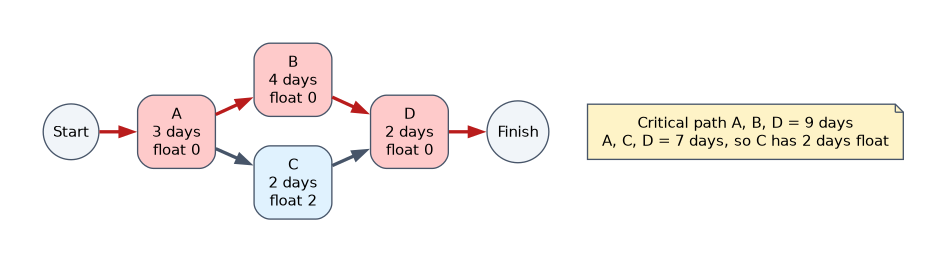 The critical path is the longest path through the network. Its activities usually have zero float, so any delay on them delays the project.
Total float is how long an activity can be delayed without delaying the project end date. Total float = late start minus early start (or late finish minus early finish).
Worked example. Activities: A (3 days) then B (4 days) then D (2 days); A also leads to C (2 days) then D.
| Path | Duration |
|---|---|
| A, B, D | 3 + 4 + 2 = 9 days |
| A, C, D | 3 + 2 + 2 = 7 days |
The critical path is A, B, D at 9 days. Activity C has 9 minus 7 = 2 days of float.
Estimating durations
| Technique | Formula or idea |
|---|---|
| Three point (beta, PERT) | (O + 4M + P) / 6 |
| Three point (triangular) | (O + M + P) / 3 |
| Analogous | Based on a similar past project; quick, less accurate |
| Parametric | Uses a rate, for example 2 hours per unit |
| Bottom up | Estimates each work package and adds them up; slow, more accurate |
For O = 4, M = 6, P = 14 days: PERT gives (4 + 24 + 14) / 6 = 7 days.
Compressing the schedule
| Technique | How | Downside |
|---|---|---|
| Crashing | Add resources to critical path activities | Increases cost |
| Fast tracking | Do activities in parallel that were planned in sequence | Increases risk and rework |
Schedule variance
Schedule variance (SV) = earned value (EV) minus planned value (PV). A negative SV means behind schedule. See the project controls page for more.
Quality and integration plans
- The quality management plan says how quality standards will be met: which standards apply, who is responsible, how deliverables are checked. Quality control checks deliverables are correct; quality assurance (manage quality) checks the process is followed.
- Integration management coordinates all the parts of the plan. Integrated change control reviews every change request, often through a change control board (CCB), and updates the baselines and plans if approved.
In a network question, list every path and add its durations. The longest one is the critical path; float for others is the difference from it.
How the exam asks about this
- "What is the lowest level of the WBS?" The work package.
- "Which compression technique adds cost?" Crashing.
- "What is the PERT estimate for O = 2, M = 5, P = 14?" (2 + 20 + 14) / 6 = 6.
What to remember for the exam
- WBS: hierarchical decomposition of all the scope; work packages at the bottom.
- Scope baseline = scope statement + WBS + WBS dictionary.
- Critical path: longest path; zero float; sets the project duration.
- Total float = LS minus ES = LF minus EF.
- PERT = (O + 4M + P) / 6; triangular = (O + M + P) / 3.
- Crashing adds cost; fast tracking adds risk.
The critical path is the longest path, not the shortest. It gives the shortest time in which the project can finish.
Common mistakes
Picking the shortest path as critical. It is the longest.
Including work outside scope in the WBS. The 100% rule means all the work and only the work.
Fast tracking activities that cannot overlap. Fast tracking suits activities linked by discretionary dependencies; mandatory (hard logic) dependencies cannot be overlapped.
Check yourself
What is the 100% rule?
The WBS includes all the work in the project scope and nothing outside it.
What is total float?
How long an activity can be delayed without delaying the project end date.
What is the difference between crashing and fast tracking?
Crashing adds resources and cost; fast tracking runs sequential activities in parallel and adds risk.
Topic 2 of 3 in Predictive, Plan-Based Methodologies
Test yourself on Predictive, Plan-Based Methodologies
The full PMI CAPM question bank has 1,049 questions, with timed practice exams and an explanation for every answer.
This study guide is independent and is not affiliated with, endorsed by, or sponsored by PMI. Vendor names, certification names and exam codes are trademarks of their respective owners and are used for identification only.