Predictive, Plan-Based Methodologies · Topic 3 of 3
Predictive Artifacts and Cost and Schedule Variances
CAPM project controls: predictive artifacts, change requests and logs, and earned value basics: PV, EV, AC, CV, SV, CPI and SPI with a worked example.
- 4 min
- Includes a diagram
- Artifacts: charter, plan and baselines, WBS, schedule, risk register, issue log, change log, traceability matrix, lessons learned.
- Change requests go through integrated change control before baselines change.
- CV = EV minus AC; SV = EV minus PV.
What it is
Project controls compare actual performance with the plan and trigger action when they differ. In a predictive project, the team records work in standard artifacts (plans, baselines, registers, logs and reports) and measures performance with earned value figures such as cost variance and schedule variance.
How it works
Common predictive artifacts
| Artifact | What it holds |
|---|---|
| Project charter | Authorization, objectives, summary milestones and budget |
| Project management plan | Subsidiary plans and the scope, schedule and cost baselines |
| WBS and WBS dictionary | Decomposed scope and the details of each element |
| Project schedule | Activities, dates and dependencies, often as a Gantt chart |
| Risk register | Identified risks, owners and responses |
| Issue log | Current issues, owners and status |
| Change log | All change requests and their status |
| Requirements traceability matrix | Links each requirement to its source and the deliverable that satisfies it |
| Lessons learned register | Knowledge gained during the project |
| Status and performance reports | Progress, variances and forecasts |
A Gantt chart shows activities as bars against a timeline. A milestone chart shows only the key dates.
Change requests
A change request is a formal proposal to change a document, deliverable or baseline. It can be a corrective action, a preventive action, a defect repair or an update. Every change request goes through integrated change control: it is analyzed for impact on scope, schedule, cost, quality and risk, then approved or rejected, often by a change control board. Approved changes update the baselines and plans.
Earned value basics
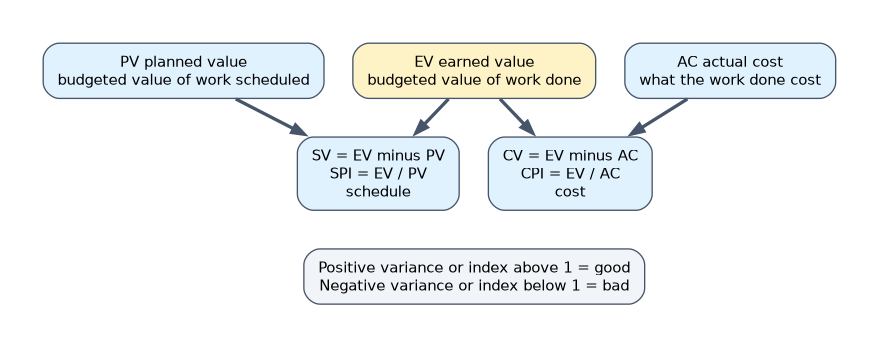
| Term | Meaning |
|---|---|
| BAC (budget at completion) | The total budget for the work |
| PV (planned value) | The budgeted value of the work scheduled to be done by now |
| EV (earned value) | The budgeted value of the work actually done by now |
| AC (actual cost) | What the work done by now actually cost |
| Measure | Formula | Good result |
|---|---|---|
| Cost variance (CV) | EV minus AC | Positive: under budget |
| Schedule variance (SV) | EV minus PV | Positive: ahead of schedule |
| Cost performance index (CPI) | EV / AC | Above 1: under budget |
| Schedule performance index (SPI) | EV / PV | Above 1: ahead of schedule |
In all four formulas, EV comes first. Negative variances, or indices below 1, are bad.
Worked example
A project has BAC = 100,000. By now, the plan says 50,000 of work should be done (PV). The team has finished work worth 40,000 (EV) and spent 45,000 (AC).
| Measure | Calculation | Result | Meaning |
|---|---|---|---|
| CV | 40,000 minus 45,000 | minus 5,000 | Over budget |
| SV | 40,000 minus 50,000 | minus 10,000 | Behind schedule |
| CPI | 40,000 / 45,000 | about 0.89 | Getting 89 cents of value per dollar |
| SPI | 40,000 / 50,000 | 0.8 | Progressing at 80% of the planned rate |
Percent complete is EV / BAC = 40%.
Memorize "EV first". CV = EV minus AC, SV = EV minus PV, CPI = EV / AC, SPI = EV / PV.
How the exam asks about this
- "EV = 30,000 and AC = 25,000. What is the CV?" 5,000, under budget.
- "SPI is 0.9. What does this mean?" The project is behind schedule.
- "Which document links requirements to the deliverables that satisfy them?" The requirements traceability matrix.
What to remember for the exam
- Artifacts: charter, plan and baselines, WBS, schedule, risk register, issue log, change log, traceability matrix, lessons learned.
- Change requests go through integrated change control before baselines change.
- CV = EV minus AC; SV = EV minus PV.
- CPI = EV / AC; SPI = EV / PV.
- Positive variance or index above 1 is good.
Actual cost is not progress. A project that has spent half its budget is not half done; earned value shows how much work is actually complete.
Common mistakes
Reversing the formula. CV is EV minus AC, not AC minus EV.
Dividing the wrong way. CPI is EV over AC.
Changing a baseline without an approved change request. Baselines change only through change control.
Check yourself
What does a CPI of 1.2 mean?
The project is getting 1.2 units of value for each unit spent, so it is under budget.
What is the formula for schedule variance?
SV = EV minus PV.
What happens to a change request before the baseline is updated?
It is analyzed and approved through integrated change control, often by a change control board.
Topic 3 of 3 in Predictive, Plan-Based Methodologies
Test yourself on Predictive, Plan-Based Methodologies
The full PMI CAPM question bank has 1,049 questions, with timed practice exams and an explanation for every answer.
This study guide is independent and is not affiliated with, endorsed by, or sponsored by PMI. Vendor names, certification names and exam codes are trademarks of their respective owners and are used for identification only.