PRINCE2 Practices · Topic 4 of 9
The Plans Practice
PRINCE2 7 plans practice: purpose, levels of plan, work package and project product descriptions, product-based planning, horizons and tolerances.
- 6 min
- Includes a diagram
- Purpose: define the means of delivering products (where, how, by whom, when and how much).
- Project plan, stage plan, optional team plan, exception plan.
- Product-based planning: project product description, product breakdown structure, product descriptions, product flow diagram.
What it is
The purpose of the plans practice is to facilitate communication and control by defining the means of delivering the products: where and how, by whom, and estimating when and how much. A plan is a proposal that shows how targets for time, cost, quality, scope, benefits, risk and sustainability will be met.
How it works
Levels of plan
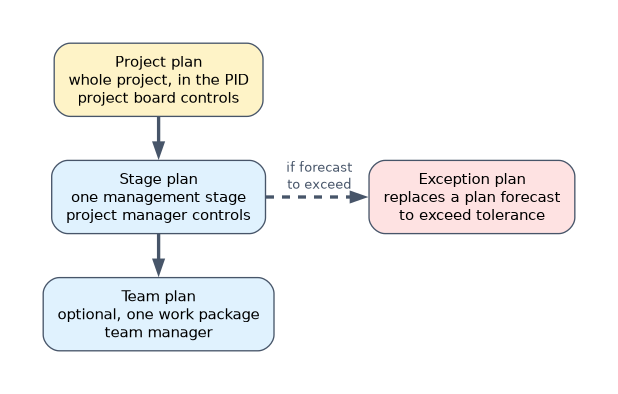
| Plan | Key facts |
|---|---|
| Project plan | High level plan for the whole project; part of the PID; used by the project board to control the project; updated at stage boundaries |
| Stage plan | Detailed plan for one management stage; used by the project manager for day-to-day control; produced near the end of the previous stage |
| Team plan | Optional; produced by a team manager to plan the work in a work package |
| Exception plan | Prepared when a plan is forecast to exceed tolerance; replaces the plan it covers once approved |
An exception plan for a stage is approved by the project board. An exception plan for the whole project needs the business layer, because only the business layer can change project tolerances.
Key concepts
| Term | Meaning |
|---|---|
| Scope | The sum of the products and the extent of their requirements, as defined by the plan's products and product descriptions |
| Dependency | A relationship between products or activities where one cannot start or finish until another has; dependencies may be internal (within the project's control) or external (outside it) |
| Schedule | A graphical representation of a plan, such as a Gantt chart, showing activities, timings and resources |
Management products
| Product | Purpose |
|---|---|
| Project product description | Describes the project's major product: its purpose, composition, the user's quality expectations, acceptance criteria and tolerances. Written in starting up a project |
| Work package description | The set of information about one or more products, agreed between project manager and team manager, used to pass responsibility for work formally |
| Plan | Covers project, stage, team and exception plans: what will be delivered, by whom, when and at what cost |
Guidance: planning horizon and stages
The planning horizon is the period of time for which it is possible to plan accurately. Beyond it, plans become guesses, which is why PRINCE2 plans the current stage in detail and later stages only at project plan level.
Management stages are sections of the project that the project manager manages on behalf of the board, separated by decision points. Their length depends on the planning horizon, risk, and the delivery approach. Stages are not the same as delivery phases such as design or build: one management stage can contain parts of several delivery phases.
Guidance: product-based planning
PRINCE2 plans start with products, not activities. Product-based planning works through four parts.
| Step | What it produces |
|---|---|
| Write the project product description | What the project as a whole must deliver |
| Create a product breakdown structure | A hierarchy of all the products |
| Write product descriptions | Purpose, composition and quality criteria for each significant product |
| Create a product flow diagram | The sequence of creation and the dependencies between products |
Guidance: tolerances and delivery sustainability
Constraints are managed with tolerances. A plan sets targets, and tolerances give the permitted variation for time, cost, quality, scope, benefits, risk and sustainability.
Delivery sustainability means considering sustainability in the way the project does its work, not only in what it delivers. Examples are reducing travel, reusing materials or choosing lower-carbon suppliers, built into the plan from the start.
The planning technique
In outline, the technique starts by defining and analysing the products, then organizing the work, including the dependencies between products and activities, preparing estimates, preparing the schedule and documenting the plan. Risks to the plan are considered along the way, and steps are repeated as information improves.
Relationship to the principles
| Principle | Link to plans |
|---|---|
| Focus on products | Product-based planning starts from products |
| Manage by stages | Project plan plus detailed stage plans |
| Manage by exception | Plans carry tolerances; exception plans respond to deviations |
| Ensure continued business justification | Plan costs and timescales feed the business case |
| Define roles, responsibilities and relationships | Plans say who delivers what |
| Learn from experience | Estimates use lessons from earlier projects |
| Tailor to suit the project | Plan formality and format suit the project |
A worked example
A museum plans a new exhibition opening on 1 June 2027. The project product description says the exhibition must hold 40 objects, meet accessibility standards and be accepted by the curator.
The product breakdown structure lists display cases, labels, an audio guide and marketing material, each with a product description. The product flow diagram shows the labels depend on final object selection, an internal dependency, while loan agreements with other museums are an external dependency. The project plan covers three stages; the current stage plan is shown as a Gantt chart schedule.
How the exam asks about this
- "Which plan is optional?" The team plan.
- "What is the first step in product-based planning?" Writing the project product description.
- "Which management product is used to formally pass responsibility for work to a team manager?" The work package description.
What to remember for the exam
- Purpose: define the means of delivering products (where, how, by whom, when and how much).
- Project plan, stage plan, optional team plan, exception plan.
- Product-based planning: project product description, product breakdown structure, product descriptions, product flow diagram.
- The planning horizon limits how far ahead detailed planning is reliable.
- Management stages are decision points, not delivery phases.
An exception plan replaces the plan it covers. It is not an extra plan running alongside the original.
Common mistakes
Starting planning with activities. PRINCE2 starts with products, then derives activities.
Treating management stages as delivery phases. Stages are about management control; delivery phases are about the specialist work.
Thinking the project board approves a project exception plan. If project tolerance is threatened, the decision sits with the business layer.
Check yourself
What is a schedule?
A graphical representation of a plan, such as a Gantt chart, showing activities, timings and resources.
What is the planning horizon?
The period of time for which it is possible to plan accurately.
What is an external dependency?
A dependency between a project product or activity and something outside the project's control.
Topic 4 of 9 in PRINCE2 Practices
Test yourself on PRINCE2 Practices
The full PeopleCert PRINCE2 7 Foundation question bank has 564 questions, with timed practice exams and an explanation for every answer.
This study guide is independent and is not affiliated with, endorsed by, or sponsored by PeopleCert. Vendor names, certification names and exam codes are trademarks of their respective owners and are used for identification only.