PRINCE2 Practices · Topic 3 of 9
The Organizing Practice
PRINCE2 7 organizing practice: purpose, the three project interests, project board, roles, team structure, role descriptions and commercial approach.
- 6 min
- Includes a diagram
- Purpose: define and establish the structure of accountability and responsibilities.
- Project board: executive, senior user(s), senior supplier(s); one executive only.
- Project assurance is independent of the project manager.
What it is
The purpose of the organizing practice is to define and establish the project's structure of accountability and responsibilities: the "who?". It sets up the temporary project organization, its roles, its decision making and its relationships with the organizations around it.
The four levels in the flow above show how authority is delegated. The business layer sits outside the project and commissions it; the other three levels are inside the project.
How it works
The three project interests
Every PRINCE2 project must represent three interests, and all three must have a voice on the project board.
| Interest | Represented on the board by | Focus |
|---|---|---|
| Business | Executive | Value for money; the business case |
| User | Senior user (one or more) | Products meet needs; benefits realised |
| Supplier | Senior supplier (one or more) | Products can be delivered to quality |
The project board
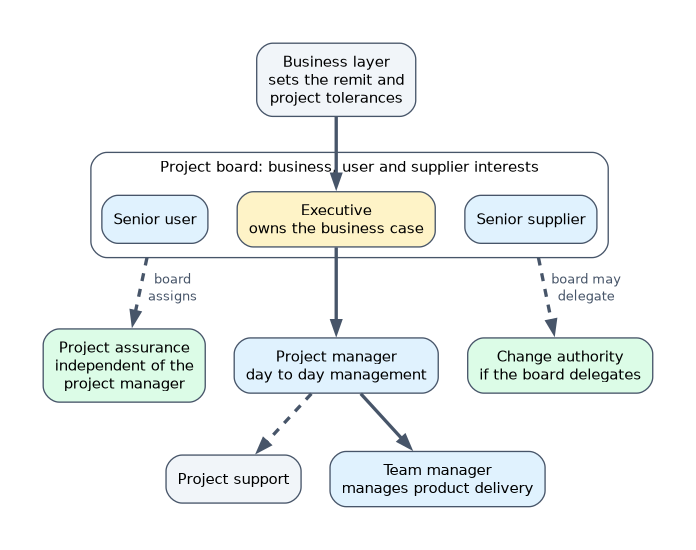 The project board is accountable to the business layer for the success of the project and has authority to direct it within the remit set by the business layer. It is made up of the executive, the senior user(s) and the senior supplier(s).
| Role | Key responsibilities |
|---|---|
| Executive | Ultimate decision maker, accountable for the project; owns the business case; there is only one executive |
| Senior user | Specifies needs, represents those who use the products, ensures benefits are realised |
| Senior supplier | Represents those who design, develop and implement products; accountable for their quality and supplier resources |
PRINCE2 7 material often calls the executive the project executive; both names mean the same role. The project board is not a democracy. The executive makes the final decision, supported by the senior user and senior supplier.
Other PRINCE2 roles
| Role | Purpose |
|---|---|
| Project assurance | Checks on behalf of the board that the project is being run properly; independent of the project manager |
| Change authority | A person or group the board delegates to approve requests for change and off-specifications |
| Project manager | Manages the project day-to-day within the constraints set by the board |
| Team manager | Delivers the products in a work package; optional (the project manager can fill it) |
| Project support | Administrative and specialist support to the project manager, such as maintaining the project log |
Roles can be shared or combined where sensible, but some cannot. The executive and project manager roles cannot be combined, and project assurance cannot be done by the project manager or project support.
Project team
The project team is everyone working on the project: the project management team roles plus the specialists who create the products. In PRINCE2 7 the team often spans several organizations, including suppliers.
Work breakdown structure
A work breakdown structure breaks the work into manageable pieces and links each piece to the people or teams who will do it. It connects the products to be delivered with the organization that delivers them, so that work packages can be assigned to the right team managers.
Management products
| Product (part of the PID) | Purpose |
|---|---|
| Project management team structure | Shows who holds each role and the reporting lines |
| Role descriptions | Define the responsibilities and authority of each role |
| Commercial management approach | Describes how the commercial relationships with suppliers will be managed, such as procurement, contracts and supplier performance |
The organizing technique
In outline, the technique works through the ecosystems. First understand the organizational ecosystem the project sits in, then design and develop the project ecosystem (roles, team structure, appointments and ways of working). Then manage changes to it during the project, and finally transition the project back into the organization at closure.
Relationship to the principles
| Principle | Link to organizing |
|---|---|
| Define roles, responsibilities and relationships | Organizing puts this principle into practice |
| Ensure continued business justification | The executive is accountable for the business case |
| Manage by exception | Delegation and tolerances follow the levels of the organization |
| Manage by stages | The team is reviewed and changed at stage boundaries |
| Learn from experience | Role design uses lessons from earlier projects |
| Focus on products | Work is assigned by product through work packages |
| Tailor to suit the project | Roles can be combined to suit size and context |
A worked example
A water company runs a project to install smart meters, using an external installer. The executive is the head of customer services, the senior user is the metering operations manager, and the senior supplier is the installer's delivery director.
The project manager is from the water company, with two team managers: one from the installer, one in-house for data systems. An independent business analyst provides user assurance, and a small change authority approves minor changes up to an agreed limit. The commercial management approach sets how the installer's performance is measured against the contract.
How the exam asks about this
- "Which role is responsible for the business case and is the ultimate decision maker?" The executive.
- "Which three interests must be represented on the project board?" Business, user and supplier.
- "Which management product describes how supplier contracts and relationships will be managed?" The commercial management approach.
What to remember for the exam
- Purpose: define and establish the structure of accountability and responsibilities.
- Project board: executive, senior user(s), senior supplier(s); one executive only.
- Project assurance is independent of the project manager.
- Team manager and change authority are optional; the project manager fills gaps.
- Team structure, role descriptions and the commercial management approach are in the PID.
The project board is not a committee that votes. The executive has the final decision.
Common mistakes
Putting the business layer inside the project. It commissions the project and sets project tolerances, but sits outside the project management team.
Combining executive and project manager. These roles must stay separate.
Confusing project assurance with quality assurance. Project assurance is a project role for the board; quality assurance is independent of the project management team.
Check yourself
Who represents the supplier interest on the project board?
The senior supplier.
Can the project manager perform project assurance?
No. Project assurance must be independent of the project manager.
What is a change authority?
A person or group to whom the project board delegates authority to approve requests for change and off-specifications.
Topic 3 of 9 in PRINCE2 Practices
Test yourself on PRINCE2 Practices
The full PeopleCert PRINCE2 7 Foundation question bank has 564 questions, with timed practice exams and an explanation for every answer.
This study guide is independent and is not affiliated with, endorsed by, or sponsored by PeopleCert. Vendor names, certification names and exam codes are trademarks of their respective owners and are used for identification only.