PRINCE2 Practices · Topic 5 of 9
The Quality Practice
PRINCE2 7 quality practice: purpose, user quality expectations, acceptance criteria, product description, quality and product registers and quality review.
- 5 min
- Includes a diagram
- Purpose: create and verify products that are fit for purpose.
- Expectations, then acceptance criteria, then quality specifications for each product.
- Quality planning, quality control and quality assurance are distinct.
What it is
The purpose of the quality practice is to define and implement the means by which the project will create and verify products that are fit for purpose. It answers "what standard?" and makes sure users get products they can actually use.
How it works
Key concepts
| Term | Meaning |
|---|---|
| Requirements | What the users need the project's products to provide, including functions and features |
| User quality expectations | A statement of the users' expectations about quality for the project's product, often broad (for example, "easy to use", "meets safety standards") |
| Acceptance criteria | A prioritised list of measurable criteria the project product must meet before the users will accept it |
| Quality specifications | The measurable quality criteria and tolerances defined for each product in its product description |
Expectations are captured early and turned into measurable acceptance criteria for the project product. These are then broken down into quality specifications for each product.
Management products
| Product | Purpose |
|---|---|
| Product description | Defines a product's purpose, composition, derivation, format, quality criteria, quality tolerance, quality method, skills required and quality responsibilities |
| Quality management approach (PID) | Describes how quality will be managed: standards, procedures, techniques, tools, records and responsibilities |
| Quality register (project log) | Records the quality activities planned and carried out, with dates, people and results |
| Product register (project log) | Records the project's products and their status, so the team knows which version exists and where |
The quality register gives the project board and assurance evidence that planned quality checks actually took place. The product register is new in PRINCE2 7 and replaces older configuration records.
Guidance: quality planning
Quality planning is about defining what quality means for this project and how it will be checked. It covers capturing the user quality expectations and acceptance criteria in the project product description, writing the quality management approach, and writing product descriptions with quality criteria for each product.
Guidance: quality control
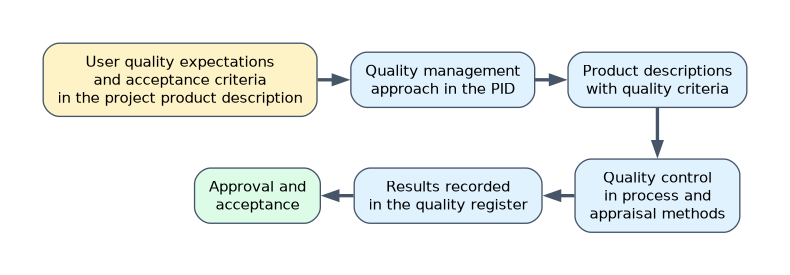 Quality control is the set of activities that check products against their quality criteria and record the results. It includes carrying out quality methods (such as testing, inspection or review), keeping quality records, and gaining approval and acceptance.
There are two broad kinds of quality method: in process methods that build quality in as products are created, and appraisal methods that check a finished product, such as testing or a quality review.
Guidance: quality assurance
Quality assurance gives confidence to the organization that the project is being run in line with the organization's quality standards and policies. It is carried out independently of the project management team, typically by a corporate quality function.
| Project assurance | Quality assurance | |
|---|---|---|
| Who for | The project board | The wider organization |
| Independent of | The project manager | The whole project management team |
| Responsibility | The project board | The business layer |
The quality technique
The PRINCE2 7 quality technique follows the guidance above in three broad steps: plan quality, control quality and accept the products. Acceptance is given by the person or group named in the product description, using the quality records as evidence.
Supporting technique: quality review
A quality review is one widely used quality method: a structured check that a document-style product meets its quality criteria, which also builds agreement among the people involved.
| Role | Responsibility |
|---|---|
| Chair | Runs the review and makes sure it is conducted properly |
| Presenter | Represents the producers of the product |
| Reviewer | Checks the product against its quality criteria |
| Administrator | Provides administrative support and records the results |
The result of each review, and of every other quality check, is recorded in the quality register.
Relationship to the principles
| Principle | Link to quality |
|---|---|
| Focus on products | Product descriptions define quality criteria |
| Manage by exception | Quality tolerances in product descriptions |
| Define roles, responsibilities and relationships | Quality responsibilities defined for each product |
| Learn from experience | Lessons improve quality methods |
| Ensure continued business justification | Products must be fit for purpose to deliver benefits |
| Manage by stages | Quality checked before a stage is closed |
| Tailor to suit the project | Quality methods suited to the products and context |
A worked example
A bank is building a mobile payments feature. The user quality expectations say it must be secure and quick to use. The acceptance criteria include "payment confirmed within three seconds for 95% of transactions" and "passes the bank's security test".
Each product description sets quality criteria and the quality method, such as automated testing for code and a quality review for the user guide. Every test and review is recorded in the quality register. The bank's internal quality function independently checks that the project follows its testing policy, providing quality assurance.
How the exam asks about this
- "What is a prioritised list of measurable criteria the project product must meet before acceptance?" Acceptance criteria.
- "Which product records the quality activities planned and carried out?" The quality register.
- "Who is quality assurance independent of?" The project management team.
What to remember for the exam
- Purpose: create and verify products that are fit for purpose.
- Expectations, then acceptance criteria, then quality specifications for each product.
- Quality planning, quality control and quality assurance are distinct.
- Quality review roles: chair, presenter, reviewer, administrator.
- Quality register records quality checks; product register records products and their status.
Quality assurance is not the same as project assurance. Quality assurance is independent of the whole project management team.
Common mistakes
Treating user quality expectations as measurable. Expectations can be broad; acceptance criteria are the measurable version.
Confusing quality control and quality assurance. Control checks products; assurance checks that the project follows the organization's standards.
Forgetting the product register. It sits in the project log alongside the quality register in PRINCE2 7.
Check yourself
Which management product records the quality method and quality criteria for a product?
The product description.
What does quality control involve?
Checking products against their quality criteria using quality methods, recording results and gaining approval and acceptance.
Which quality review role checks the product against its quality criteria?
The reviewer. The chair runs the review, the presenter represents the producers and the administrator records results.
Topic 5 of 9 in PRINCE2 Practices
Test yourself on PRINCE2 Practices
The full PeopleCert PRINCE2 7 Foundation question bank has 564 questions, with timed practice exams and an explanation for every answer.
This study guide is independent and is not affiliated with, endorsed by, or sponsored by PeopleCert. Vendor names, certification names and exam codes are trademarks of their respective owners and are used for identification only.