Value Stream Mapping and Management · Topic 1 of 1
Value Streams, Mapping and Management
Core and enabling value streams, value stream mapping and management, complexity thinking, and lead time and wait time on a value stream map.
- 3 min
- Includes a diagram
- Value stream: the steps that create and deliver products and services.
- Core streams deliver to consumers; enabling streams support other streams.
- Mapping visualizes; management continually improves.
What it is
A value stream is the series of steps an organization undertakes to create and deliver products and services to consumers. Value stream mapping makes those steps and the delays between them visible, and value stream management continually oversees and improves the flow, so value reaches consumers efficiently.
How it works
Types of value stream
| Type | Meaning |
|---|---|
| Core value stream | Directly creates and delivers products and services to consumers |
| Enabling value stream | Does not deliver to consumers directly but supports other value streams, for example onboarding new staff or providing internal tools |
Mapping, management and complexity
| Term | Meaning |
|---|---|
| Value stream mapping | A technique that visualizes the steps, flows and delays in a value stream |
| Value stream management | The continual oversight and improvement of value streams |
| Complexity thinking | Viewing the organization as a system whose outcomes cannot be fully predicted, so approaches must adapt |
Mapping is how you see the stream; management is how you keep improving it. Mapping usually feeds management.
Optimising workflows for complexity
In complex environments, workflows cannot be fully specified in advance. Teams improve flow by:
- Making small, iterative changes with feedback and learning what works.
- Increasing visibility and collaboration across the teams involved.
- Reducing delays, handoffs and waste.
- Finding bottlenecks: steps whose limited capacity slows the whole flow.
Adding approvals, maximising each team's local utilisation or writing exhaustive documentation up front usually slows flow.
Elements of a value stream map
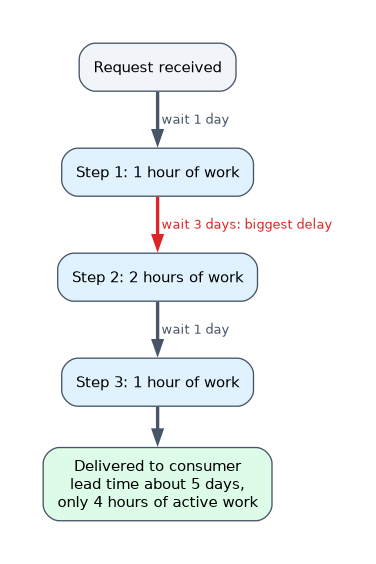
| Element | Meaning |
|---|---|
| Process time | Time spent actively working on a step |
| Wait time | Time work waits between two steps |
| Lead time | Total elapsed time from a request starting to delivery to the consumer |
| Handoffs | Transfers of work between people or teams |
Work that spends days waiting between two steps shows a delay that is a candidate for improvement.
Lead time is the whole journey; process time is only the active work; wait time is the gaps. The difference between lead time and process time is where improvement usually lies.
How the exam asks about this
- "A value stream that supports other value streams is called what?" An enabling value stream.
- "How does value stream management differ from mapping?" Management continually improves the stream; mapping visualizes it.
- "Which map element shows time waiting between steps?" Wait time.
What to remember for the exam
- Value stream: the steps that create and deliver products and services.
- Core streams deliver to consumers; enabling streams support other streams.
- Mapping visualizes; management continually improves.
- Complexity thinking: outcomes cannot be fully predicted, so adapt iteratively.
- Map elements include process time, wait time, lead time and handoffs.
Do not expect to design a perfect workflow up front. In complex environments the right answer is iterative improvement with feedback.
Common mistakes
Reversing core and enabling. Core delivers directly to consumers.
Treating mapping as management. Mapping is a technique within management.
Confusing lead time and process time. Lead time includes the waiting.
Check yourself
What is a core value stream?
A value stream that directly creates and delivers products and services to consumers.
What is complexity thinking?
Viewing an organization as a system whose outcomes cannot be fully predicted, so approaches must adapt.
What is lead time on a value stream map?
The total elapsed time from a request starting to its delivery to the consumer.
Topic 1 of 1 in Value Stream Mapping and Management
Test yourself on Value Stream Mapping and Management
The full PeopleCert ITIL 5 Foundation question bank has 527 questions, with timed practice exams and an explanation for every answer.
This study guide is independent and is not affiliated with, endorsed by, or sponsored by PeopleCert. Vendor names, certification names and exam codes are trademarks of their respective owners and are used for identification only.