Key ITIL Terms and Definitions · Topic 4 of 4
Service Relationships, Roles and SLAs
ITIL 5 service relationships: provider, consumer, digital product vendor, sponsor, customer and user roles, relationship types, service journey and SLAs.
- 3 min
- Includes a diagram
- Provider and consumer are roles that organizations take.
- Sponsor: budget. Customer: requirements and outcomes. User: daily use.
- Relationships range from basic to cooperative to collaborative.
What it is
A service relationship is the cooperation between a service provider and a service consumer. ITIL defines who takes part, which roles people hold on the consumer side, how close the relationship can be, and how service quality is agreed and measured.
How it works
Parties
| Term | Meaning |
|---|---|
| Organization | A person or group of people with its own functions, responsibilities, authorities and relationships, working to achieve its objectives |
| Service provider | The role an organization takes when it provides services to consumers |
| Service consumer | The role an organization or person takes when it consumes services |
| Digital product vendor | An organization that supplies digital products for others to install and run themselves |
The same organization can be a provider in one relationship and a consumer in another. A software company licensing a product that customers run themselves is a digital product vendor, not their service provider.
Consumer roles
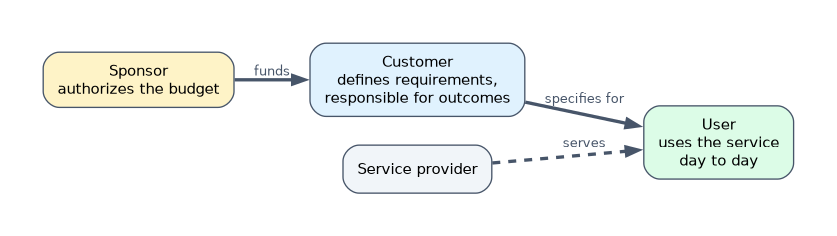
| Role | Responsibility |
|---|---|
| Sponsor | Authorizes the budget for service consumption |
| Customer | Defines the requirements for a service and takes responsibility for the outcomes of consuming it |
| User | Uses the service in day-to-day activities |
One person can hold more than one role, for example a small business owner who is sponsor, customer and user at once.
Types of service relationship
| Type | Description |
|---|---|
| Basic | Simple, transactional exchange of goods or services |
| Cooperative | Mutual understanding and coordination between provider and consumer |
| Collaborative | The closest type: shared goals, shared responsibility for outcomes and shared risk |
The service journey describes the consumer's end-to-end path of interactions with a provider and how the relationship develops over time, for example from a simple purchase to joint planning and shared investment.
Quality and agreements
| Term | Meaning |
|---|---|
| Service quality | How well a service meets the requirements and expectations set for it |
| Service level | One or more metrics that define expected or achieved service quality |
| Service Level Agreement (SLA) | A documented agreement between a provider and a consumer that identifies the services and the expected service levels |
Sponsor pays, customer defines requirements and owns the outcomes, user uses. Most role questions reduce to this one line.
How the exam asks about this
- "Who authorizes the budget?" The sponsor.
- "A company licenses software that customers install and run themselves. What is it?" A digital product vendor.
- "What describes how the relationship progresses over time?" The service journey.
What to remember for the exam
- Provider and consumer are roles that organizations take.
- Sponsor: budget. Customer: requirements and outcomes. User: daily use.
- Relationships range from basic to cooperative to collaborative.
- The service journey is the progression of the relationship over time.
- A service level is a metric; an SLA is the documented agreement.
A digital product vendor does not manage the consumer's costs and risks of running the product, so it is not acting as the consumer's service provider.
Common mistakes
Mixing up customer and sponsor. The customer defines requirements; the sponsor funds.
Thinking an SLA sets the price. It documents services and expected service levels.
Assuming one person holds one role. A person can hold several.
Check yourself
Which role defines requirements and takes responsibility for outcomes?
The customer.
What is a collaborative service relationship?
The closest type, where provider and consumer share goals, responsibility for outcomes and risk.
What is a service level?
One or more metrics that define expected or achieved service quality.
Topic 4 of 4 in Key ITIL Terms and Definitions
Test yourself on Key ITIL Terms and Definitions
The full PeopleCert ITIL 5 Foundation question bank has 527 questions, with timed practice exams and an explanation for every answer.
This study guide is independent and is not affiliated with, endorsed by, or sponsored by PeopleCert. Vendor names, certification names and exam codes are trademarks of their respective owners and are used for identification only.