Key ITIL Terms and Definitions · Topic 3 of 4
Service Offerings and Value Co-creation
ITIL 5 service offerings and interactions, goods, access to resources and service actions, and value co-creation with outcomes, outputs, costs and risks.
- 3 min
- Includes a diagram
- A service offering is a formal description of services for a target consumer group.
- Goods transfer ownership; access to resources does not; service actions are work the provider performs.
- Value is perceived benefit, usefulness and importance.
What it is
A service offering is how a provider packages what it gives a consumer. Value co-creation is the idea that value is not delivered by the provider alone: provider and consumer create it together, and the consumer judges it by weighing the outcomes they get against the costs and risks involved.
How it works
Service offerings
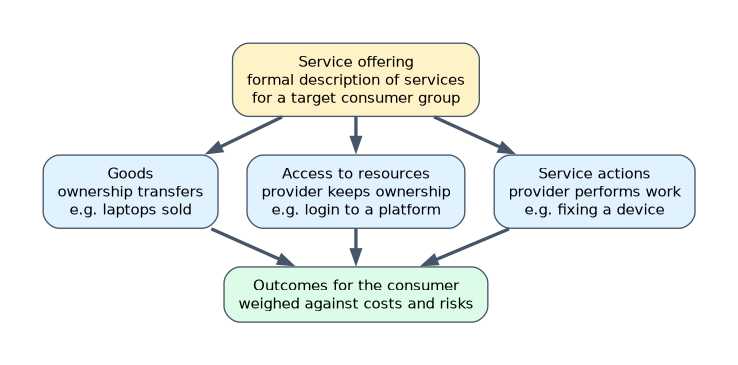 A service offering is a formal description of one or more services designed to address the needs of a target consumer group. Service interactions are the exchanges between provider and consumer through which the offering is provided and used.
An offering can include three kinds of element:
| Element | What happens | Example |
|---|---|---|
| Goods | Ownership of a resource is transferred to the consumer | Laptops sold to the consumer, who then owns and looks after them |
| Access to resources | The consumer may use resources the provider still owns, under agreed terms | Login access to a hosted platform |
| Service actions | The provider performs actions to meet the consumer's needs | A technician fixing a device, an agent answering a question |
The test is ownership: if it moves to the consumer, it is a good; if the provider keeps it and the consumer uses it, it is access to resources.
Value and its parts
| Term | Meaning |
|---|---|
| Value | The perceived benefits, usefulness and importance of something |
| Value co-creation | Value created together by provider and consumer through their relationship |
| Output | A tangible or intangible deliverable of an activity |
| Outcome | A result for a stakeholder, enabled by one or more outputs |
| Cost | The amount of money spent on a specific activity or resource |
| Risk | A possible event that could cause harm or loss, or make it more difficult to achieve objectives |
Example: a provider delivers a self-service portal (an output). The consumer's staff resolve requests 30 percent faster (an outcome).
How the parts contribute to value
- Outcomes add value; costs and risks taken away from the consumer add value, while those imposed on the consumer reduce it.
- Utility, warranty, user experience and sustainability together shape how valuable the consumer finds the service.
- Feedback from consumers lets the provider adjust, so value keeps being co-created over time.
When an option describes something the provider produces, it is an output. When it describes a benefit the consumer experiences, it is an outcome.
How the exam asks about this
- "Login access to a hosted platform is which element?" Access to resources.
- "Faster resolution of requests after a new portal is what?" An outcome.
- "What are the three elements of a service offering?" Goods, access to resources and service actions.
What to remember for the exam
- A service offering is a formal description of services for a target consumer group.
- Goods transfer ownership; access to resources does not; service actions are work the provider performs.
- Value is perceived benefit, usefulness and importance.
- Outputs are deliverables; outcomes are results for stakeholders.
- Consumers weigh outcomes against costs and risks.
Value is defined by the consumer's perception, not by how much effort the provider put in.
Common mistakes
Confusing output and outcome. The portal is the output; the faster work is the outcome.
Calling hosted access a good. Ownership stays with the provider.
Thinking value flows one way. It is co-created.
Check yourself
What is a service offering?
A formal description of one or more services designed to address the needs of a target consumer group.
What is the difference between an output and an outcome?
An output is a deliverable of an activity; an outcome is a result for a stakeholder that outputs enable.
Which element of a service offering transfers ownership to the consumer?
Goods.
Topic 3 of 4 in Key ITIL Terms and Definitions
Test yourself on Key ITIL Terms and Definitions
The full PeopleCert ITIL 5 Foundation question bank has 527 questions, with timed practice exams and an explanation for every answer.
This study guide is independent and is not affiliated with, endorsed by, or sponsored by PeopleCert. Vendor names, certification names and exam codes are trademarks of their respective owners and are used for identification only.