IP Multicast · Topic 1 of 5
Multicast Concepts, Addressing and Traffic Flow
JN0-650 study page on IP multicast concepts: components, IPv4 and IPv6 group addresses, MAC mapping, shared and source trees, and PIM sparse mode flow.
- 6 min
- Includes a diagram
- Multicast range 224.0.0.0/4; link local 224.0.0.0/24; SSM 232.0.0.0/8; administratively scoped 239.0.0.0/8.
- IPv6:
ff00::/8, withff02::link scope andff3x::/32for SSM. - The multicast MAC starts with 01:00:5e and uses the low 23 bits; 32 groups map to one MAC.
What it is
Unicast sends a separate copy to each receiver. Broadcast sends to everyone in a segment. Multicast sends one copy toward a group of receivers, and routers replicate the packet only where the path branches.
A multicast group is an IP address in a reserved range. Receivers join a group, and a source sends to the group address. The source does not need to know who the receivers are.
How it works
Components
| Component | Role |
|---|---|
| Source | Sends traffic to a group address |
| Receiver | A host that joined the group |
| IGMP | Host to router protocol that signals group membership (IPv4) |
| MLD | The IPv6 equivalent of IGMP |
| PIM | Router to router protocol that builds the distribution trees |
| First hop router | The router connected to the source |
| Last hop router | The router connected to the receivers |
| Rendezvous point (RP) | The meeting point for sources and receivers in sparse mode |
Routers use the unicast routing table, built by an IGP, to find the way back to the source. PIM does not carry its own routes; it reuses unicast routes, which is why it is called protocol independent.
IPv4 multicast addresses
The multicast range is 224.0.0.0/4, which is 224.0.0.0 through 239.255.255.255.
| Range | Use |
|---|---|
| 224.0.0.0/24 | Link local control traffic; never forwarded by routers |
| 224.0.1.0/24 | Internetwork control, such as 224.0.1.39 and 224.0.1.40 for Auto-RP |
| 232.0.0.0/8 | Source-specific multicast (SSM) |
| 233.0.0.0/8 | GLOP addressing |
| 239.0.0.0/8 | Administratively scoped, private use inside an organization |
Well-known link local groups worth remembering:
| Address | Group |
|---|---|
| 224.0.0.1 | All hosts on the subnet |
| 224.0.0.2 | All routers on the subnet |
| 224.0.0.5 and 224.0.0.6 | OSPF routers and OSPF designated routers |
| 224.0.0.13 | PIM routers |
| 224.0.0.22 | IGMPv3 reports |
IPv6 multicast addresses
IPv6 multicast addresses start with ff00::/8. The fourth hex digit gives the scope. For example ff02::1 is all nodes on the link, ff02::2 is all routers on the link and ff02::d is all PIM routers. SSM for IPv6 uses ff3x::/32, where x is the scope.
Layer 2 mapping
An Ethernet frame to a multicast group uses a MAC address that starts with 01:00:5e. The low 23 bits of the group IP address fill the rest of the MAC address. IPv4 groups have 28 variable bits, so 32 different groups share each MAC address.
Because 32 groups share one MAC address, a switch can deliver a stream to a host that did not ask for it. The host's IP stack discards the traffic, but the link carries it.
Distribution trees
| Tree | Notation | Rooted at | Used by |
|---|---|---|---|
| Source tree (shortest path tree) | (S,G) | The source | SPT, SSM |
| Shared tree (RP tree) | (*,G) | The RP | Initial ASM state |
A tree describes which interfaces a router uses to receive and to forward. The interface toward the root is the incoming interface, and the ones toward receivers are the outgoing interface list.
Traffic flow in PIM sparse mode
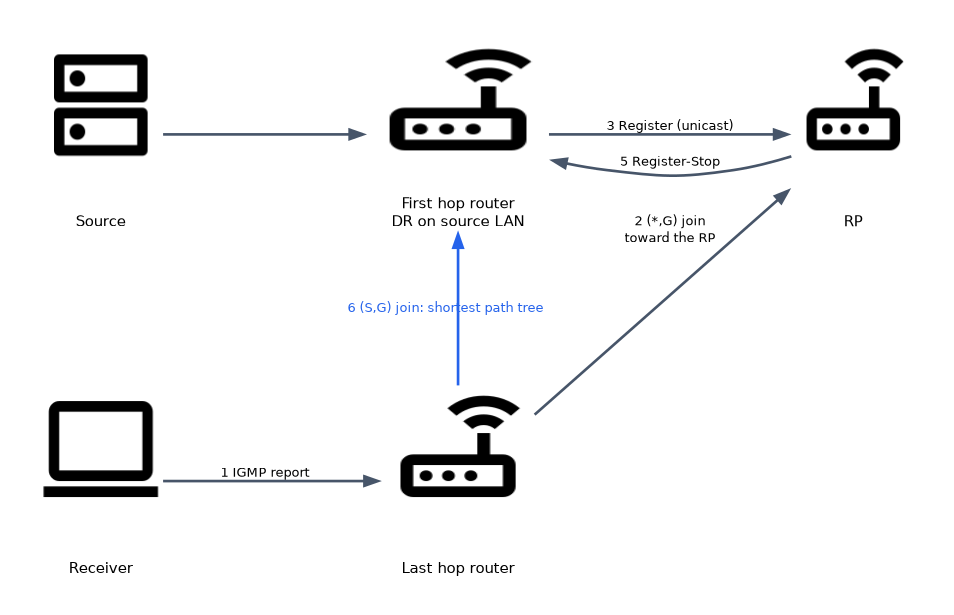 Sparse mode builds a tree only where receivers asked for one, so it fits networks where receivers are few and spread out.
- A receiver sends an IGMP report for group G.
- The last hop router sends a PIM (*,G) join toward the RP, hop by hop, building the shared tree.
- The source starts sending. Its first hop router is the designated router (DR) on the source LAN, and it encapsulates the first packets in PIM Register messages sent by unicast to the RP.
- The RP decapsulates them, sends the traffic down the shared tree, and joins the source tree (S,G) toward the source.
- When native traffic arrives at the RP, the RP sends a Register-Stop to the first hop router.
- The last hop router can switch to the shortest path tree by sending an (S,G) join toward the source. Junos does this on the first packet by default.
- After the switch, the last hop router prunes the source off the shared tree.
Picture two trees. The shared tree is the temporary meeting place through the RP, and the source tree is the direct path that traffic uses once it is established.
Other PIM modes
| Mode | Idea |
|---|---|
| Sparse (PIM-SM) | Explicit joins; needs an RP for ASM; the standard choice |
| Dense (PIM-DM) | Flood everywhere, then prune; rarely used |
| SSM | Joins go straight to the source; no RP |
Common mistakes
Expecting multicast addresses to be routable like unicast. They are group labels, not locations.
Forgetting the 32:1 MAC overlap. Different groups can share one MAC address.
Assuming routers forward 224.0.0.0/24. It is link local and stays on the segment.
Thinking the RP carries all traffic forever. Last hop routers normally switch to the source tree.
Mixing up (S,G) and (,G). (,G) is any source through the RP, (S,G) is a specific source.
What to remember for the exam
- Multicast range 224.0.0.0/4; link local 224.0.0.0/24; SSM 232.0.0.0/8; administratively scoped 239.0.0.0/8.
- IPv6:
ff00::/8, withff02::link scope andff3x::/32for SSM. - The multicast MAC starts with 01:00:5e and uses the low 23 bits; 32 groups map to one MAC.
- IGMP is host to router; PIM is router to router and uses unicast routes.
- PIM sparse mode flow: join to the RP, Register to the RP, then switch to the source tree.
- (*,G) is the shared tree; (S,G) is the source tree.
Check yourself
How many IPv4 multicast groups share one multicast MAC address?
Thirty-two, because only 23 of the 28 variable group bits go into the MAC.
What does the first hop router send to the RP when a new source starts?
PIM Register messages, unicast, carrying the source's packets, until the RP sends Register-Stop.
Which range is reserved for SSM in IPv4?
232.0.0.0/8.
Topic 1 of 5 in IP Multicast
Test yourself on IP Multicast
The full Juniper JNCIP-ENT JN0-650 question bank has 858 questions, with timed practice exams and an explanation for every answer.
This study guide is independent and is not affiliated with, endorsed by, or sponsored by Juniper. Vendor names, certification names and exam codes are trademarks of their respective owners and are used for identification only.