IP Multicast · Topic 2 of 5
ASM, SSM and Reverse Path Forwarding
JN0-650 study page on any-source and source-specific multicast, plus the RPF check on Junos: inet.0 and inet.2, RPF failures and verification commands.
- 6 min
- Includes a diagram
- ASM: (*,G) joins to an RP, any source. SSM: (S,G) joins to the source, no RP, default range 232.0.0.0/8.
- SSM needs IGMPv3 on receivers (or an SSM map) and is more secure.
- RPF: accept a packet only if it arrives on the interface used to reach its source.
What it is
Any-source multicast (ASM) lets a receiver join a group and accept traffic from any source that sends to it. It needs a rendezvous point so receivers and sources can find each other.
Source-specific multicast (SSM) lets a receiver ask for traffic from one particular source for a group, written (S,G). Because the receiver already knows the source, no RP and no shared tree are needed.
Reverse path forwarding (RPF) is the loop prevention rule for all multicast. A router accepts a multicast packet only when it arrives on the interface it would use to send unicast traffic back to the source.
How it works
ASM versus SSM
| Item | ASM | SSM |
|---|---|---|
| Receiver asks for | Group G, any source | Source S and group G |
| Join type | (*,G) toward the RP | (S,G) toward the source |
| Needs an RP | Yes | No |
| Needs MSDP between domains | Yes, to share sources | No |
| IGMP version | 1, 2 or 3 | IGMPv3 (or a mapping for IGMPv2 hosts) |
| Default address range | Everything not SSM | 232.0.0.0/8 |
| Protects from unwanted senders | No | Yes, only the named source is accepted |
SSM is simpler and more secure because there is no source discovery problem and a rogue sender cannot inject traffic. It requires receivers or an application to know the source address in advance. For a host that uses IGMPv2 and only knows the group, an SSM map on the router maps the group to a source.
On Junos, the SSM range is 232.0.0.0/8 by default. You can add more group ranges under routing-options multicast ssm-groups. PIM sparse mode must still run on the interfaces, and the receivers' interfaces must use IGMPv3 when the receiver itself signals the source.
set protocols pim interface ge-0/0/1.0 mode sparse
set protocols igmp interface ge-0/0/2.0 version 3
set routing-options multicast ssm-groups 239.99.0.0/16If a question says the receivers know the source and wants the simplest design with no RP, the answer is SSM with IGMPv3.
The RPF check
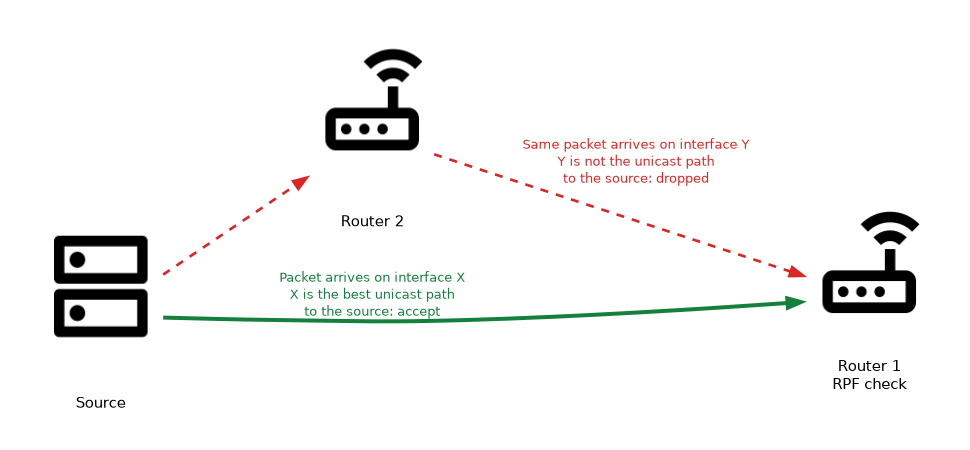 For every multicast packet, a router looks at the source address and finds the best unicast route to it. If the interface that route points out equals the interface the packet arrived on, the packet passes. If not, it is dropped. The check is done for (S,G) state against the source and for (*,G) state against the RP address.
PIM joins and prunes use the same logic. A router sends a join out of its RPF interface to the RPF neighbor toward the source or the RP, so the tree always follows the unicast path in reverse.
| Check on | Looks up |
|---|---|
| (S,G) forwarding | The route to the source S |
| (*,G) forwarding | The route to the RP address |
| PIM Join toward a source or RP | The same route, to find the RPF neighbor |
When RPF fails, the packet is silently dropped, and nothing in the configuration looks wrong. This is the single most common cause of "multicast does not work".
Which routing table does RPF use
By default, Junos uses the unicast table inet.0 for RPF. It can also use a separate table, inet.2, which holds routes used only for multicast. Routes learned with BGP family inet multicast (MBGP) are placed in inet.2 by default; other routes, such as static or interface routes, get there through a routing table group. This is useful when the unicast best path is not the path you want multicast to take. PIM uses only the first table in the import list of the routing table group configured under protocols pim rib-group, so once that points to inet.2, interface routes must be copied into inet.2 as well; there is no automatic fallback to inet.0. Use show multicast rpf to see which table PIM uses.
Common RPF failures
| Cause | Result |
|---|---|
| Asymmetric routing: unicast path differs from where the stream arrives | Traffic dropped |
| No route to the source or to the RP | No tree built |
| Source not on a directly attached PIM interface | First hop router cannot register |
| Equal cost paths | Joins and traffic can use different interfaces; Junos picks one RPF neighbor |
| PIM not enabled on the RPF interface | Join cannot be sent |
Verifying RPF
show multicast rpf
show multicast route
show pim join extensive
show route 10.1.1.10
show multicast rpf shows the RPF interface and neighbor Junos uses for each source or RP prefix. show multicast route shows the (S,G) entries with their incoming and outgoing interfaces, and show pim join extensive shows the join state and its upstream neighbor.
Common mistakes
Blaming the RP when traffic does not arrive. The RPF check is a more common cause.
Configuring SSM but leaving receivers on IGMPv2. Without an SSM map, the host cannot signal the source.
Expecting SSM to need an RP. It does not.
Forgetting that RPF follows the unicast route. If routing is asymmetric, RPF fails.
Putting multicast routes in inet.2 and expecting unicast to use them. inet.2 is only for multicast RPF.
What to remember for the exam
- ASM: (*,G) joins to an RP, any source. SSM: (S,G) joins to the source, no RP, default range 232.0.0.0/8.
- SSM needs IGMPv3 on receivers (or an SSM map) and is more secure.
- RPF: accept a packet only if it arrives on the interface used to reach its source.
- The check uses the source for (S,G) state and the RP address for (*,G) state.
inet.0is the default RPF table;inet.2holds multicast specific routes.show multicast rpfandshow multicast routeverify the check.
Check yourself
Which service model needs no rendezvous point?
SSM, because receivers join (S,G) directly toward the known source.
A multicast packet arrives on an interface that is not the best unicast path back to the source. What happens?
It fails the RPF check and the router drops it.
What does a router use for the RPF check of a (*,G) entry?
The unicast route to the RP address.
Topic 2 of 5 in IP Multicast
Test yourself on IP Multicast
The full Juniper JNCIP-ENT JN0-650 question bank has 858 questions, with timed practice exams and an explanation for every answer.
This study guide is independent and is not affiliated with, endorsed by, or sponsored by Juniper. Vendor names, certification names and exam codes are trademarks of their respective owners and are used for identification only.