Virtualization and Cloud Computing · Topic 3 of 4
Cloud Service and Deployment Models
Compare IaaS, PaaS, SaaS and desktop as a service, and tell public, private, hybrid and community clouds apart, with the shared responsibility idea.
- 4 min
- Includes a diagram
- IaaS rents infrastructure; PaaS rents a platform for apps; SaaS rents software.
- DaaS provides a hosted virtual desktop.
- In IaaS the customer manages the operating system and above.
What it is
Cloud computing means using computing resources, such as servers, storage and software, over a network from a provider instead of owning and running them yourself. You rent what you need and the provider operates the underlying equipment.
Two questions describe any cloud. The service model asks what you rent, and the deployment model asks who the cloud is shared with.
How it works
Service models
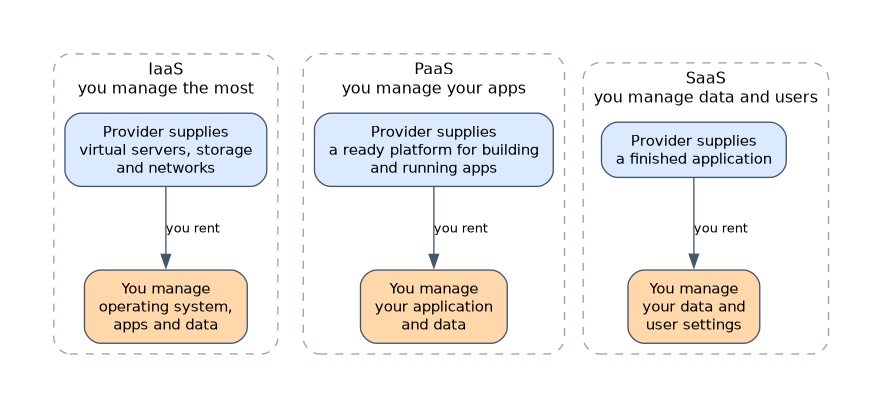 The models differ in how much the provider manages and how much you manage.
| Model | You get | You manage | Example use |
|---|---|---|---|
| Infrastructure as a service (IaaS) | Virtual servers, storage and networks | The operating system, apps and data | Hosting a custom server without buying hardware |
| Platform as a service (PaaS) | A ready platform for building and running apps | Your application and data | Developers deploying a web app |
| Software as a service (SaaS) | A finished application | Your data and user settings | Web email, online office tools, customer systems |
| Desktop as a service (DaaS) | A hosted virtual desktop | Your files and settings | A remote workforce using a virtual desktop |
From IaaS to SaaS the provider takes on more of the work. With IaaS you handle the most, and with SaaS the least.
Shared responsibility
The provider secures the facility, hardware and the layers it runs. The customer secures what it controls, such as accounts, data, access settings and, in IaaS, the operating system. The provider's security does not remove the customer's duty to set strong passwords, use multifactor authentication and manage who may see data.
Deployment models
| Model | Who uses it | Notes |
|---|---|---|
| Public cloud | Many customers share the provider's resources | Low cost, quick to start, shared hardware |
| Private cloud | One organisation only | More control, more cost; may sit in the company's own data centre or be hosted |
| Hybrid cloud | A mix of public and private, linked together | Keeps sensitive work private and uses public cloud for extra capacity |
| Community cloud | Several organisations with shared needs, such as a group of schools or agencies | Shares cost and rules among members |
A public cloud serves many customers, but their data is kept separate. A private cloud is used by a single organisation, even if a provider runs it.
Internal and external resources
Resources that sit in the organisation's own data centre are internal. Resources that sit with a provider are external. A hybrid cloud joins the two, so a company may keep a database in its own building and run web servers in a public cloud.
Choosing a model
- Choose SaaS when you only need to use finished software.
- Choose PaaS when developers want to build apps without managing servers.
- Choose IaaS when you need full control of the operating system and software.
- Choose private cloud when rules require data to stay under tight control.
- Choose hybrid when you need both control and flexible capacity.
Ask "who patches the operating system?" The customer does in IaaS; the provider does in PaaS and SaaS.
Cost model
Cloud usually replaces a large upfront purchase with regular charges that depend on use. This is flexible, but costs can grow if services are left running that are no longer needed.
What to remember for the exam
- IaaS rents infrastructure; PaaS rents a platform for apps; SaaS rents software.
- DaaS provides a hosted virtual desktop.
- In IaaS the customer manages the operating system and above.
- The provider secures its hardware and facility; the customer secures its data and access.
- Public cloud is shared by many customers; private cloud serves one organisation.
- Hybrid cloud links public and private clouds.
- Community cloud is shared by organisations with a common need.
- Cloud shifts cost from buying equipment to paying for use.
Common mistakes
Mixing up PaaS and SaaS. PaaS gives developers a platform to build on; SaaS gives users a finished application.
Thinking the provider handles everything. Customers are still responsible for their own accounts, data and settings.
Calling a private cloud one that is simply virtualised. A private cloud is for one organisation and offers cloud style self service, not just virtual machines.
Assuming public means unsafe. Public clouds can be secure when configured correctly, although the data is held off site.
Forgetting hybrid is two things joined. It needs a connection and shared management between the two parts.
Check yourself
Which service model gives you a finished application over the internet?
Software as a service (SaaS).
What is a hybrid cloud?
A mix of public and private cloud resources that work together.
In IaaS, who is responsible for patching the guest operating system?
The customer.
Topic 3 of 4 in Virtualization and Cloud Computing
Test yourself on Virtualization and Cloud Computing
The full CompTIA A+ 220-1201 question bank has 856 questions, with timed practice exams and an explanation for every answer.
This study guide is independent and is not affiliated with, endorsed by, or sponsored by CompTIA. Vendor names, certification names and exam codes are trademarks of their respective owners and are used for identification only.