Virtualization and Cloud Computing · Topic 4 of 4
Cloud Characteristics
Learn cloud traits: shared resources, rapid elasticity, scalability, metered use, high availability, on demand access and file synchronization.
- 5 min
- Includes a diagram
- Shared resources, or multi tenancy, let many customers use one pool of hardware.
- On demand self service lets customers create resources without waiting.
- Rapid elasticity adds and removes resources as demand changes.
What it is
Cloud services share a set of traits that set them apart from a traditional server room. They are quick to get, they grow and shrink, they are measured and billed by use, and they stay available even when parts fail.
The exam asks you to name the trait that a scenario describes.
How it works
Shared resources
Providers pool hardware and share it among many customers. This is also called resource pooling or multi tenancy: many tenants use the same hardware, but their data and settings are kept separate. Sharing is why cloud services can cost less than owning equipment.
Resources can be internal, within an organisation's own data centre, or external, at the provider. Hybrid setups use both.
On demand self service
A customer can create resources whenever needed, through a web portal or a programming interface, without waiting for a person at the provider to do it. A new server or storage space can be ready in minutes.
Rapid elasticity
Elasticity is the ability to add or remove resources quickly as demand changes. A shop that gets heavy web traffic at holiday time can add servers for a few days and drop them afterwards. The system can do this automatically.
Scalability
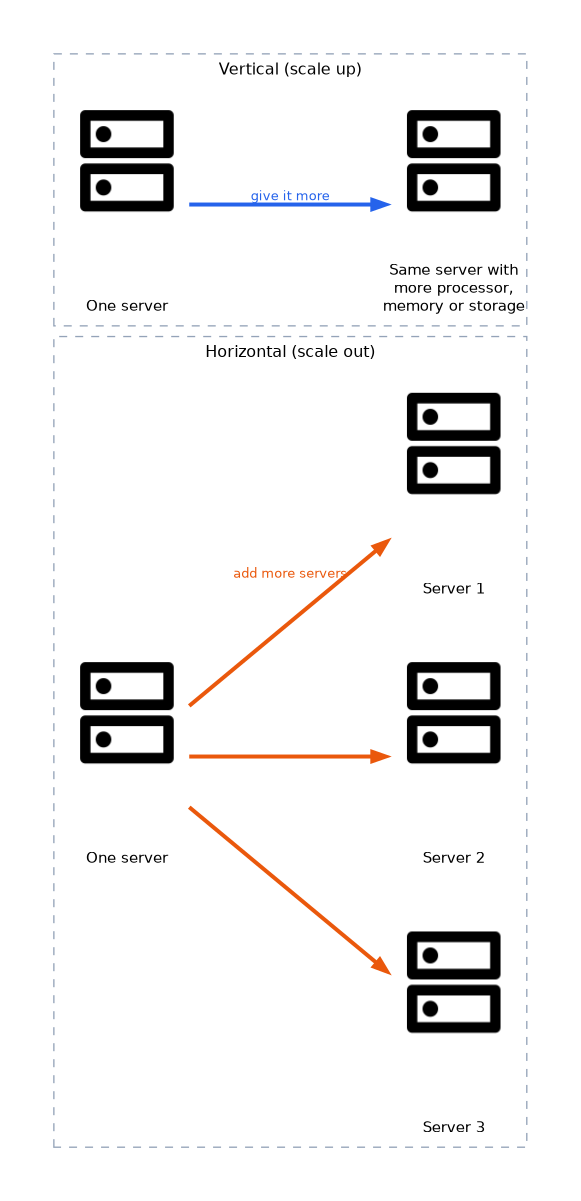 Scalability is the ability to handle growth. There are two common ways.
| Type | Meaning |
|---|---|
| Vertical (scale up) | Give one server more processor, memory or storage |
| Horizontal (scale out) | Add more servers and share the work among them |
Elasticity is about changing quickly in both directions. Scalability is about the ability to grow when needed.
Metered utilization
Cloud use is measured, and customers pay for what they use. This is also called measured service or pay as you go. It makes cost follow demand, and it gives both sides a clear record of usage.
Metering also counts data movement. Ingress is data going into the cloud, such as an upload, and is usually free.
Egress is data leaving the cloud, such as a download or a transfer to another provider, and is usually charged by the amount.
High availability
High availability means services stay up even when a part fails. Providers spread systems over several servers, data centres and regions, so the loss of one does not stop the service. Customers can add to this by placing their own systems in more than one location.
High availability is not the same as backup. Availability keeps a service running, while backups protect data against loss or damage.
File synchronization
File synchronization keeps the same files up to date across devices through a cloud storage service. When you change a file on a laptop, the new version appears on your phone and other computers. It also keeps an off site copy.
Points to know:
- A deletion or a corrupted file can sync to every device, so synchronization is not a full backup.
- Sync needs a network connection, and changes made offline sync later.
- Conflicts arise when two people edit the same file at once, and the service may keep both versions.
- Sharing settings decide who can open a file, so check them.
Sync services copy mistakes as well as good changes. If you delete a folder on one device, the deletion can spread to all, so keep separate backups of important data.
Benefits and risks
Benefits include lower upfront cost, fast start, easy growth and less equipment to maintain. Risks include dependence on the provider and the network, loss of control over where data sits, ongoing cost and the need to configure security correctly.
Connecting to cloud services
Access depends on the network. A loss of internet access can cut off cloud services, so critical sites may need a backup link. Cloud services are usually reached with a web browser or a client app over a secure connection.
What to remember for the exam
- Shared resources, or multi tenancy, let many customers use one pool of hardware.
- On demand self service lets customers create resources without waiting.
- Rapid elasticity adds and removes resources as demand changes.
- Scalability means handling growth, by scaling up or out.
- Metered utilization means paying for what you use.
- High availability keeps services running when parts fail.
- File synchronization keeps files matched across devices but is not a backup.
- Cloud access depends on the network connection.
Common mistakes
Mixing up elasticity and scalability. Elasticity is fast change both ways, while scalability is the ability to grow.
Treating sync as backup. Deleted or damaged files can sync everywhere.
Assuming high availability means no outage ever. It lowers the chance, but it does not remove it.
Ignoring the network. Cloud services fail from the user's side if the internet link fails.
Forgetting the metered bill. Unused resources left running still cost money.
Check yourself
Which trait lets a company add servers for a busy week and remove them afterwards?
Rapid elasticity.
Why is file synchronization not a backup?
Deletions and corrupted files sync to all devices, so the damage spreads.
What does metered utilization mean?
The provider measures use and customers pay for what they use.
Topic 4 of 4 in Virtualization and Cloud Computing
Test yourself on Virtualization and Cloud Computing
The full CompTIA A+ 220-1201 question bank has 856 questions, with timed practice exams and an explanation for every answer.
This study guide is independent and is not affiliated with, endorsed by, or sponsored by CompTIA. Vendor names, certification names and exam codes are trademarks of their respective owners and are used for identification only.