Snowflake for Gen AI · Topic 11 of 13
Cross-Region Inference and the CORTEX_ENABLED_CROSS_REGION Parameter
Cross-region inference for Cortex: the CORTEX_ENABLED_CROSS_REGION parameter, its values and default, who sets it, data handling and latency trade-offs.
- 4 min
- Includes a diagram
- Parameter:
CORTEX_ENABLED_CROSS_REGION; set withALTER ACCOUNTby ACCOUNTADMIN. - Values: DISABLED, ANY_REGION, cloud wide (AWS_GLOBAL and so on), regional (AWS_US and so on).
- Data stays at home; prompts and responses travel transiently; credits charged in the requesting region.
What it is
Not every model is deployed in every Snowflake region. Cross-region inference lets your account use a model that runs in another region, so a request made in your home region can be processed elsewhere. It is controlled by one account level parameter, CORTEX_ENABLED_CROSS_REGION.
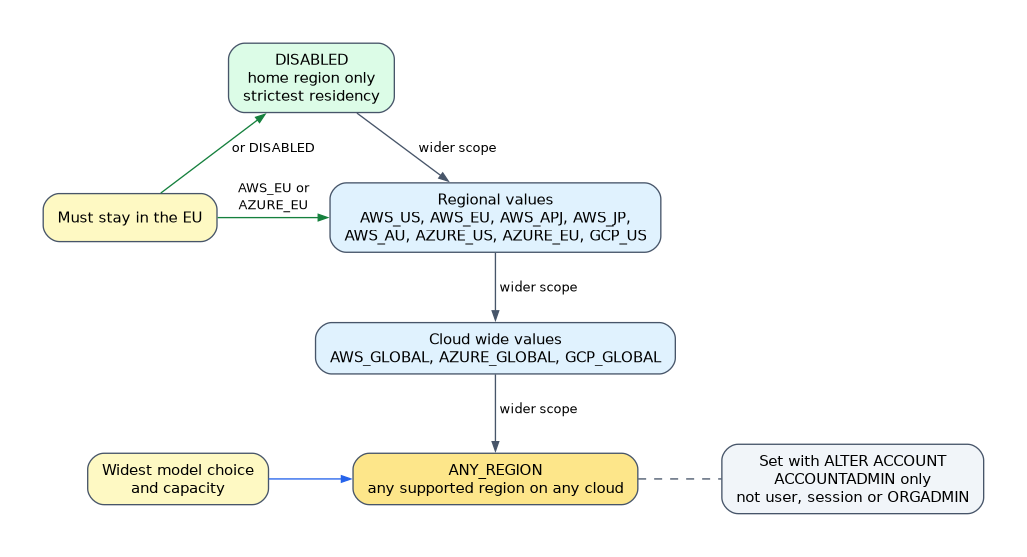
The trade is simple: wider model availability and capacity against strict data residency. The exam tests which value to choose and what actually leaves the region.
How it works
The parameter
ALTER ACCOUNT SET CORTEX_ENABLED_CROSS_REGION = 'ANY_REGION';
SHOW PARAMETERS LIKE 'CORTEX_ENABLED_CROSS_REGION' IN ACCOUNT;| Value | Meaning |
|---|---|
| DISABLED | Processing only in the account's home region; strictest residency, but only models deployed there |
| ANY_REGION | Any Snowflake supported region on any cloud; broadest models and highest capacity |
| Cloud wide values | AWS_GLOBAL, AZURE_GLOBAL, GCP_GLOBAL, or comma separated combinations; requests stay within the named cloud |
| Regional values | AWS_US, AWS_EU, AWS_APJ, AWS_JP, AWS_AU, AZURE_US, AZURE_EU, GCP_US, or combinations; requests stay within the named regions |
Only ACCOUNTADMIN can set it, with ALTER ACCOUNT. It cannot be set at the user or session level, and ORGADMIN cannot set it.
Default
New organizations created in commercial regions after March 9, 2026 default to ANY_REGION. Other commercial accounts inherit a same cloud geography value such as AWS_US or AZURE_EU. If you have data residency requirements, set it explicitly instead of relying on the default.
Do not assume DISABLED is the default. Check the current value with SHOW PARAMETERS before answering a residency question.
What moves and what does not
- Customer data stays stored only in the account's home region.
- The prompt and response go transiently to the processing region and are not persisted there.
- Inside one cloud, traffic uses the provider's private backbone. Across clouds it uses the public internet with mutual TLS (mTLS).
- Credits are consumed in the requesting region, even when processing happens elsewhere, and there are no data egress charges.
Considerations: latency and availability
When two answers both enable cross-region inference, compare the scope. A narrow value such as AWS_EU limits where prompts can travel while still widening model choice, and ANY_REGION widens it the most. The exam rewards the narrowest value that still meets the model availability need.
| Factor | Effect |
|---|---|
| Latency | Varies with infrastructure and network distance; Snowflake advises testing your own use case |
| Availability | ANY_REGION gives the widest model access; narrower values reduce model choice |
| Residency | DISABLED or a narrow regional value keeps processing close; ANY_REGION does not |
| Capacity | Broader scope gives more capacity and fewer capacity limits |
Government regions are a special case. US Commercial Gov on AWS, FedRAMP High Plus and DoD regions use AWS_US, and with ANY_REGION their requests are processed within the United States. DoD and FedRAMP High Plus regions do not route requests to each other.
Where it matters
Features that rely on models not deployed in your region, such as Cortex Analyst outside its natively supported regions, Copilot inline in regions that are not natively supported and Cortex Code, need the parameter. Cortex Fine-tuning does not support cross-region inference, and cross-region inference for Cortex Search is not available in all regions.
A request that says "must keep processing in the EU" points to AWS_EU or AZURE_EU or DISABLED, not ANY_REGION.
Common mistakes
Setting it as a user parameter. Only ACCOUNTADMIN sets it, at account level.
Thinking data is stored in the remote region. Only the transient prompt and response travel.
Expecting extra egress charges. The docs state there are none.
Choosing ANY_REGION for strict residency. Pick DISABLED or a regional value.
Forgetting it for fine-tuned models. They are not supported; the model runs in its own region.
What to remember for the exam
- Parameter:
CORTEX_ENABLED_CROSS_REGION; set withALTER ACCOUNTby ACCOUNTADMIN. - Values: DISABLED, ANY_REGION, cloud wide (AWS_GLOBAL and so on), regional (AWS_US and so on).
- Data stays at home; prompts and responses travel transiently; credits charged in the requesting region.
- Latency varies; test it. ANY_REGION gives the most models.
- Cross-cloud traffic uses mTLS over the public internet.
Check yourself
Who can set
CORTEX_ENABLED_CROSS_REGION?ACCOUNTADMIN, using
ALTER ACCOUNT; not users, sessions or ORGADMIN.Where are credits charged when a request is processed in another region?
In the requesting (home) region.
Which value keeps all inference in the home region?
DISABLED.
Topic 11 of 13 in Snowflake for Gen AI
Test yourself on Snowflake for Gen AI
The full Snowflake GES-C02 question bank has 585 questions, with timed practice exams and an explanation for every answer.
This study guide is independent and is not affiliated with, endorsed by, or sponsored by Snowflake. Vendor names, certification names and exam codes are trademarks of their respective owners and are used for identification only.