Managing Products with Agility · Topic 2 of 5
Product Value and Evidence-Based Management
Product value for PSPO I: the Product Owner as value maximizer, outcomes over output, and the four Key Value Areas of Evidence-Based Management.
- 4 min
- Includes a diagram
- The Product Owner is accountable for maximizing value; how varies by organization.
- Measure outcomes, not output.
- EBM Key Value Areas: Current Value, Unrealized Value, Time to Market, Ability to Innovate.
What it is
The Product Owner is accountable for maximizing the value of the product resulting from the work of the Scrum Team. The Scrum Guide notes that how this is done may vary widely across organizations, Scrum Teams and individuals. Value is not the amount of work done; it is what the product achieves for its customers and for the organization.
Scrum.org's Evidence-Based Management (EBM) guidance gives a way to measure value with evidence instead of opinion.
How it works
Output versus outcome
| Output | Outcome |
|---|---|
| Number of items completed | Customers who use the new feature |
| Velocity | Customer satisfaction |
| Lines of code | Revenue or cost saved |
| Hours worked | Time for customers to get what they need |
Output shows activity; outcomes show value. A team can finish many items that nobody uses. Velocity is not a measure of value, and it should not be used to compare teams.
How the Product Owner maximizes value
- Ordering the Product Backlog so the most valuable work comes first.
- Releasing usable Increments early so value reaches users sooner and the team learns sooner.
- Not building items that will not add enough value. Removing an item from the Product Backlog can add more value than building it.
- Keeping quality high. The Definition of Done protects the product; quality does not decrease during the Sprint.
- Measuring results after each release and adapting the Product Backlog.
The four Key Value Areas
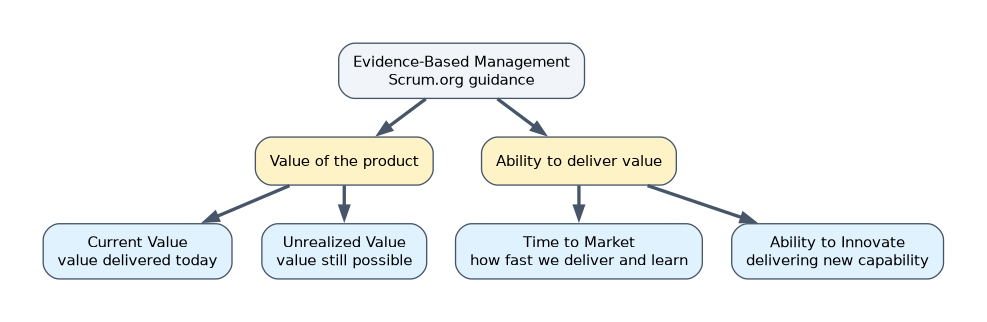 EBM looks at value through four Key Value Areas (KVAs):
| Key Value Area | Question it answers | Example measures |
|---|---|---|
| Current Value | How much value does the product deliver today? | Customer satisfaction, revenue per employee, customer usage |
| Unrealized Value | How much more value could the product deliver? | Market share, the gap between current and desired customer satisfaction |
| Time to Market | How quickly can the organization deliver new value and learn? | Release frequency, lead time, cycle time |
| Ability to Innovate | How well can the organization deliver new capabilities? | Technical debt, defect trends, time spent on new work |
Current Value and Unrealized Value describe the value of the product. Time to Market and Ability to Innovate describe the organization's ability to deliver value. A product with high Current Value but low Ability to Innovate may struggle to respond to change.
Technical debt and value
Technical debt reduces Ability to Innovate: more time goes into keeping the product working and less into new value. Making technical debt transparent and dealing with it through the Product Backlog is part of protecting future value. The Product Owner orders that work like any other item.
A worked example
A Product Owner has two options for the next Sprints: a new reporting feature many stakeholders ask for, or reducing the time it takes to release. Release frequency is once per quarter, so learning is slow. Improving Time to Market would let the team test every later idea faster. Weighing current value against the ability to deliver value, the Product Owner orders the release improvement first and explains the decision at the Sprint Review.
When a question compares a measure of activity (velocity, hours, items done) with a measure of customer result (satisfaction, usage, revenue), the customer result is the better measure of value.
How the exam asks about this
- "Who is accountable for maximizing the value of the product?" The Product Owner.
- "Is velocity a good measure of value?" No; it measures output, not value.
- "Which Key Value Area covers how fast the organization can learn from customers?" Time to Market.
What to remember for the exam
- The Product Owner is accountable for maximizing value; how varies by organization.
- Measure outcomes, not output.
- EBM Key Value Areas: Current Value, Unrealized Value, Time to Market, Ability to Innovate.
- Releasing usable Increments sooner speeds up learning.
- Not building low value items is also a way to maximize value.
Comparing teams by velocity encourages inflated estimates and says nothing about the value they delivered.
Common mistakes
Measuring value by items completed. That is output.
Ignoring technical debt. It lowers Ability to Innovate and future value.
Thinking every stakeholder request adds value. Saying no, or not yet, is part of the job.
Check yourself
Name the four Key Value Areas of Evidence-Based Management.
Current Value, Unrealized Value, Time to Market and Ability to Innovate.
Why is velocity not a measure of value?
It measures output, the amount of work done, not the outcome for customers.
Which Key Value Area does growing technical debt hurt?
Ability to Innovate.
Topic 2 of 5 in Managing Products with Agility
Test yourself on Managing Products with Agility
The full Scrum.org PSPO I question bank has 1,065 questions, with timed practice exams and an explanation for every answer.
This study guide is independent and is not affiliated with, endorsed by, or sponsored by Scrum.org. Vendor names, certification names and exam codes are trademarks of their respective owners and are used for identification only.