Understanding and Applying the Scrum Framework · Topic 2 of 5
The Scrum Team and Its Accountabilities
The Scrum Team for PSM I: size, cross-functional and self-managing teams, and the accountabilities of the Developers, Product Owner and Scrum Master.
- 4 min
- Includes a diagram
- One Scrum Master, one Product Owner, Developers; no sub-teams or hierarchies.
- Typically 10 or fewer people; cross-functional and self-managing.
- The whole Scrum Team is accountable for a valuable, useful Increment each Sprint.
What it is
The fundamental unit of Scrum is a small team of people, a Scrum Team. It consists of one Scrum Master, one Product Owner and Developers. Within a Scrum Team there are no sub-teams or hierarchies. It is a cohesive unit of professionals focused on one objective at a time, the Product Goal. The Scrum Guide defines three accountabilities, not job titles.
How it works
The team as a whole
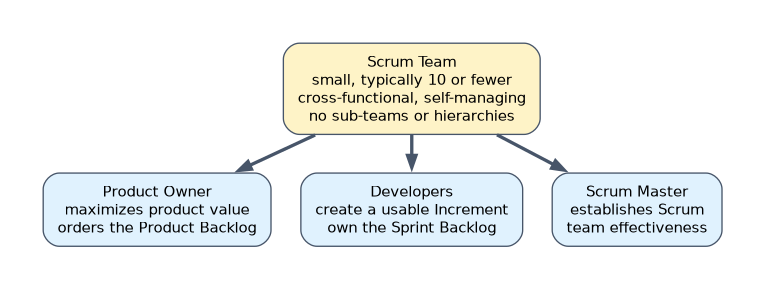
- Cross-functional: the members have all the skills necessary to create value each Sprint.
- Self-managing: they internally decide who does what, when and how.
- Small: small enough to remain nimble and large enough to complete significant work within a Sprint, typically 10 or fewer people. If Scrum Teams become too large, they should consider reorganizing into multiple cohesive Scrum Teams focused on the same product, sharing the same Product Goal, Product Backlog and Product Owner.
- Responsible for all product-related activities, from stakeholder collaboration, verification, maintenance and operation to experimentation, research and development.
- The entire Scrum Team is accountable for creating a valuable, useful Increment every Sprint.
Developers
Developers are the people committed to creating any aspect of a usable Increment each Sprint. They are always accountable for:
- Creating a plan for the Sprint, the Sprint Backlog.
- Instilling quality by adhering to a Definition of Done.
- Adapting their plan each day toward the Sprint Goal.
- Holding each other accountable as professionals.
Product Owner
The Product Owner is accountable for maximizing the value of the product resulting from the work of the Scrum Team, and for effective Product Backlog management:
- Developing and explicitly communicating the Product Goal.
- Creating and clearly communicating Product Backlog items.
- Ordering Product Backlog items.
- Ensuring that the Product Backlog is transparent, visible and understood.
The Product Owner may do this work or delegate it, but remains accountable. The Product Owner is one person, not a committee. Those wanting to change the Product Backlog can do so by trying to convince the Product Owner.
Scrum Master
The Scrum Master is accountable for establishing Scrum as defined in the Scrum Guide and for the Scrum Team's effectiveness. Scrum Masters are true leaders who serve the Scrum Team and the larger organization.
| Serves | How |
|---|---|
| The Scrum Team | Coaching self-management and cross-functionality; helping focus on high-value Increments that meet the Definition of Done; causing the removal of impediments; ensuring all events take place and are positive, productive and kept within the timebox |
| The Product Owner | Helping find techniques for Product Goal definition and Product Backlog management; helping the team understand the need for clear, concise items; helping establish empirical product planning; facilitating stakeholder collaboration as requested or needed |
| The organization | Leading, training and coaching Scrum adoption; planning and advising Scrum implementations; helping people understand an empirical approach; removing barriers between stakeholders and Scrum Teams |
The Scrum Master does not assign work, approve the Sprint Backlog or own the Product Backlog. Options that give the Scrum Master these powers are distractors.
How the exam asks about this
- "Who decides how many items to select for the Sprint?" The Developers.
- "Who is accountable for ordering the Product Backlog?" The Product Owner.
- "Who is accountable for the Scrum Team's effectiveness?" The Scrum Master.
What to remember for the exam
- One Scrum Master, one Product Owner, Developers; no sub-teams or hierarchies.
- Typically 10 or fewer people; cross-functional and self-managing.
- The whole Scrum Team is accountable for a valuable, useful Increment each Sprint.
- The Product Owner is one person and remains accountable even when delegating.
- The Scrum Master serves the team, the Product Owner and the organization.
"Developers" in Scrum does not mean only programmers. It includes anyone who creates any aspect of the Increment, whatever their specialism.
Common mistakes
Using 2017 terms. The Scrum Guide 2020 says Developers, not "Development Team".
Making the Product Owner a committee. It is one person.
Treating the Scrum Master as a manager. The Scrum Master serves and leads, but does not direct the work.
Check yourself
What are the three accountabilities in a Scrum Team?
Developers, Product Owner and Scrum Master.
How can a stakeholder change the Product Backlog?
By trying to convince the Product Owner.
What does self-managing mean for a Scrum Team?
The team internally decides who does what, when and how.
Topic 2 of 5 in Understanding and Applying the Scrum Framework
Test yourself on Understanding and Applying the Scrum Framework
The full Scrum.org PSM I question bank has 811 questions, with timed practice exams and an explanation for every answer.
This study guide is independent and is not affiliated with, endorsed by, or sponsored by Scrum.org. Vendor names, certification names and exam codes are trademarks of their respective owners and are used for identification only.