Understanding and Applying the Scrum Framework · Topic 1 of 5
Empiricism and the Scrum Values
Scrum theory for PSM I: empiricism and lean thinking, the three pillars of transparency, inspection and adaptation, and the five Scrum Values.
- 3 min
- Includes a diagram
- Scrum is founded on empiricism and lean thinking.
- Empiricism: knowledge comes from experience and decisions based on what is observed.
- Three pillars: transparency, inspection, adaptation.
What it is
Scrum is founded on empiricism and lean thinking. Empiricism asserts that knowledge comes from experience and making decisions based on what is observed. Lean thinking reduces waste and focuses on the essentials. Scrum uses an iterative, incremental approach to optimize predictability and control risk. The Scrum Values of commitment, focus, openness, respect and courage give the pillars of empiricism the trust they need to work.
How it works
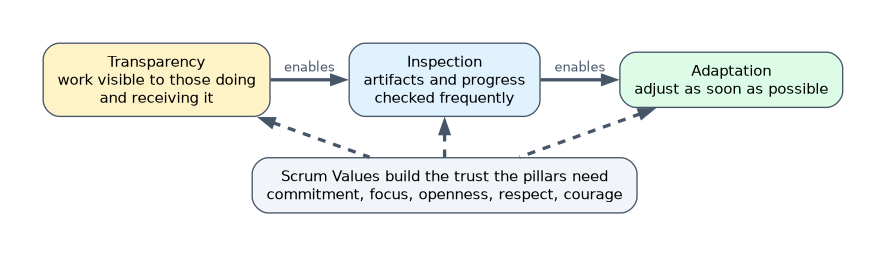
The three pillars
| Pillar | Meaning |
|---|---|
| Transparency | The emergent process and work must be visible to those performing the work as well as those receiving it. Important decisions are based on the perceived state of the three artifacts |
| Inspection | The artifacts and progress toward agreed goals must be inspected frequently and diligently to detect potentially undesirable variances or problems |
| Adaptation | If any aspects of a process deviate outside acceptable limits, or the resulting product is unacceptable, the process or materials must be adjusted as soon as possible to minimize further deviation |
The pillars depend on each other:
- Transparency enables inspection. Inspection without transparency is misleading and wasteful.
- Inspection enables adaptation. Inspection without adaptation is considered pointless.
- Adaptation becomes more difficult when the people involved are not empowered or self-managing.
The five Scrum events are the formal opportunities for inspection and adaptation.
The Scrum Values
| Value | What it looks like |
|---|---|
| Commitment | The Scrum Team commits to achieving its goals and to supporting each other |
| Focus | The primary focus is on the work of the Sprint, to make the best possible progress toward these goals |
| Openness | The Scrum Team and its stakeholders are open about the work and the challenges |
| Respect | Scrum Team members respect each other to be capable, independent people |
| Courage | Scrum Team members have the courage to do the right thing and to work on tough problems |
When these values are embodied by the Scrum Team and the people they work with, the empirical pillars come to life, building trust.
If a scenario shows a team hiding problems or reporting only good news, the issue is transparency and the value of openness. Fixes that make the real state visible are usually the right answer.
How the exam asks about this
- "What are the three pillars of empiricism?" Transparency, inspection and adaptation.
- "When should adaptation happen?" As soon as possible, to minimize further deviation.
- "Which value is about doing the right thing and working on tough problems?" Courage.
What to remember for the exam
- Scrum is founded on empiricism and lean thinking.
- Empiricism: knowledge comes from experience and decisions based on what is observed.
- Three pillars: transparency, inspection, adaptation.
- Five values: commitment, focus, openness, respect, courage.
- Events are the formal opportunities to inspect and adapt.
Inspection without adaptation is pointless. A team that inspects at every event but changes nothing is not using empiricism.
Common mistakes
Listing "planning" or "control" as a pillar. The pillars are transparency, inspection and adaptation.
Waiting until the next Sprint to adapt. Adjust as soon as possible.
Treating the values as optional extras. They make the pillars work.
Check yourself
What does empiricism assert?
That knowledge comes from experience and making decisions based on what is observed.
What does transparency enable?
Inspection; inspection without transparency is misleading and wasteful.
Name the five Scrum Values.
Commitment, focus, openness, respect and courage.
Topic 1 of 5 in Understanding and Applying the Scrum Framework
Test yourself on Understanding and Applying the Scrum Framework
The full Scrum.org PSM I question bank has 811 questions, with timed practice exams and an explanation for every answer.
This study guide is independent and is not affiliated with, endorsed by, or sponsored by Scrum.org. Vendor names, certification names and exam codes are trademarks of their respective owners and are used for identification only.