Managing Products with Agility · Topic 1 of 3
Product Value, Stakeholders and Customers
Product value for PSM I: the Product Owner as value maximizer, measuring value with evidence, and working with stakeholders at the Sprint Review.
- 3 min
- Includes a diagram
- The Product Owner is accountable for maximizing product value.
- The organization must respect the Product Owner's decisions.
- An Increment must be usable to provide value.
What it is
In Scrum, the Product Owner is accountable for maximizing the value of the product resulting from the work of the Scrum Team. Value is judged by the people the product serves, so the Scrum Team works closely with stakeholders and customers, above all at the Sprint Review, to learn what to do next.
How it works
Value and the Product Owner
- How the Product Owner maximizes value may vary widely across organizations, Scrum Teams and individuals.
- For Product Owners to succeed, the entire organization must respect their decisions. Those decisions are visible in the content and ordering of the Product Backlog, and through the inspectable Increment at the Sprint Review.
- In order to provide value, the Increment must be usable; delivering usable Increments to users sooner lets the team learn sooner.
Measuring value with evidence
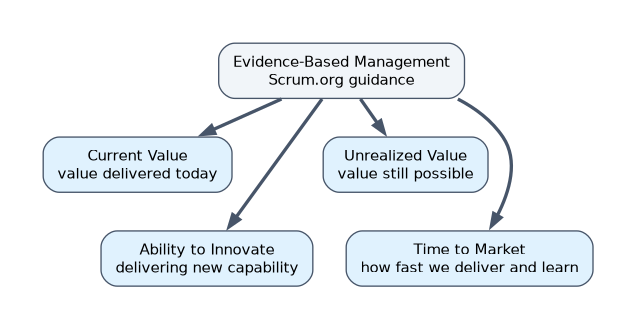 Scrum.org's Evidence-Based Management (EBM) guidance helps organizations measure value rather than output. It looks at four Key Value Areas:
| Key Value Area | Question |
|---|---|
| Current Value | How much value does the product deliver today? |
| Unrealized Value | How much more value could it deliver? |
| Ability to Innovate | How well can the organization deliver new capabilities? |
| Time to Market | How quickly can it deliver and learn? |
Output measures such as the number of items completed say little about value. Outcomes such as customer satisfaction, usage and revenue say more.
Stakeholders and customers
- Customers use or pay for the product; stakeholders are anyone with an interest in it, such as users, sponsors, managers and other teams.
- At the Sprint Review, the Scrum Team presents results to key stakeholders and they collaborate on what to do next. The Product Backlog may be adjusted.
- Stakeholders who want to change the Product Backlog do so by trying to convince the Product Owner.
- The Scrum Master helps by facilitating stakeholder collaboration as requested or needed and by removing barriers between stakeholders and Scrum Teams.
- Stakeholders do not attend the Daily Scrum as participants; the Scrum Team may invite people to Sprint Planning to give advice.
If a stakeholder bypasses the Product Owner and asks Developers to add work in the middle of a Sprint, the answer is to direct the request to the Product Owner, not to accept or refuse it without them.
How the exam asks about this
- "Who is accountable for maximizing the value of the product?" The Product Owner.
- "Where do stakeholders and the Scrum Team collaborate on what to do next?" At the Sprint Review.
- "Which is a better measure of value: items completed or customer satisfaction?" Customer satisfaction, an outcome.
What to remember for the exam
- The Product Owner is accountable for maximizing product value.
- The organization must respect the Product Owner's decisions.
- An Increment must be usable to provide value.
- Measure outcomes, not just output; EBM has four Key Value Areas.
- Stakeholders influence the Product Backlog through the Product Owner and the Sprint Review.
Velocity or the number of completed items is not a measure of value. A team can finish many items that nobody uses.
Common mistakes
Letting stakeholders add work directly to the Sprint. Go through the Product Owner.
Measuring value by output. Outcomes matter.
Treating the Sprint Review as a sign-off meeting. It is a working session.
Check yourself
Who is accountable for maximizing the value of the product?
The Product Owner.
What must the organization do for the Product Owner to succeed?
Respect the Product Owner's decisions.
Name the four Key Value Areas of Evidence-Based Management.
Current Value, Unrealized Value, Ability to Innovate and Time to Market.
Topic 1 of 3 in Managing Products with Agility
Test yourself on Managing Products with Agility
The full Scrum.org PSM I question bank has 811 questions, with timed practice exams and an explanation for every answer.
This study guide is independent and is not affiliated with, endorsed by, or sponsored by Scrum.org. Vendor names, certification names and exam codes are trademarks of their respective owners and are used for identification only.