Process · Topic 7 of 12
Earned Value Management
Master the earned value formulas PV, EV, AC, CV, SV, CPI, SPI, EAC, ETC, VAC and TCPI with a worked example and guidance for choosing the right EAC.
- 5 min
- Includes a diagram
- CV = EV - AC and SV = EV - PV, with positive meaning good.
- CPI = EV / AC and SPI = EV / PV, with above 1 meaning good.
- EAC = BAC / CPI when current cost performance continues.
What it is
Earned value management (EVM) measures project performance by comparing three things: what you planned to do, what you actually did and what it cost. It combines scope, schedule and cost in one set of numbers, so you can tell objectively whether a project is ahead or behind and over or under budget.
It is mainly a predictive technique, although the ideas can be applied to agile work with release or story point based measures.
How it works
The three inputs
| Term | Meaning |
|---|---|
| BAC (budget at completion) | Total approved budget for the work |
| PV (planned value) | Budget for the work scheduled to be done by now |
| EV (earned value) | Budget for the work actually completed by now |
| AC (actual cost) | Real cost of the work done by now |
EV is measured in budget terms, not in money actually spent. Percent complete is EV divided by BAC.
Variances and indices
| Measure | Formula | Positive or above 1 means |
|---|---|---|
| Cost variance (CV) | EV - AC | Under budget |
| Schedule variance (SV) | EV - PV | Ahead of schedule |
| Cost performance index (CPI) | EV / AC | Getting more value than money spent |
| Schedule performance index (SPI) | EV / PV | Progressing faster than planned |
A memory aid is that EV always comes first in the formula. A negative variance, or an index below 1, is bad. Indices of exactly 1 and variances of zero mean on plan.
Forecasting
The estimate at completion (EAC) is the forecast final cost. The formula depends on the assumption you make about future performance.
| Situation | EAC formula |
|---|---|
| Past variance is typical and will continue | BAC / CPI |
| Variance was a one off, and the rest goes to plan | AC + (BAC - EV) |
| Both cost and schedule performance affect the rest | AC + (BAC - EV) / (CPI x SPI) |
| The original estimate is no longer valid | AC + new bottom up ETC |
Then the remaining measures follow.
| Measure | Formula |
|---|---|
| Estimate to complete (ETC) | EAC - AC (or a fresh bottom up estimate) |
| Variance at completion (VAC) | BAC - EAC |
| TCPI to meet BAC | (BAC - EV) / (BAC - AC) |
| TCPI to meet EAC | (BAC - EV) / (EAC - AC) |
The to complete performance index (TCPI) shows the cost efficiency required on the remaining work. A TCPI above 1 means the team must perform better than so far, and a figure far above 1 suggests the target is unrealistic.
Worked example
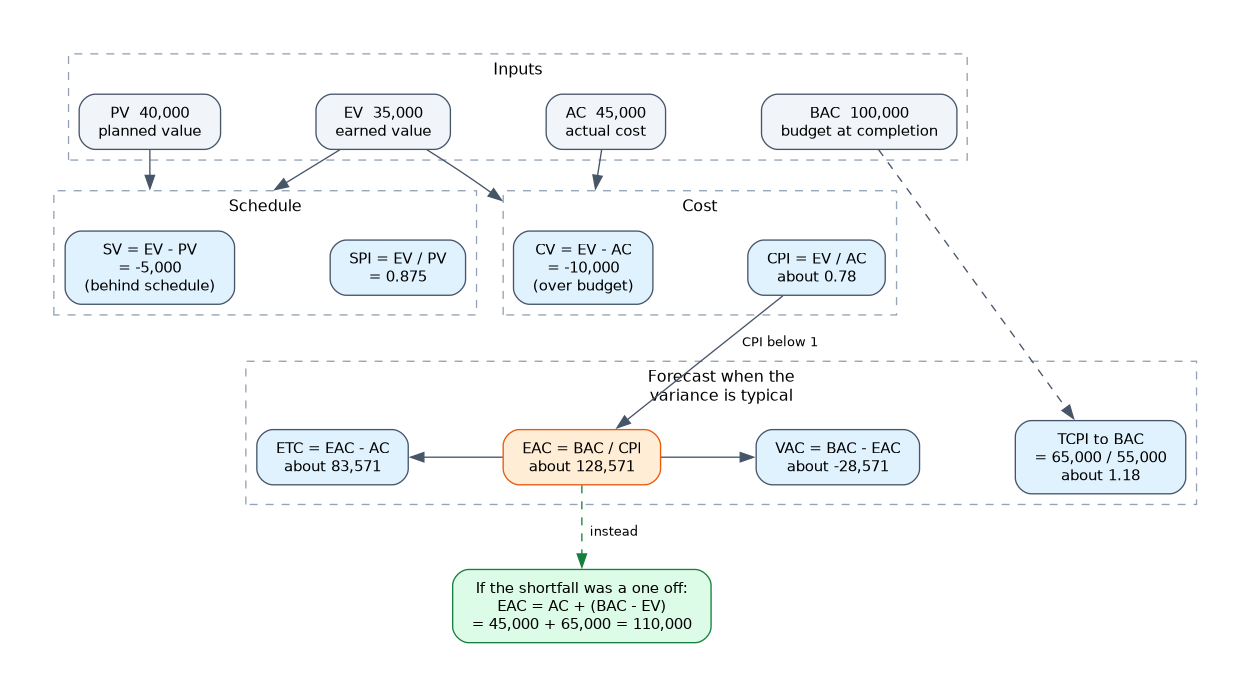 Suppose BAC = 100,000, PV = 40,000, EV = 35,000 and AC = 45,000.
| Measure | Calculation | Result |
|---|---|---|
| CV | 35,000 - 45,000 | -10,000 (over budget) |
| SV | 35,000 - 40,000 | -5,000 (behind schedule) |
| CPI | 35,000 / 45,000 | about 0.78 |
| SPI | 35,000 / 40,000 | 0.875 |
| EAC (typical) | 100,000 / 0.7778 | about 128,571 |
| ETC | 128,571 - 45,000 | about 83,571 |
| VAC | 100,000 - 128,571 | about -28,571 |
| TCPI to BAC | 65,000 / 55,000 | about 1.18 |
If the shortfall was a one off, EAC = 45,000 + 65,000 = 110,000 instead. The choice of formula is a judgment stated in the question, so read for clues such as "will continue at the current rate".
Reading the picture
SV is measured in money terms and loses meaning at the end, because EV and PV both reach BAC. SPI behaves better late in the project. Plot PV, EV and AC as S curves over time to see trends: EV below PV means behind, and AC above EV means overspending.
Using EVM in agile and hybrid work
Agile projects use burndown, burnup and velocity to show progress, but earned value ideas still apply when budget, release scope and time are tracked. For a hybrid project, EV can be calculated on the predictive parts.
Write the formulas as CV and SV first (subtract), then CPI and SPI (divide), keeping EV first every time, and check the sign of the result against the story in the question.
What to remember for the exam
- CV = EV - AC and SV = EV - PV, with positive meaning good.
- CPI = EV / AC and SPI = EV / PV, with above 1 meaning good.
- EAC = BAC / CPI when current cost performance continues.
- EAC = AC + (BAC - EV) when the variance is atypical.
- EAC = AC + (BAC - EV) / (CPI x SPI) when cost and schedule both drive the rest.
- ETC = EAC - AC, and VAC = BAC - EAC.
- TCPI = (BAC - EV) / (BAC - AC) to meet BAC, or (BAC - EV) / (EAC - AC) to meet EAC.
- Percent complete = EV / BAC.
- Read which assumption the question gives before choosing an EAC formula.
Common mistakes
Subtracting in the wrong order. CV is EV minus AC, and getting it backwards flips the meaning.
Dividing the wrong way. CPI is EV over AC, not AC over EV.
Using AC as earned value. Money spent is not progress, and EV is the value of the work completed.
Picking the wrong EAC. If the question says the problem will not recur, use the atypical formula.
Reading a good SV at the end as success. SV drifts to zero when work is finished, even if the project was late.
Do not confuse the TCPI denominator. For BAC it is BAC minus AC, and for EAC it is EAC minus AC.
Check yourself
What is the cost performance index if EV = 80 and AC = 100?
CPI = 80 / 100 = 0.8, which means over budget.
Which EAC formula applies when the current variance is expected to continue?
EAC = BAC / CPI.
What does VAC tell you?
The difference between the original budget and the forecast final cost, calculated as BAC - EAC, where a negative value means an overrun.
Topic 7 of 12 in Process
Test yourself on Process
The full PMI PMP question bank has 1,463 questions, with timed practice exams and an explanation for every answer.
This study guide is independent and is not affiliated with, endorsed by, or sponsored by PMI. Vendor names, certification names and exam codes are trademarks of their respective owners and are used for identification only.