Process · Topic 6 of 12
Cost Estimating and Budgeting
Estimate costs with analogous, parametric, bottom up and three point methods, set contingency and management reserves, and build the cost baseline.
- 5 min
- Includes a diagram
- Bottom up is the most accurate, analogous the quickest, and parametric uses rates and quantities.
- Beta (PERT) estimate = (O + 4M + P) / 6, triangular = (O + M + P) / 3, standard deviation = (P - O) / 6.
- Contingency reserve is inside the cost baseline for known risks.
What it is
Managing project finance means working out what the project will cost, setting a budget the organization approves and keeping spending under control. It begins with cost estimates for the work, adds reserves for uncertainty and ends with a cost baseline used for measuring performance.
The next page covers earned value, which uses the baseline to measure how the project is doing against it.
How it works
Estimating techniques
| Technique | How it works | Accuracy and use |
|---|---|---|
| Analogous | Uses actual cost of a similar past project | Fast and cheap, less accurate, good early |
| Parametric | Uses a unit rate times a quantity, or a statistical relationship | More accurate when data is sound |
| Bottom up | Estimates each work package, then adds them up | Most accurate, takes the most effort |
| Three point | Uses optimistic, most likely and pessimistic values | Reflects uncertainty |
| Expert judgment | Relies on experienced people | Often combined with other methods |
Estimates are usually expressed as ranges that narrow as the project advances. An early rough order of magnitude estimate has a wide range, and a later definitive estimate has a narrow one.
Three point estimates
With three values, the project manager can calculate an expected cost or duration. With O for optimistic, M for most likely and P for pessimistic:
| Method | Formula |
|---|---|
| Triangular | (O + M + P) / 3 |
| Beta (PERT, program evaluation and review technique) | (O + 4M + P) / 6 |
| Standard deviation | (P - O) / 6 |
For example, with O = 10, M = 14 and P = 24, the beta estimate is (10 + 56 + 24) / 6 = 15, and the standard deviation is (24 - 10) / 6, which is about 2.3. A larger standard deviation means more uncertainty.
Reserves
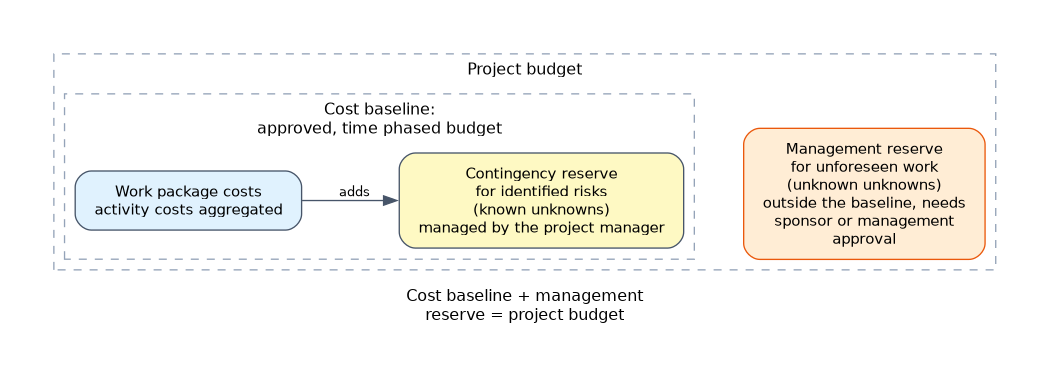 Reserves cover uncertainty, and they come in two kinds.
| Reserve | Covers | Where it sits |
|---|---|---|
| Contingency reserve | Identified risks, the known unknowns | Included in the cost baseline, managed by the project manager |
| Management reserve | Unforeseen work, the unknown unknowns | Outside the cost baseline, released with sponsor or management approval |
Cost baseline plus management reserve equals the project budget. The baseline is the approved, time phased budget and excludes management reserve.
Building the budget
The budget process aggregates activity costs into work packages, adds contingency, and then rolls the figures up to the project level. A funding limit reconciliation checks that spending per period does not exceed available funding. Where the profile of spending does not match the funding, the schedule may need adjusting.
The result is displayed as an S shaped curve of cumulative planned cost against time. This curve is the basis for earned value work.
Costs across the lifecycle
Life cycle costing looks at the total cost of the product, including operating and maintenance costs, not just the project costs. Value engineering seeks lower cost for the same function. Sunk costs, money already spent, should not influence whether to continue.
Agile estimating and budgeting
Agile teams estimate in relative sizes, such as story points, and measure how many points they complete per sprint, called velocity. A team with a steady cost per sprint can forecast cost by multiplying sprint cost by the number of sprints needed. Funding is often released in stages, so the organization can stop if value is not appearing.
Controlling cost
Control cost compares actual spending with the baseline, analyzes variances, and forecasts the final cost. Changes to the baseline need approval through change control. The project manager reports early when costs trend away from the plan.
When someone wants a quick estimate and little information exists, an analogous or parametric figure with a stated range is usually the sensible answer.
Planning financial reporting
Decide in advance how financial information will be reported. The plan states which reports are needed, how often, and who receives them, such as the sponsor, the finance department and governance bodies. It links reports to the cost accounts so that figures reconcile with the organization's accounting records.
It also includes forecasts, such as estimate at completion, and cash flow reporting, which shows when money must be available. Align the format and timing with the finance department's reporting cycle.
What to remember for the exam
- Bottom up is the most accurate, analogous the quickest, and parametric uses rates and quantities.
- Beta (PERT) estimate = (O + 4M + P) / 6, triangular = (O + M + P) / 3, standard deviation = (P - O) / 6.
- Contingency reserve is inside the cost baseline for known risks.
- Management reserve is outside the baseline for unknown unknowns and needs approval to use.
- Budget = cost baseline + management reserve.
- Sunk cost should not drive decisions.
- Agile estimating uses relative sizing and velocity, with staged funding.
- Estimates become more accurate as information increases.
Common mistakes
Putting management reserve in the baseline. It sits outside the baseline, and the project manager cannot spend it alone.
Using the wrong divisor. Beta divides by 6 and triangular divides by 3.
Counting sunk costs. Past spending is gone, so decide on future cost and value.
Treating an early estimate as a commitment. Early figures carry wide ranges and should be refined.
Forgetting operating cost. The cheapest project can create an expensive product to run.
Reserves are not free money. They need justification and tracking, and using management reserve requires formal approval.
Check yourself
Calculate the beta estimate for O = 6, M = 9 and P = 18.
(6 + 36 + 18) / 6 = 10.
Where does management reserve sit relative to the cost baseline?
Outside it, and the budget is the baseline plus management reserve.
Which estimating technique is usually the most accurate?
Bottom up estimating, because it estimates each work package and totals them.
Topic 6 of 12 in Process
Test yourself on Process
The full PMI PMP question bank has 1,463 questions, with timed practice exams and an explanation for every answer.
This study guide is independent and is not affiliated with, endorsed by, or sponsored by PMI. Vendor names, certification names and exam codes are trademarks of their respective owners and are used for identification only.