PMI PMP Certification Exam
PMI Project Management Professional (PMP)
The PMI Project Management Professional (PMP) certification validates the ability to lead and direct projects across predictive, agile and hybrid approaches. The exam follows PMI's examination content outline and is weighted People 33 percent, Process 41 percent and Business Environment 26 percent, with about half the content drawn from agile or hybrid ways of working. Questions are situational: they describe a project situation and ask what the project manager should do first, next or best, grounded in the PMBOK Guide and PMI's Code of Ethics and Professional Conduct. This practice exam mirrors that style with scenario questions, multiple-response items, drag-and-drop matching and chart or table exhibits such as burndowns, earned value reports, RACI matrices and risk registers.
Certification Overview
- Exam name: PMP
- Vendor: PMI
- Exam code: PMP
- Duration: 230 minutes
- Total questions: 180
- Passing score: 70%
Who Should Take This Exam?
Project Manager, Programme Coordinator, Delivery Manager, Scrum Master, Project Lead, PMO Analyst, Team Lead moving into project management
Prerequisites
A four-year degree with 36 months leading projects and 35 hours of project management education or CAPM, or a secondary diploma with 60 months leading projects and 35 hours of education or CAPM.
Topics Covered
- People
- Process
- Business Environment
Question Types
- Multiple Choice (Single Answer)
- Multiple Choice (Multiple Answers)
- Drag and Drop
- Exhibit / Chart Based
PMP Practice Questions
Our question bank contains 1463+ practice questions for this certification. Sample questions from each exam chapter. Expand a question to see the answer choices. With a subscription, you get unlimited practice exams with randomized questions from our full question bank.
People
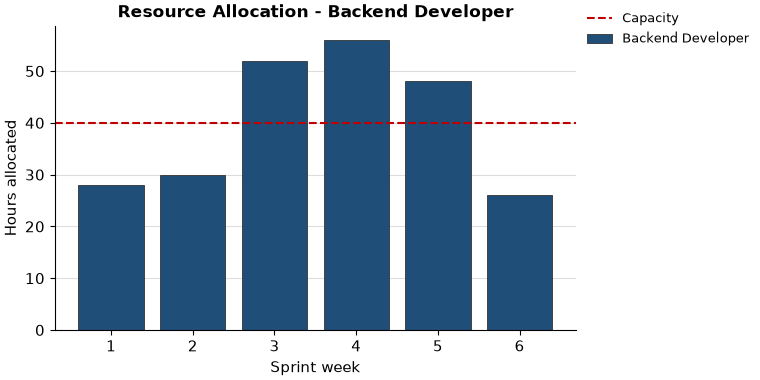
Refer to the exhibit. Based on the resource allocation shown for weeks 1-6, what should the project manager do FIRST?
- A. Smooth the schedule by moving non-critical tasks within their float to spare-capacity weeks. Correct answer
- B. Escalate the allocation to the sponsor as a scope risk requiring a change request.
- C. Approve overtime for the developer through week 5 to keep pace with the schedule.
- D. Level the schedule by delaying the developer's tasks, which pushes out the project's end date.
Option A is correct because smoothing moves non-critical tasks within their float into the weeks that have spare capacity. Weeks 3, 4 and 5 exceed the 40-hour line by 12, 16 and 8 hours (36 in total), while weeks 1, 2 and 6 have 36 spare hours, so the work fits without moving the end date. Levelling would delay tasks and extend the end date, overtime adds cost and fatigue, and a scope-risk change request is premature when the load can simply be rebalanced.
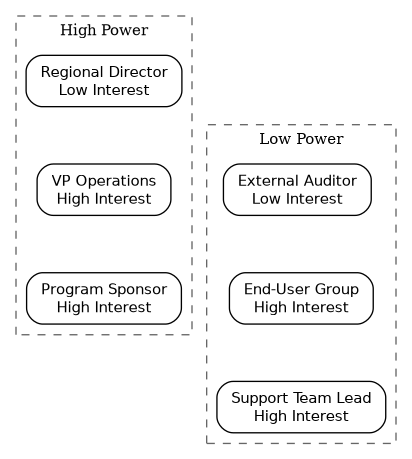
Based on the stakeholder map shown, which engagement approach is BEST for the Regional Director?
- A. Manage the Regional Director closely with frequent, detailed engagement and consultation.
- B. Keep the Regional Director satisfied with occasional, high-level updates. Correct answer
- C. Keep the Regional Director informed through regular, detailed project status updates.
- D. Monitor the Regional Director with minimal effort and no proactive communication.
Option B is correct because the Regional Director sits in the High Power cluster with Low Interest, which is the keep-satisfied quadrant: occasional, high-level updates. Close management and detailed status updates suit high-interest stakeholders, and minimal monitoring would ignore a stakeholder with real power.
A bank is merging two mobile apps into one product. Each app's team has run its own sprints for a year, and the combined backlog reads like two products stitched together. Which TWO actions should the project manager take? (Choose two.)
- A. Adopt the larger app's existing vision for the merged product
- B. Map each epic to the new vision and defer those that do not serve it Correct answer
- C. Merge the two backlogs and rank items by the size of each app's user base
- D. Run a vision workshop with both product owners and representative users Correct answer
- E. Delegate the wording of the merged product's purpose to the enterprise architect
Options B and D are correct because the merged product needs one shared purpose: a workshop with both product owners and users creates it, and mapping each epic to it defers work that no longer fits. Adopting one app's vision (A), ranking by user base (C) or delegating the wording to an architect (E) skips the shared ownership the merged teams need.
Two weeks into a hybrid program, the vendor's waterfall team and the in-house Scrum team describe the program's end goal differently in their status reports, even though the charter is signed and clear. What should the project manager do NEXT?
- A. Bring both teams together to agree one goal statement from the charter Correct answer
- B. Ask the sponsor to send both teams a written reminder of the charter's aims
- C. Update the status report template to use one goal statement
- D. Have each team lead present their goal to the steering committee
Option A is correct because a single goal statement drawn from the signed charter removes the misalignment at its source, and bringing both teams together is the project manager's role. Option B leaves the alignment to the sponsor, option C changes the reporting template without agreeing the goal, and option D escalates a difference the teams have not yet worked on.
A newly assigned project manager is handed a signed document that states the project's high-level objectives and names the project manager as the person authorized to lead it. What is this document?
- A. Scope statement
- B. Business case
- C. Project management plan
- D. Project charter Correct answer
Option D is correct because the project charter formally authorizes the project, states its high-level objectives and names the project manager. The business case justifies the investment, the project management plan describes how the work will be executed, and the scope statement details the deliverables.
During sprint 4, two developers on a Scrum team disagree about whether to refactor the order-matching module or work around it. The debate is heated but stays on technical merit, and the sprint goal is at risk. Which action should the project manager take?
- A. Have the product owner choose the approach with the lower cost
- B. Facilitate a team vote on the approach at the retrospective
- C. Escalate the disagreement to the engineering manager for a decision
- D. Ask both developers to present their evidence and agree an approach Correct answer
Option D is correct because a technical disagreement is best resolved by collaboration: the developers present their evidence and the team agrees an approach that protects the sprint goal. A vote at the retrospective comes too late, escalation bypasses the team's own ability to resolve it, and the product owner decides what is built, not how.
A hybrid program shares one performance tester between an agile mobile team and a predictive billing workstream. Each lead has a committed milestone that needs the tester during the same three weeks. The project manager has already met both leads twice, and neither lead has authority to reassign the tester, whose manager reports to the sponsor. What should the project manager do NEXT?
- A. Ask the tester to decide which milestone to support this quarter
- B. Facilitate a third meeting where the leads split the tester's hours
- C. Escalate the conflict to the sponsor with the cost of delay Correct answer
- D. Hire a contract tester and update the budget forecast to cover it
Option C is correct because two meetings have already failed and neither lead can reassign the tester, so the decision needs someone with authority over both, the sponsor, who should see the cost of delay. A third meeting repeats a step that has not worked, the tester should not arbitrate between the leads, and hiring a contractor commits budget before the priority is set.
Process
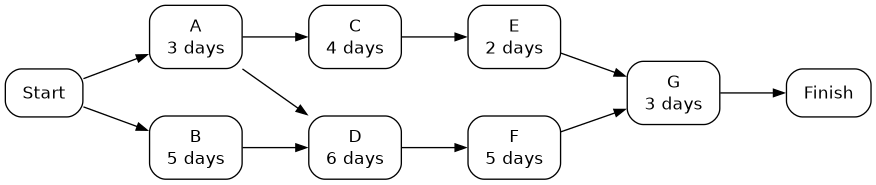
Using the network diagram shown, by how many days can activity C slip before the project finish date is delayed?
- A. 2 days
- B. 7 days Correct answer
- C. 10 days
- D. 12 days
Option B is correct because the three paths are A-C-E-G = 12 days, A-D-F-G = 17 days and B-D-F-G = 19 days, so the critical path is 19 days. C sits only on the 12-day path, so its float is 19 - 12 = 7 days. Two is E's duration, ten is a path-length misreading, and twelve is the length of C's own path rather than its float.
A hospital-equipment project has a hardware track on a fixed plan and a software track working in sprints. The steering group cannot see how the two fit together, and each track reports against its own milestones. Which TWO actions should the project manager take? (Choose two.)
- A. Move the software track to phase-gate reviews
- B. Show dependencies between the tracks in one roadmap Correct answer
- C. Merge both tracks into one detailed task-level schedule
- D. Agree integration milestones both tracks commit to Correct answer
- E. Ask the PMO to draw up the plan
Options B and D are correct because a hybrid program needs the two tracks connected at a level the steering group can see: a roadmap of dependencies and integration milestones both tracks commit to. Merging everything into one task-level schedule (C) or moving the software track to phase gates (A) forces one method on both, and leaving the plan to the PMO (E) leaves the tracks unaligned.
The funding board releases money only against a baselined plan that shows committed resources and a vendor-confirmed cost, and its rules do not allow partial releases. The draft plan names two engineers who are also assigned to another project starting next week, and the vendor's cost is a verbal estimate. The board meets in ten days. Which TWO actions should the project manager take? (Choose two.)
- A. Get the vendor's cost confirmed in writing Correct answer
- B. Request a staged release of funds from the board
- C. Ask the sponsor to instruct the other project to release the engineers
- D. Baseline the plan with the two open items listed as risks
- E. Settle the engineers' allocation with the other project's manager Correct answer
Options A and E are correct because the board releases money only against a plan with committed resources and a vendor-confirmed cost, so the project manager gets the cost confirmed in writing and settles the engineers' allocation with the other project's manager. A staged release (B) is ruled out by the board's rules, baselining with open items listed as risks (D) fails its conditions, and asking the sponsor to instruct the other project (C) skips the negotiation.
Which document is the approved, integrated plan that describes how the project will be executed, monitored and controlled?
- A. Business case
- B. Scope statement
- C. Project management plan Correct answer
- D. Project charter
Option C is correct because the project management plan is the approved, integrated document describing how the project will be executed, monitored and controlled. The business case justifies the investment, the scope statement details the deliverables, and the charter authorizes the project.
A hybrid project delivers a custom hardware unit with a fixed 36-week supplier lead time, plus the software that runs on it. The software requirements are still changing every quarter, and the steering committee wants one integrated plan it can track. What should the project manager do?
- A. Keep a predictive plan for the hardware and let the software teams report sprints separately
- B. Create a roadmap anchored on the hardware milestones, with software plans nested under it Correct answer
- C. Build a task-level integrated schedule for the whole project and baseline it
- D. Ask the software teams to freeze requirements for the year so one schedule holds
Option B is correct because a roadmap anchored on the hardware milestones gives the steering committee one integrated view while the software plans can keep changing beneath it. Separate reporting gives no single plan, a baselined task-level schedule breaks under quarterly requirement changes, and freezing requirements for a year is unrealistic.
In a hybrid program, the hardware scope is baselined under formal change control. A customer representative asks an engineer to add a summary report to a deliverable, and the engineer estimates two days of work. What should the project manager do?
- A. Absorb the two days in schedule float and tell the customer the report is done
- B. Decline the request
- C. Approve the report as a minor change within the project manager's own authority
- D. Log the request and assess its impact through the change control process Correct answer
Option D is correct because the request changes a baselined deliverable, so it is logged and its impact assessed through change control before any work starts. Absorbing it in float or approving it alone bypasses control, and declining outright skips the assessment.
A three-phase migration has detailed requirements for phase one only, and phases two and three depend on what the first phase teaches the team. The sponsor wants the WBS baselined before funding is released next month. What should the project manager do?
- A. Baseline the summary-level WBS and raise change requests as the detail emerges
- B. Decompose all three phases into work packages and baseline the complete WBS for funding
- C. Ask the sponsor to agree funding for phase one and baseline the WBS for that phase
- D. Decompose phase one into work packages and keep the later phases as planning packages Correct answer
Option D is correct because detailed decomposition is done for phase one only, with later phases held as planning packages until the team learns more, which is rolling wave planning. A summary-only baseline lacks the detail funding needs, and decomposing all three phases invents detail that will change.
Business Environment
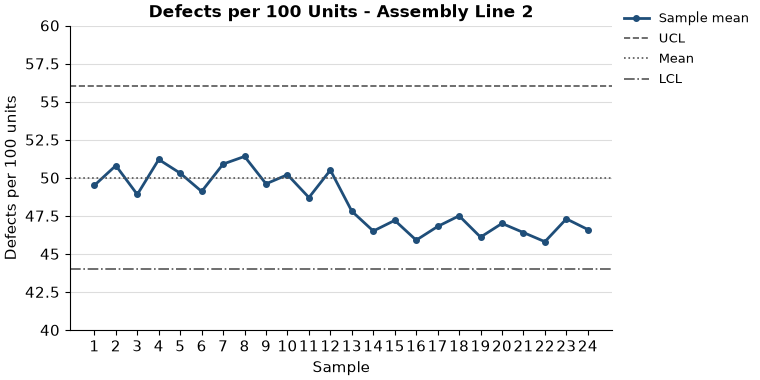
A process change was made at sample 13 of the control chart shown. What should the project manager do next?
- A. Recalculate the limits from samples after the change Correct answer
- B. Keep the original limits because no point is outside them
- C. Report the improvement using the original limits
- D. Widen the original limits to include the new mean
Option A is correct because after the process change at sample 13 the sample means settle lower (45.8 to 47.8) and stay there, so the original limits centred on 50 no longer describe the process. The PM should recalculate the limits from the samples after the change. Keeping the old limits, widening them, or reporting the improvement against them all misrepresent the new process.
Three vendors on a program escalate problems to whichever executive they know best. Two decisions have been reversed by a different executive within a week, and nobody is sure who can decide what. Which TWO actions should the project manager take? (Choose two.)
- A. Ask the sponsor to publish the governance structure Correct answer
- B. Chair a weekly call with the three vendors
- C. Define escalation paths and decision rights Correct answer
- D. Send escalations to the PMO by email
- E. Let each executive keep handling the vendor they know best
Options A and C are correct because the reversals come from unclear authority, so the project manager defines escalation paths and decision rights and has the sponsor publish the governance structure. Letting each executive handle the vendor they know (E), sending escalations to the PMO by email (D) or chairing a weekly vendor call (B) leaves the question of who decides unanswered.
Who is typically accountable for the business case and for securing funding for a project?
- A. The project sponsor Correct answer
- B. The PMO director
- C. The project manager
- D. The functional manager
Option A is correct because the sponsor owns the business case and secures the funding for the project. The project manager delivers the work, the PMO director supports methods and the functional manager supplies resources, but none of them is accountable for the case.
The steering committee minutes remove the reporting module from scope. The product owner keeps its export function, which serves only that module, at the top of the backlog and says content decisions are hers under the governance plan. The next sprint starts Monday. What should the project manager do?
- A. Clarify with the committee chair if export is inside the removed scope Correct answer
- B. Ask the sponsor to rule between the product owner and the committee on export
- C. Direct the team to drop the export function, following the minutes
- D. Agree with the product owner to keep export in the sprint and note the gap
Option A is correct because the scope boundary belongs to the steering committee, so the project manager clarifies with its chair whether export falls inside the removed module before the sprint starts. Directing the team, agreeing with the product owner, or asking the sponsor to rule each settles the point without the party who set the boundary.
A regulator publishes a data-retention rule that applies to a system the team is building. It takes effect in five months, and the legal team has not finished interpreting it. What should the project manager do?
- A. Add the rule to the compliance plan and refine it as legal advises Correct answer
- B. Log a risk for the rule and review it after the next release
- C. Ask the team to build the strictest reading into each component
- D. Pause design of the storage components
Option A is correct because the rule is added to the compliance plan and refined as legal finishes its interpretation, so design continues on a known requirement. Building the strictest reading, pausing design, or only logging a risk for later either wastes effort or leaves the requirement unplanned.
A launch is fixed for a regulator's deadline in six weeks. Testing shows that a required access control fails for administrator accounts, and the fix needs eight weeks. The compliance officer says a documented manual control, such as a weekly access review, is acceptable to the regulator if the risk committee approves it, and the committee meets in ten days. What should the project manager do?
- A. Document the manual control and take it to the risk committee Correct answer
- B. Move the launch by eight weeks and finish the fix under the original design
- C. Ask the regulator for a deadline extension while the team builds the fix
- D. Launch with administrator accounts disabled and enable them after the fix
Option A is correct because the compliance officer has already said the regulator accepts a documented manual control if the risk committee approves it, and the committee meets before the deadline. Moving the launch, asking for an extension, or launching with accounts disabled gives up the date or the function when an approved route exists.
Frequently Asked Questions
How many questions are on the exam?
The PMP exam contains 180 questions.
What is the passing score?
You need 70% to pass.
How long is the exam?
You have 230 minutes to complete the exam.
Practice with realistic mock exams to prepare for your PMI certification.