People · Topic 4 of 7
Engaging Stakeholders
Identify and analyze stakeholders, use the power and interest grid and engagement assessment matrix, and plan engagement for predictive and agile projects.
- 4 min
- Includes a diagram
- Identify stakeholders early and repeatedly, because the list changes.
- The stakeholder register records who they are, what they expect and how much influence they hold.
- Power and interest grid: high power and high interest means manage closely, and low power with low interest means monitor.
What it is
A stakeholder is any person, group or organization that can affect the project or be affected by it. That includes sponsors, customers, users, team members, suppliers, regulators and even critics. Engaging stakeholders means involving them in the right way, at the right time, so that their support grows and their concerns are heard.
Engagement is continuous. New stakeholders appear and the interest of existing ones shifts as the project progresses.
How it works
Identifying stakeholders
Start early, ideally from the charter and the business case, and repeat the exercise throughout the project. Useful sources include the organization chart, contracts, interviews, workshops and the users of the product. Ask each stakeholder whom else you should talk to.
The output is a stakeholder register. It lists each person or group, their role, contact details, main requirements and expectations, their influence and their current attitude to the project.
Analysing stakeholders
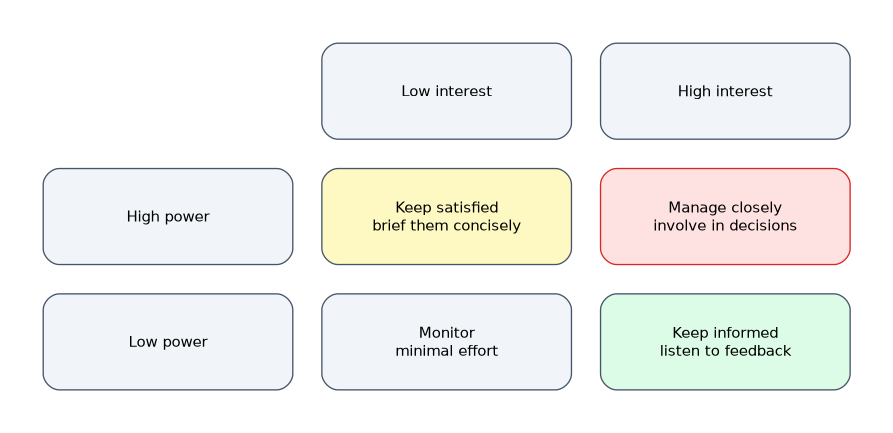 Analysis tells you how much attention each stakeholder needs. One common tool is a power and interest grid.
| Power | Interest | Approach |
|---|---|---|
| High | High | Manage closely, involve in decisions |
| High | Low | Keep satisfied, brief them concisely |
| Low | High | Keep informed, listen to feedback |
| Low | Low | Monitor, with minimal effort |
Other models use influence, impact or the salience model. The salience model ranks stakeholders by three attributes: power, legitimacy (a valid claim) and urgency (how pressing the claim is). A stakeholder with all three is the most important to address.
Assessing engagement levels
An engagement assessment matrix compares where each stakeholder is now with where you need them to be. The usual levels are:
- Unaware: does not know about the project or its effects.
- Resistant: knows but opposes change.
- Neutral: knows but neither supports nor opposes.
- Supportive: backs the project and its changes.
- Leading: actively works to make the project succeed.
The gap between the current and desired level shows who needs effort. A powerful stakeholder who is resistant is a bigger concern than a minor one who is neutral.
Planning and carrying out engagement
A stakeholder engagement plan states how to move people from their current level to the desired one. It covers the methods, frequency and owner of each interaction. Typical actions include one to one meetings, demos, workshops, surveys and regular status updates.
Interpersonal skills do much of the work here. Active listening, negotiation, political awareness and cultural awareness all help the project manager understand what each person values.
Agile and hybrid engagement
Agile projects build engagement into the rhythm of delivery. Customers or their representatives see working increments in sprint reviews and give feedback that shapes the backlog. The product owner acts as the main voice of the customer.
Hybrid projects often combine a formal stakeholder register with frequent demos. The point is the same in every approach: stakeholders should see progress, influence direction and have no surprises.
Monitoring
Engagement needs checking. If a supportive stakeholder starts missing meetings, or a resistant one stops complaining, ask why. Update the register and plan whenever the picture changes.
When an exam question asks about a stakeholder who is resistant or unaware and holds high power, the best answer usually involves direct, early communication to understand and address their concerns.
What to remember for the exam
- Identify stakeholders early and repeatedly, because the list changes.
- The stakeholder register records who they are, what they expect and how much influence they hold.
- Power and interest grid: high power and high interest means manage closely, and low power with low interest means monitor.
- The salience model uses power, legitimacy and urgency.
- Engagement levels are unaware, resistant, neutral, supportive and leading.
- Compare current engagement with desired engagement to see where effort should go.
- Agile engagement comes from frequent reviews, the product owner and visible progress.
- Good engagement uses interpersonal skills, such as listening, negotiation and cultural awareness.
Common mistakes
Identifying stakeholders once. New regulators, users or executives will appear, so repeat the analysis.
Ignoring low power stakeholders. Users with little formal power can still make or break acceptance of the result.
Treating all stakeholders equally. Time is limited, so spend more on those with higher power, interest and impact.
Hiding bad news from a powerful stakeholder. Surprises damage trust, and early honest communication usually costs less.
Planning engagement but not checking it. An unmonitored plan quickly becomes out of date.
Do not choose an answer that drops a resistant stakeholder from the register to simplify communication, since resistance is exactly what needs active management.
Check yourself
What should you do with a stakeholder who has high power and high interest?
Manage them closely and involve them in key decisions.
Name the five engagement levels.
Unaware, resistant, neutral, supportive and leading.
What does the salience model add to a power and interest grid?
It adds legitimacy and urgency alongside power, so claims can be ranked by all three attributes.
Topic 4 of 7 in People
Test yourself on People
The full PMI PMP question bank has 1,463 questions, with timed practice exams and an explanation for every answer.
This study guide is independent and is not affiliated with, endorsed by, or sponsored by PMI. Vendor names, certification names and exam codes are trademarks of their respective owners and are used for identification only.