People · Topic 7 of 7
Planning and Managing Communication
Build a communication plan, pick push, pull or interactive methods, count communication channels, overcome barriers, and use agile information radiators.
- 5 min
- Includes a diagram
- The model includes sender, encoding, message, medium, decoding, receiver and feedback.
- Noise distorts messages, and feedback confirms understanding.
- Interactive communication is best for complex or sensitive topics, push is one way, and pull lets receivers fetch information.
What it is
Communication is how information moves between people on the project. Project managers spend a very large share of their time communicating, and poor communication is a common root cause of project trouble.
Planning communication means deciding who needs what information, when, how and from whom. Managing it means delivering that information and checking that it was understood.
How it works
Communication basics
The basic model has a sender, a message, a medium and a receiver. The sender encodes the idea, and the receiver decodes it. Noise is anything that distorts the message, such as a poor connection, language differences, distraction or cultural assumptions.
Feedback closes the loop. Without it, the sender cannot tell whether the message was understood.
Communication methods
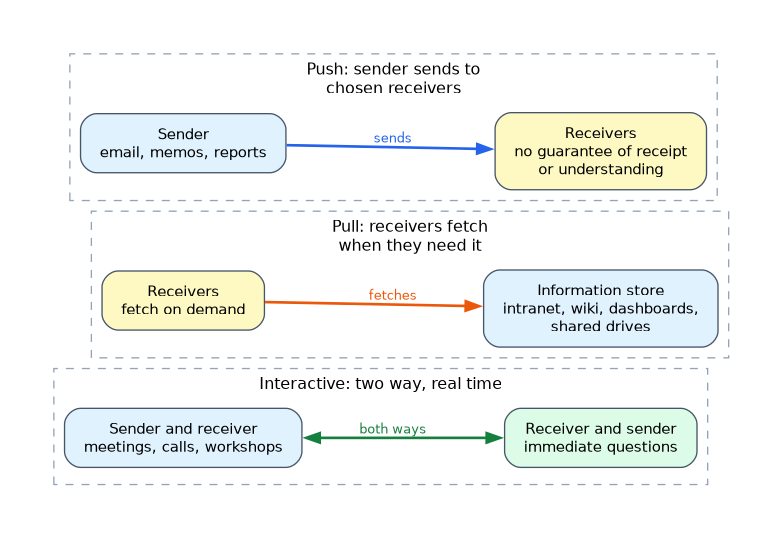
| Method | Description | Examples |
|---|---|---|
| Interactive | Two way, real time exchange | Meetings, calls, workshops |
| Push | Sender sends to chosen receivers, no guarantee of receipt or understanding | Email, memos, reports |
| Pull | Receivers fetch information when they need it | Intranet, wiki, dashboards, shared drives |
Interactive communication is the most effective for complex or sensitive topics, because it allows immediate questions. Push suits routine notices, and pull suits large amounts of material that people consult on demand.
Communication channels
The number of channels grows quickly as a group grows. The formula for the number of potential communication channels is n x (n - 1) / 2, where n is the number of people.
A team of 5 has 10 channels. If 3 more people join, the group has 8 people and 28 channels. This is why larger projects need a communication plan and structure.
The communication management plan
The plan sets out the communication requirements of stakeholders and the way to meet them. It usually records:
- the stakeholders and what information each needs;
- the content, format, language and level of detail;
- the method, such as meeting, report or dashboard;
- the frequency and timing;
- the sender and the person responsible for each item;
- an escalation path and the way to update the plan.
The stakeholder register and engagement analysis feed the plan. Factors that affect choices include urgency, the available technology, the team's skills, the project length and the working environment, such as a virtual or co-located team.
Managing communication
During delivery the project manager sends the planned information, collects feedback and watches for problems. Typical items are status reports, dashboards, meeting minutes, risk and issue updates and presentations. Active listening, clear writing and awareness of culture all help.
Virtual teams need extra care. Time zones, tools and language differences can create misunderstandings, so agree on meeting times, channels and norms.
Agile communication
Agile teams prefer face to face or direct conversation. Daily stand ups, sprint planning, sprint reviews and retrospectives provide regular, structured touchpoints.
Information radiators, such as task boards, burndown charts and dashboards, display progress openly so that anyone can see it without asking. A shared board is an example of the pull method.
Hybrid projects mix the two styles. Formal reports and milestone updates go to governance bodies, while the team keeps its boards and short meetings for daily coordination.
Checking effectiveness
The project manager monitors whether communication works. Signs of trouble include repeated questions, missed deadlines and surprised stakeholders. Surveys, direct feedback and observation can all be used, and the plan is updated when needs change.
When two answers both mention sending a report, prefer the one that uses the method your stakeholder actually needs and includes a way to confirm understanding.
What to remember for the exam
- The model includes sender, encoding, message, medium, decoding, receiver and feedback.
- Noise distorts messages, and feedback confirms understanding.
- Interactive communication is best for complex or sensitive topics, push is one way, and pull lets receivers fetch information.
- Channels = n (n - 1) / 2, so adding people increases complexity quickly.
- The communication management plan states who needs what, when, how and from whom.
- Stakeholder analysis feeds the plan, and the plan is updated as needs change.
- Agile teams use daily stand ups, reviews, retrospectives and information radiators.
- Written communication should be clear, concise and appropriate to the audience.
Common mistakes
Assuming sent means understood. Push methods do not prove that anyone read or grasped the message.
Miscounting channels. Remember the formula uses n x (n - 1) / 2, not n x (n - 1), and it counts the whole group, including the project manager.
Sending everything to everyone. Too much information is as harmful as too little, because people stop reading.
Using email for hard conversations. Sensitive or complex topics need an interactive method.
Forgetting culture and time zones. Virtual teams need agreed norms for language, availability and tools.
If a question asks how many channels exist after a team grows, check whether the count includes the project manager before you apply the formula.
Check yourself
How many communication channels exist among 6 people?
6 x 5 / 2 = 15 channels.
Which communication method suits a complex or sensitive discussion?
Interactive communication, because it allows immediate two way questions and clarification.
What is an information radiator?
A visible display of project information, such as a task board or burndown chart, that anyone can view without asking.
Topic 7 of 7 in People
Test yourself on People
The full PMI PMP question bank has 1,463 questions, with timed practice exams and an explanation for every answer.
This study guide is independent and is not affiliated with, endorsed by, or sponsored by PMI. Vendor names, certification names and exam codes are trademarks of their respective owners and are used for identification only.