Business Environment · Topic 4 of 8
Issues and Impediments
Tell issues from risks, run an issue log, remove team impediments as a servant leader, and escalate problems when they exceed project authority.
- 5 min
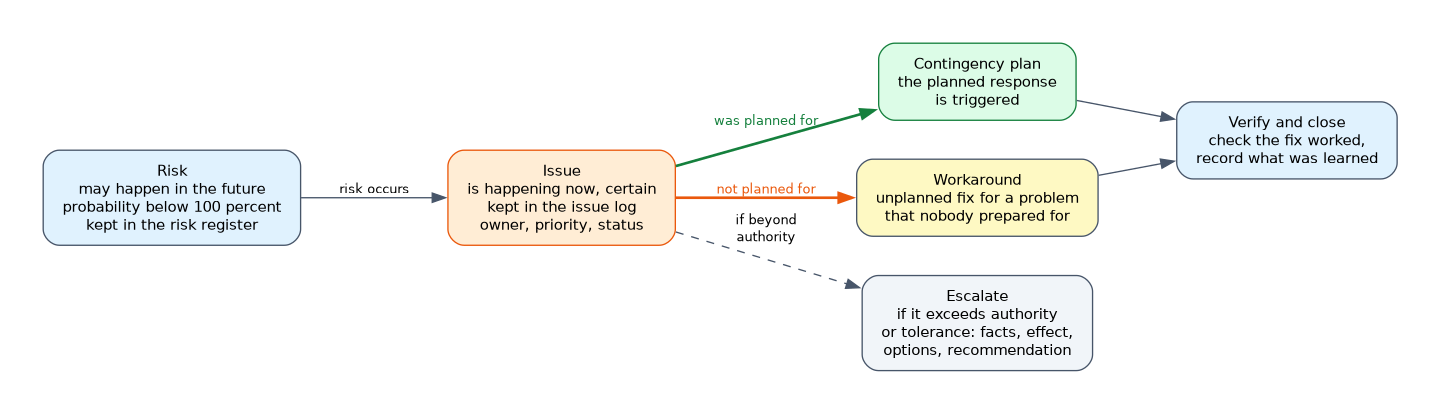
- Includes a diagram
- An issue has happened, and a risk might happen.
- Issues go in the issue log with an owner, priority, status and resolution.
- A workaround is an unplanned response to a problem that was not anticipated.
What it is
An issue is a problem that has already happened and is affecting the project now. An impediment is anything that blocks the team from making progress, such as a missing access right, an unavailable decision maker or a broken tool. Managing issues and removing impediments keeps work moving.
This differs from risk management. A risk is an uncertain future event, while an issue is a certain present problem.
How it works
Issue versus risk
| Aspect | Risk | Issue |
|---|---|---|
| Timing | May happen in the future | Is happening now |
| Certainty | Probability below 100 percent | Certain |
| Tracked in | Risk register | Issue log |
| Handled by | Risk responses | Resolution actions |
A risk that occurs becomes an issue. If it was planned for, the response or contingency plan is triggered. If it was not planned for, the team uses a workaround, which is an unplanned fix for a problem that has appeared.
The issue log
An issue log records each issue with an identifier, a description, the date raised, who raised it, an owner, a priority, a target date, the current status and the resolution. Review it regularly, because aging issues become bigger problems.
Priority depends on impact and urgency. An issue that blocks the critical path or a compliance deadline comes first.
Resolving issues
- Confirm the issue is real and understand it.
- Find the cause and the effects on scope, schedule, cost, quality and people.
- Assign an owner and decide the action.
- Resolve it, or escalate if it needs a decision outside your authority or tolerance.
- Check that the fix worked and record what was learned.
If the resolution changes a baseline, use change control. If the same issue repeats, address the root cause.
Removing impediments
Agile teams surface impediments in the daily stand up, and anyone may raise one. The servant leader, such as a scrum master or project manager, takes responsibility for removing impediments or getting the right person involved. The aim is to protect the team's focus, not to do their work for them.
Typical impediments include:
- waiting for decisions or approvals;
- unclear priorities from stakeholders;
- missing tools, environments or access;
- interruptions and competing demands on team members;
- dependencies on other teams.
Keep an impediment board or list visible and review progress daily. Aim for quick resolution, because blocked work sits idle and loses value.
Escalation
Some issues cannot be solved at the project level. Escalate when it exceeds your authority, when the solution needs resources or decisions you cannot give, or when tolerance is breached. Present the facts, the effect, the options and your recommendation, and follow the escalation path in the governance plan.
Predictive and hybrid practice
In a predictive project, issues are reviewed at status meetings and in reports, with owners and dates. In a hybrid project, the team's daily impediment list feeds the project level issue log when a problem affects the wider plan.
Preventing issues
Good risk management, clear communication and regular stakeholder contact reduce the number of issues. Learn from each one, and add the lesson to checklists and risk reviews.
To decide whether something is a risk or an issue, ask whether it has already happened. If yes, it is an issue.
What to remember for the exam
- An issue has happened, and a risk might happen.
- Issues go in the issue log with an owner, priority, status and resolution.
- A workaround is an unplanned response to a problem that was not anticipated.
- A risk that occurs may become an issue, and its planned response or contingency plan is then used.
- Servant leaders remove impediments so the team can focus.
- Daily stand ups are a place to surface impediments.
- Escalate when an issue exceeds authority or tolerance, with facts and options.
- Use change control if a resolution changes a baseline.
- Address root causes of repeated issues.
Common mistakes
Confusing risks and issues. Putting a current problem in the risk register means no one owns its resolution.
Leaving issues without owners. Unowned issues drift and grow.
Solving the team's problems for them. The leader removes obstacles and coaches, while the team does the work.
Escalating too late. Waiting until the damage is done reduces the options.
Fixing symptoms only. Without root cause analysis, the same issue returns.
Do not ignore a small impediment because it seems minor, since a blocked team member quickly turns into a missed commitment.
Check yourself
How do you tell an issue from a risk?
An issue has already happened and is certain, while a risk is an uncertain future event.
Who is responsible for removing a team's impediments in agile work?
The servant leader, such as the scrum master or project manager, working with the right people.
What is a workaround?
An unplanned response to a risk event that has occurred and had no prepared response.
Topic 4 of 8 in Business Environment
Test yourself on Business Environment
The full PMI PMP question bank has 1,463 questions, with timed practice exams and an explanation for every answer.
This study guide is independent and is not affiliated with, endorsed by, or sponsored by PMI. Vendor names, certification names and exam codes are trademarks of their respective owners and are used for identification only.