Business Environment · Topic 3 of 8
Managing and Controlling Changes
Follow the integrated change control process, understand change requests, the change control board and configuration management, and handle agile change.
- 4 min
- Includes a diagram
- Record every change request, and assess impact before any decision.
- Change request types are corrective action, preventive action, defect repair and update.
- The CCB approves or rejects changes to baselines within its defined authority.
What it is
Change is normal on projects, and it must be managed rather than blocked. Change control is the process of recording requests to change the plan, baselines, deliverables or documents, judging their effect, and then approving, rejecting or deferring them. It protects the baselines and keeps stakeholders informed.
Uncontrolled change leads to scope creep, cost overruns and confusion about what has been agreed.
How it works
Types of change request
| Type | Meaning |
|---|---|
| Corrective action | Brings expected future performance back in line with the plan |
| Preventive action | Reduces the chance of future problems or deviation |
| Defect repair | Fixes a nonconforming product or component |
| Update | Changes controlled documents, baselines or plans |
Anyone may raise a request, but it must be recorded in a change log. Requests can be formal or informal at first, yet only a documented request enters the process.
The process step by step
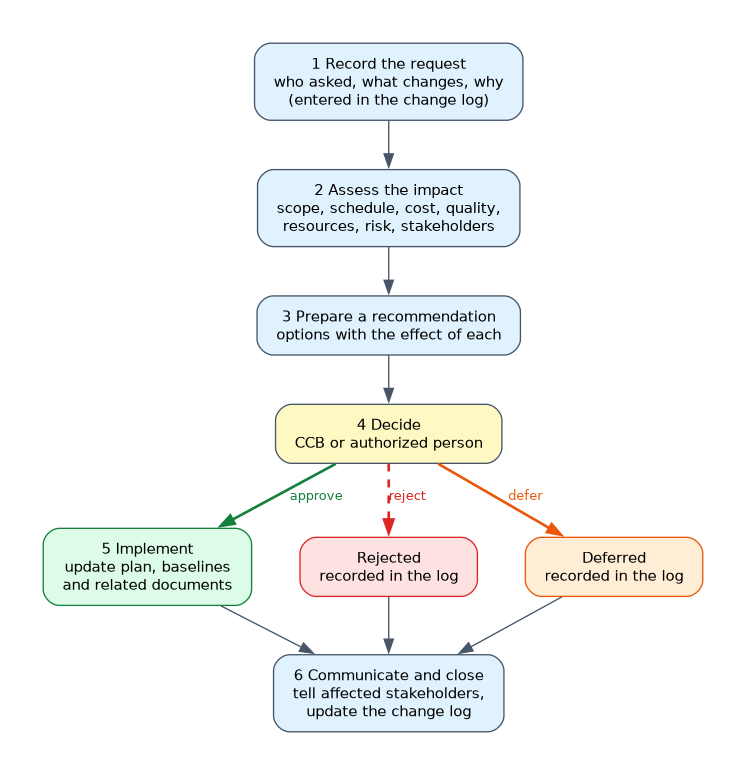
- Record the request. Capture who asked, what changes, and why.
- Assess the impact. Check the effect on scope, schedule, cost, quality, resources, risk and stakeholders. Consider alternatives.
- Prepare a recommendation. Present options with the effect of each.
- Decide. The authorized person or the change control board (CCB) approves, rejects or defers the request.
- Implement. If approved, carry out the change and update the plan, baselines and related documents.
- Communicate and close. Tell affected stakeholders and update the change log.
The key rule is to assess before acting. A project manager does not simply implement a change because a senior person asked.
The change control board
The CCB is a group with the authority to approve or reject changes to baselines. It may include the sponsor, key stakeholders, technical experts and the project manager. Its limits are set in the governance plan, and small changes within tolerance can be approved by the project manager without a board meeting.
Some projects use an emergency path for urgent changes, and the decision is recorded afterwards.
Configuration management
Configuration management keeps track of the versions and characteristics of deliverables and documents. It includes identifying each item, controlling changes, recording status and auditing that the items match what was approved. This prevents people from working from outdated versions.
Version control tools in software work are an example of the same idea.
Change in agile and hybrid projects
Agile accepts change through the backlog. The product owner can add, remove or reorder items at any time, but the work inside a sprint stays stable. If a major change cannot wait, the product owner may cancel the sprint, though that is rare.
Hybrid projects often use formal change control on the baselines needed for contracts, budget or regulatory commitments, and backlog changes inside the agreed scope envelope. Make clear which level each change belongs to.
Keeping control
Track all requests and their status, report them regularly and look for patterns. Many changes of the same kind can signal weak requirements or poor engagement, so fix the cause too.
When asked what to do first on receiving a change request, evaluate its impact before approving, rejecting or telling the team to start work.
What to remember for the exam
- Record every change request, and assess impact before any decision.
- Change request types are corrective action, preventive action, defect repair and update.
- The CCB approves or rejects changes to baselines within its defined authority.
- After approval, update the plan, baselines and documents and tell stakeholders.
- Rejected and deferred requests are also recorded.
- Configuration management controls versions and the integrity of items.
- In agile work, change enters through the backlog and is ordered by the product owner.
- Changes inside tolerance may be approved by the project manager.
Common mistakes
Implementing before approval. Work done on an unapproved change may be waste and breaks the baseline.
Skipping impact analysis. A change that looks small can hit schedule, cost or quality elsewhere.
Forgetting to update the baseline. An approved change that is not reflected makes variance reports meaningless.
Applying formal change control to every backlog tweak. Agile backlogs have their own ordering process.
Blaming requesters. Treat repeated changes as information about gaps in requirements or engagement.
Do not let the team start work on a change that has not been approved, and once it is approved, update the plan and documents so that everyone works from the same version.
Check yourself
What is the first thing to do when a change request arrives?
Record it and assess its impact on scope, schedule, cost, quality, resources and risk.
Name the four types of change request.
Corrective action, preventive action, defect repair and update.
How does an agile team usually handle a new request?
The product owner adds it to the backlog and orders it against other items, keeping the current sprint stable.
Topic 3 of 8 in Business Environment
Test yourself on Business Environment
The full PMI PMP question bank has 1,463 questions, with timed practice exams and an explanation for every answer.
This study guide is independent and is not affiliated with, endorsed by, or sponsored by PMI. Vendor names, certification names and exam codes are trademarks of their respective owners and are used for identification only.