Project Management Fundamentals and Core Concepts · Topic 1 of 6
Projects, Programs, Portfolios and Life Cycles
CAPM basics: what a project is, projects versus programs, portfolios and operations, predictive and adaptive life cycles, and the five process groups.
- 4 min
- Includes a diagram
- A project is temporary and unique; operations are ongoing and repetitive.
- Program: related projects for shared benefits. Portfolio: work grouped for strategy.
- Predictive suits stable requirements; adaptive suits uncertainty; hybrid mixes both.
What it is
A project is a temporary endeavor undertaken to create a unique product, service or result. Temporary means it has a definite beginning and end, not that it is short. Unique means the output has not been produced in exactly this way before.
Projects are how organizations make change happen. A project moves the organization from a current state to a desired future state, for example a new system, a new product or a new way of working.
How it works
Project, program, portfolio and operations
| Term | What it is | Example |
|---|---|---|
| Project | A temporary effort that creates a unique output | Build a new mobile app |
| Program | Related projects and other work managed together to get benefits not available by managing them separately | App, website and call centre projects for one customer experience initiative |
| Portfolio | Projects, programs and operations managed as a group to achieve strategic objectives | All the digital investments a company selects and funds |
| Operations | Ongoing, repetitive work that keeps the business running | Running the app support desk every day |
Projects end; operations continue. When a project finishes, its outputs are usually transitioned to operations, which then run and maintain them.
Project life cycles
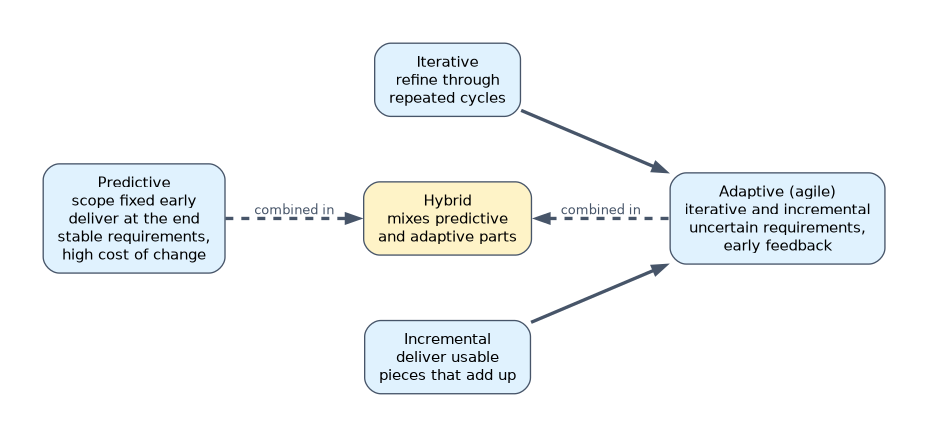 A project life cycle is the series of phases a project passes through from start to finish. The development approach decides how the product is created.
| Approach | How it works | Suits |
|---|---|---|
| Predictive (plan-based, waterfall) | Scope, schedule and cost are defined early; work moves through phases in order | Stable, well understood requirements; high cost of change |
| Iterative | The product is refined through repeated cycles based on feedback | Ideas that need prototyping and learning |
| Incremental | The product is delivered in usable pieces that add up | Early partial value is useful |
| Adaptive (agile) | Iterative and incremental together; scope is refined every iteration | Uncertain or changing requirements |
| Hybrid | A mix, for example predictive hardware and agile software | Projects with parts of both kinds |
A phase is a group of related activities that ends with one or more deliverables. Many organizations hold a phase gate at the end of a phase, where a decision is made to continue, change or stop.
The five process groups
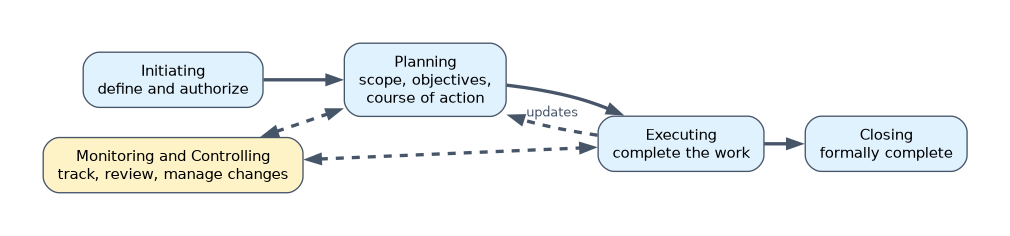 PMI's Process Groups practice guide organizes project management processes into five groups:
| Process group | Purpose |
|---|---|
| Initiating | Define and authorize a new project or phase |
| Planning | Establish scope, objectives and the course of action |
| Executing | Complete the work in the plan |
| Monitoring and Controlling | Track, review and regulate progress; manage changes |
| Closing | Formally complete the project or phase |
Process groups are not phases. They can repeat within every phase, and monitoring and controlling runs alongside the other groups.
Reviewing project scope
Project scope is the work needed to deliver the product with its specified features and functions. Product scope is the features and functions of the product itself. When you review a scope statement, check that it says what is included, what is excluded, what the deliverables are and how they will be accepted.
A question that describes repetitive, ongoing work with no end date is describing operations, not a project.
How the exam asks about this
- "A company runs several related projects to deliver one set of benefits. What is this?" A program.
- "Requirements are unclear and expected to change. Which approach fits?" Adaptive.
- "Which process group formally authorizes a project?" Initiating.
What to remember for the exam
- A project is temporary and unique; operations are ongoing and repetitive.
- Program: related projects for shared benefits. Portfolio: work grouped for strategy.
- Predictive suits stable requirements; adaptive suits uncertainty; hybrid mixes both.
- Five process groups: Initiating, Planning, Executing, Monitoring and Controlling, Closing.
- Process groups are not the same as phases.
- A project is a vehicle for change from a current to a future state.
Temporary does not mean short. A ten year construction project is still temporary because it has a definite end.
Common mistakes
Calling a program a big project. A program groups related projects to gain extra benefits.
Treating process groups as phases. They can occur in every phase.
Mixing up project scope and product scope. Project scope is the work; product scope is the features.
Check yourself
What makes an effort a project rather than operations?
It is temporary, with a definite start and end, and creates a unique product, service or result.
What is a portfolio?
Projects, programs and operations managed as a group to achieve strategic objectives.
Name the five process groups.
Initiating, Planning, Executing, Monitoring and Controlling, and Closing.
Topic 1 of 6 in Project Management Fundamentals and Core Concepts
Test yourself on Project Management Fundamentals and Core Concepts
The full PMI CAPM question bank has 1,049 questions, with timed practice exams and an explanation for every answer.
This study guide is independent and is not affiliated with, endorsed by, or sponsored by PMI. Vendor names, certification names and exam codes are trademarks of their respective owners and are used for identification only.