Business Analysis Frameworks · Topic 1 of 4
Business Analysis Roles and Stakeholder Communication
CAPM business analysis: stakeholder roles such as process owner and product owner, internal versus external roles, and choosing communication channels.
- 4 min
- Includes a diagram
- Missing a stakeholder means missing requirements.
- Process owner: accountable for a process. Process manager: runs it day to day.
- Product manager: product strategy and roadmap. Product owner: backlog and value for the team.
What it is
A business analyst (BA) helps the organization understand its needs and define solutions that deliver value. To do that, the BA must know who the stakeholders are, what role each plays, and how to communicate with each of them.
How it works
Why identify stakeholders and roles
Requirements come from people. If a stakeholder is missed, their needs are missed, and the solution may fail or need costly rework later. Clear roles tell everyone who provides requirements, who decides, who approves and who is only kept informed.
Common stakeholder roles
| Role | Responsibility |
|---|---|
| Sponsor | Funds the initiative and is accountable for its benefits |
| Product manager | Owns the product strategy and roadmap over the product's life |
| Product owner | Represents stakeholders to an agile team; orders the backlog to maximize value |
| Process owner | Accountable for a business process and its performance, usually a senior role |
| Process manager | Runs the process day to day for the process owner |
| Subject matter expert (SME) | Provides deep knowledge of an area |
| End user | Uses the solution and knows how work is really done |
| Business analyst | Elicits, analyzes, documents and validates requirements |
| Project manager | Manages the project delivering the solution |
Internal and external roles
| Internal | External |
|---|---|
| Sponsor, employees, end users, business units, project team | Customers, suppliers and vendors, regulators, partners, the public |
External stakeholders often have contractual or legal requirements that cannot be ignored, such as regulations.
Analyzing stakeholders
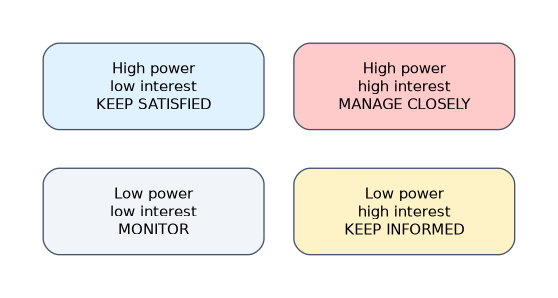 A power/interest grid helps decide how to engage each group:
| Low interest | High interest | |
|---|---|---|
| High power | Keep satisfied | Manage closely |
| Low power | Monitor | Keep informed |
A RACI chart (Responsible, Accountable, Consulted, Informed) clarifies who does what for each deliverable. Only one person is Accountable for each item.
Choosing a communication channel
| Need | Good channel or tool |
|---|---|
| Discuss a complex or sensitive topic | Face-to-face or video meeting |
| Formal decision or approval to record | Written report, email with sign-off |
| Regular status for many people | Dashboard or status report |
| Present a proposal to executives | Short presentation focused on value and decisions |
| Clarify requirements with a team | Workshop or walkthrough |
| Reference material people look up | Shared repository or wiki (pull) |
Why the BA's communication matters
The BA connects groups that speak different languages: business users, developers, testers and management. Good communication keeps requirements consistent across teams, avoids features being built differently from what was asked, and makes sure changes to requirements reach everyone affected.
Choose the richest channel for complex or sensitive topics (face-to-face), and written channels when a record or approval is needed.
How the exam asks about this
- "Who is accountable for a business process and its performance?" The process owner.
- "A stakeholder has high power but low interest. How should they be managed?" Keep satisfied.
- "Which channel is best for resolving a disagreement about a requirement?" A face-to-face or video meeting.
What to remember for the exam
- Missing a stakeholder means missing requirements.
- Process owner: accountable for a process. Process manager: runs it day to day.
- Product manager: product strategy and roadmap. Product owner: backlog and value for the team.
- Internal stakeholders are inside the organization; external include customers, suppliers and regulators.
- Power/interest grid: manage closely, keep satisfied, keep informed, monitor.
- Match the channel to the message: rich for complex, written for records.
Email is a poor choice for resolving conflict or complex questions. It is fine for confirming decisions already made.
Common mistakes
Treating the product owner and product manager as the same. The product manager owns long-term strategy; the product owner works with the team on the backlog.
Ignoring regulators. External stakeholders can impose mandatory requirements.
Using one channel for everyone. Different stakeholders need different channels.
Check yourself
Why should stakeholders be identified early?
Because requirements come from them, and a missed stakeholder means missed requirements and later rework.
What is the difference between a process owner and a process manager?
The process owner is accountable for the process and its results; the process manager runs it day to day.
In a power/interest grid, how do you handle high power, high interest stakeholders?
Manage them closely.
Topic 1 of 4 in Business Analysis Frameworks
Test yourself on Business Analysis Frameworks
The full PMI CAPM question bank has 1,049 questions, with timed practice exams and an explanation for every answer.
This study guide is independent and is not affiliated with, endorsed by, or sponsored by PMI. Vendor names, certification names and exam codes are trademarks of their respective owners and are used for identification only.