PRINCE2 Practices · Topic 8 of 9
Progress Controls, Tolerances and Escalation
PRINCE2 7 progress practice: purpose, tolerances at each level, event-driven and time-driven controls, forecasting, escalation and the progress technique.
- 6 min
- Includes a diagram
- Purpose: monitor and compare actuals with plans, forecast, and control unacceptable deviations.
- Business layer sets project tolerance; board sets stage tolerance; project manager sets work package tolerance.
- Event-driven controls happen at events; time-driven controls happen at regular intervals.
What it is
The purpose of the progress practice is to establish mechanisms to monitor and compare actual achievements against those planned, provide a forecast for the project's objectives and its continued viability, and control any unacceptable deviations.
How it works
Key concepts
| Term | Meaning |
|---|---|
| Forecast | A prediction, based on progress so far and current knowledge, of how the project, stage or work package is likely to finish |
| Tolerance | The permissible deviation above and below a plan's target for an aspect of performance, without escalating to the next level of management |
| Exception | A situation where it can be forecast that there will be a deviation beyond the agreed tolerance levels |
| Event-driven control | A control that takes place when a specific event occurs, such as the end of a stage, completion of the PID or an exception |
| Time-driven control | A control that takes place at predefined periodic intervals, such as weekly checkpoint reports or monthly highlight reports |
Guidance: tolerances for progress control
Tolerances are set for each level of management and for the aspects of performance: time, cost, quality, scope, benefits, risk and sustainability.
| Level | Sets tolerance for | Example |
|---|---|---|
| Business layer | The project | Project cost tolerance plus or minus 10% |
| Project board | Each stage, within project tolerance | Stage two time tolerance plus or minus two weeks |
| Project manager | Each work package, within stage tolerance | Work package cost tolerance plus or minus 5% |
Tolerances are recorded in different places: project tolerances in the PID and project plan, stage tolerances in the stage plan, work package tolerances in the work package description, and product quality tolerances in product descriptions.
Guidance: types of control
The project board controls through authorisations (initiation, the project, each stage, closure), progress updates (highlight reports) and exceptions and changes. The project manager controls through work package authorisation, checkpoint reports from team managers and the project log.
Event-driven controls give decision points; time-driven controls give a steady rhythm of information.
Guidance: reviewing and reporting progress and lessons
Reviewing progress means comparing actual achievements with the plan, using the plans, the project log and checkpoint reports, and updating forecasts. Lessons are reviewed at the same time, so that what is learned is applied to the rest of the project.
Reporting progress means passing the right information to the right level at the right time: checkpoint reports to the project manager, highlight reports to the project board, and end stage and end project reports at the decision points. Lessons are reported in a lessons report when useful, and at least at project closure.
Guidance: forecasting
Forecasting looks forward, not just back. It asks whether, based on what has happened so far, the work will finish within tolerance and whether the business case will still hold. Good forecasts let exceptions be raised early, while there is still time to act.
Guidance: escalating
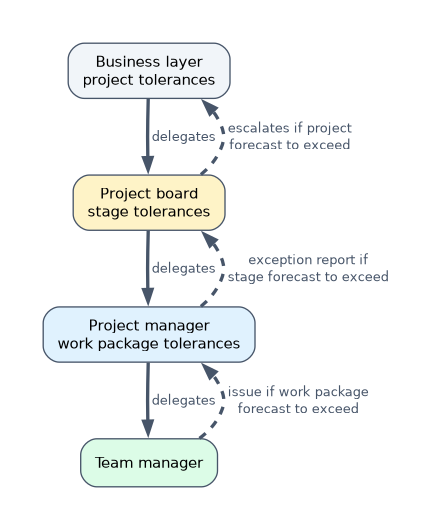
| Situation | What happens |
|---|---|
| Work package forecast to exceed tolerance | The team manager raises an issue to the project manager |
| Stage forecast to exceed tolerance | The project manager sends an exception report to the project board |
| Project forecast to exceed tolerance | The project board escalates to the business layer |
After an exception report, the project board may ask for an exception plan, which is reviewed in managing a stage boundary and replaces the current plan once approved.
Guidance: data and systems in progress management
Digital tools and data can make progress control quicker and more accurate: dashboards, automated reporting and trend analysis. The quality and security of that data must be managed, which is the role of the digital and data management approach in the PID.
The progress technique
The PRINCE2 7 progress technique centres on managing exceptions. In outline: tolerances are delegated to each level, progress is compared with the plan and forecast, a forecast breach is raised as an issue or exception report, the level above decides, and an exception plan replaces the current plan if needed.
Relationship to the principles
| Principle | Link to progress |
|---|---|
| Manage by exception | Tolerances and escalation are the core of progress control |
| Manage by stages | Stage boundaries are event-driven controls |
| Ensure continued business justification | Forecasts check continued viability |
| Learn from experience | Lessons reviewed and reported throughout |
| Define roles, responsibilities and relationships | Each level knows what it may decide and must report |
| Focus on products | Progress is measured by products completed |
| Tailor to suit the project | Reporting frequency and format suit the project |
A worked example
A housing association's refurbishment project has a stage cost tolerance of plus or minus £20,000. Weekly checkpoint reports show a team manager's work package overspending, and the project manager's forecast shows the stage finishing £35,000 over budget.
Because the forecast is beyond stage tolerance, the project manager sends an exception report to the project board with options. The board asks for an exception plan, which is approved at the stage boundary.
How the exam asks about this
- "Which type of control is a highlight report?" A time-driven control.
- "What is an exception?" A situation where it can be forecast that there will be a deviation beyond agreed tolerance levels.
- "Who sets stage tolerances?" The project board.
What to remember for the exam
- Purpose: monitor and compare actuals with plans, forecast, and control unacceptable deviations.
- Business layer sets project tolerance; board sets stage tolerance; project manager sets work package tolerance.
- Event-driven controls happen at events; time-driven controls happen at regular intervals.
- Escalate when tolerance is forecast to be exceeded.
- Exception report goes to the board; exception plan replaces the current plan.
An exception is based on a forecast. If the project manager waits until tolerance has actually been exceeded, the escalation is late.
Common mistakes
Calling end stage reports time-driven. They are triggered by the end of a stage, an event.
Thinking tolerances are only for time and cost. They can cover all seven performance aspects.
Looking only backwards. Progress control depends on forecasting, not just reporting what happened.
Check yourself
Is a checkpoint report event-driven or time-driven?
Time-driven: it is produced at a frequency agreed in the work package.
Who does the project board escalate to if project tolerance is forecast to be exceeded?
The business layer.
What is a forecast in PRINCE2?
A prediction, based on progress so far and current knowledge, of how the project, stage or work package will finish.
Topic 8 of 9 in PRINCE2 Practices
Test yourself on PRINCE2 Practices
The full PeopleCert PRINCE2 7 Foundation question bank has 564 questions, with timed practice exams and an explanation for every answer.
This study guide is independent and is not affiliated with, endorsed by, or sponsored by PeopleCert. Vendor names, certification names and exam codes are trademarks of their respective owners and are used for identification only.