The ITIL Value System · Topic 1 of 5
The ITIL Value System and Governance
The five components of the ITIL Value System, its purpose of turning opportunity and demand into value, and governance with evaluate, direct and monitor.
- 3 min
- Includes a diagram
- Five components: guiding principles, governance, value chain, management practices, continual improvement.
- The value system turns opportunity and demand into value.
- Its purpose is continual co-creation of value with stakeholders.
What it is
The ITIL Value System describes how the components and activities of an organization work together to enable continual co-creation of value with its stakeholders. Governance is one of its components: the means by which the organization is directed and controlled.
How it works
The five components
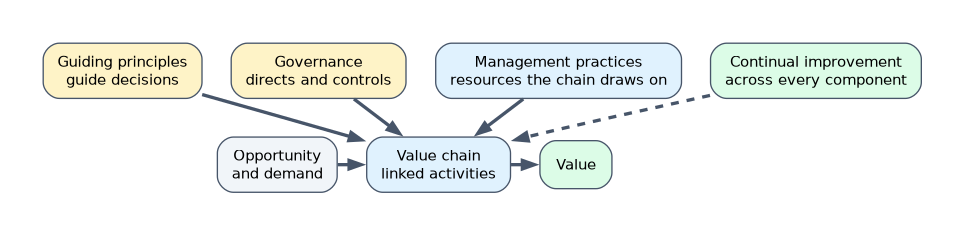
| Component | Role |
|---|---|
| Guiding principles | Recommendations that guide decisions and actions in all circumstances |
| Governance | Directs and controls the organization |
| Value chain | The set of linked activities that turns opportunity and demand into value |
| Management practices | Sets of organizational resources for performing work, which the value chain draws on |
| Continual improvement | Keeps everything aligned with changing needs, at every level |
Inputs and outputs: the value system takes in opportunity (chances to add value) and demand (need or desire for products and services) and produces value.
Purpose: to enable the continual co-creation of value with stakeholders, by making sure all parts of the organization work together rather than in silos.
The four dimensions, service level agreements and individual teams such as the service desk are not components of the value system.
Governance
| Point | Detail |
|---|---|
| Definition | The means by which an organization is directed and controlled |
| Who is accountable | The governing body, such as the board |
| Activities | Evaluate, direct and monitor |
| Activity | What it does |
|---|---|
| Evaluate | Assesses the organization, its strategy and its environment |
| Direct | Sets direction and approves strategy and policies |
| Monitor | Tracks performance and conformance against policy and direction |
The enabling nature of governance
Governance is not only about control. Clear direction, policies and decision rights enable people to act with confidence and speed, because they know what is expected and who decides. Governance sets direction; management carries it out.
Evaluate, direct, monitor. If an option offers plan, build, run, or identify, assess, treat, it is describing something else.
How the exam asks about this
- "Which is a component of the value system?" Governance (not the four dimensions or an SLA).
- "What does the value system take in and produce?" Opportunity and demand in, value out.
- "Who is accountable for governance?" The governing body.
What to remember for the exam
- Five components: guiding principles, governance, value chain, management practices, continual improvement.
- The value system turns opportunity and demand into value.
- Its purpose is continual co-creation of value with stakeholders.
- Governance: the means by which an organization is directed and controlled.
- Governance activities: evaluate, direct, monitor.
Governance is the governing body's responsibility. Managers carry out the direction it sets, but they do not replace it.
Common mistakes
Listing the four dimensions as a value system component. They are a separate model.
Thinking governance only restricts. It also enables.
Mixing up governance and management. Direction versus execution.
Check yourself
What are the five components of the ITIL Value System?
Guiding principles, governance, value chain, management practices and continual improvement.
What does the value system turn into value?
Opportunity and demand.
What are the three governance activities?
Evaluate, direct and monitor.
Topic 1 of 5 in The ITIL Value System
Test yourself on The ITIL Value System
The full PeopleCert ITIL 5 Foundation question bank has 527 questions, with timed practice exams and an explanation for every answer.
This study guide is independent and is not affiliated with, endorsed by, or sponsored by PeopleCert. Vendor names, certification names and exam codes are trademarks of their respective owners and are used for identification only.