The ITIL Value System · Topic 3 of 5
Value Chain Terms and Definitions
ITIL 5 value chain terms: incident, event, service request, problem, known error, release, CI/CD, reliability, SRE, observability and metrics.
- 4 min
- Includes a diagram
- Event: change of state. Incident: unplanned interruption. Service request: normal agreed request.
- Problem: cause of incidents. Known error: analysed, unresolved problem.
- CI merges and tests often; continuous delivery keeps changes releasable; continuous deployment releases automatically.
What it is
The value chain is a set of linked activities that turns inputs into value. The syllabus asks you to define many terms used in value chain work, from product specifications to incidents, problems and continuous deployment, and to understand how the value chain supports the organization's purpose and operating model.
How it works
Products and the operating model
| Term | Meaning |
|---|---|
| Value chain | A set of linked activities that turns inputs into value |
| Product specification | A description of the intended features of a product |
| Product prototype | An early version used to test the concept and gather feedback |
| Operating model | A description of how an organization works to deliver value |
The value chain supports the organization's purpose (why it exists) by linking the work performed to the value it delivers, and supports the operating model by delivering the products and services the model describes.
Operations terms
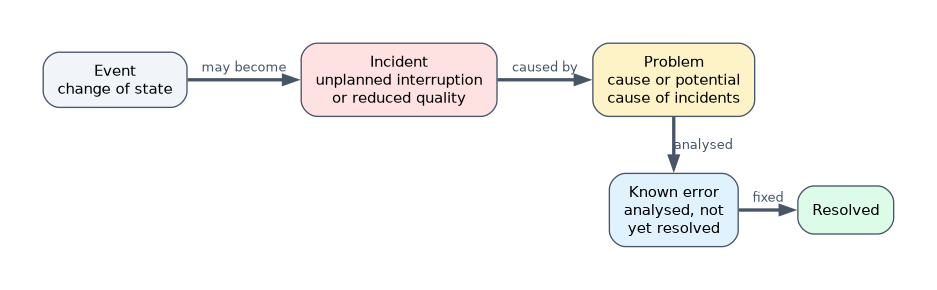
| Term | Meaning |
|---|---|
| Event | A change of state that has significance for the management of a service or other configuration item |
| Incident | An unplanned interruption to a service or reduction in its quality |
| Service request | A request from a user for something that is part of normal, agreed service delivery |
| Disaster | A sudden, unplanned event that causes great damage or serious loss to an organization |
| Problem | A cause, or potential cause, of one or more incidents |
| Error | A flaw or mistake that can lead to a failure |
| Known error | A problem that has been analysed but not yet resolved |
A monitoring warning that no user has noticed is an event; it may or may not need action. A calendar nobody can open is an incident. Its underlying cause is a problem.
Change and release terms
| Term | Meaning |
|---|---|
| Release | A version of a service or other component made available for use |
| Test | Checking that a product or service works as intended and meets its requirements, typically before it is released |
| Continuous integration | Merging code changes frequently, with automated builds and tests on each merge |
| Continuous delivery | Keeping tested changes always ready to release, with release still a decision |
| Continuous deployment | Automatically releasing every change that passes its tests to production |
If a manager still approves each release to production, the team uses continuous delivery, not continuous deployment.
Reliability terms
| Term | Meaning |
|---|---|
| Reliability | How consistently a service performs its intended function |
| Site Reliability Engineering (SRE) | Applying engineering practices to keep services reliable |
| Observability | The ability to infer a system's internal state from the data it outputs, such as logs, metrics and traces |
Key success metrics
Each value chain activity has success metrics, for example deployment frequency (how often a team releases), mean time to restore service after incidents, change failure rate, average time to fulfil a request, and the error budget remaining against a reliability target.
Problem is the cause, incident is the interruption, error is the flaw, and known error is an analysed problem that is not yet fixed. The syllabus expects you to tell these apart.
How the exam asks about this
- "Which term describes a cause, or potential cause, of incidents?" Problem.
- "Changes are built and tested automatically but a manager approves each release." Continuous integration and delivery, not deployment.
- "What does observability provide?" The ability to infer internal state from logs, metrics and traces.
What to remember for the exam
- Event: change of state. Incident: unplanned interruption. Service request: normal agreed request.
- Problem: cause of incidents. Known error: analysed, unresolved problem.
- CI merges and tests often; continuous delivery keeps changes releasable; continuous deployment releases automatically.
- Observability infers internal state from outputs; SRE engineers reliability.
- The value chain supports the organization's purpose and operating model.
An event is not automatically an incident. Only interruptions or reductions in quality are incidents.
Common mistakes
Calling a known error resolved. It is analysed but not yet fixed.
Confusing delivery with deployment. Deployment needs no manual approval step.
Treating a service request as an incident. Requests are normal, agreed delivery.
Check yourself
What is a known error?
A problem that has been analysed but has not yet been resolved.
What does continuous integration involve?
Merging code changes frequently into a shared codebase, with automated builds and tests on each merge.
What is an event?
A change of state that has significance for the management of a service or other configuration item.
Topic 3 of 5 in The ITIL Value System
Test yourself on The ITIL Value System
The full PeopleCert ITIL 5 Foundation question bank has 527 questions, with timed practice exams and an explanation for every answer.
This study guide is independent and is not affiliated with, endorsed by, or sponsored by PeopleCert. Vendor names, certification names and exam codes are trademarks of their respective owners and are used for identification only.