The ITIL Value System · Topic 5 of 5
The ITIL Continual Improvement Model
The seven steps of the ITIL Continual Improvement Model, from the vision to keeping the momentum going, and its role in the ITIL Value System.
- 3 min
- Includes a diagram
- Seven steps: vision; where are we now; where do we want to be; how do we get there; take action; did we get there; how do we keep the momentum going.
- Step 2 assesses before change; step 6 checks results.
- Continual improvement keeps everything aligned with changing needs.
What it is
Continual improvement is a component of the ITIL Value System that keeps products, services, practices and the organization aligned with changing needs. The ITIL Continual Improvement Model gives a structured, repeatable way to plan and carry out improvements of any size.
How it works
The seven steps
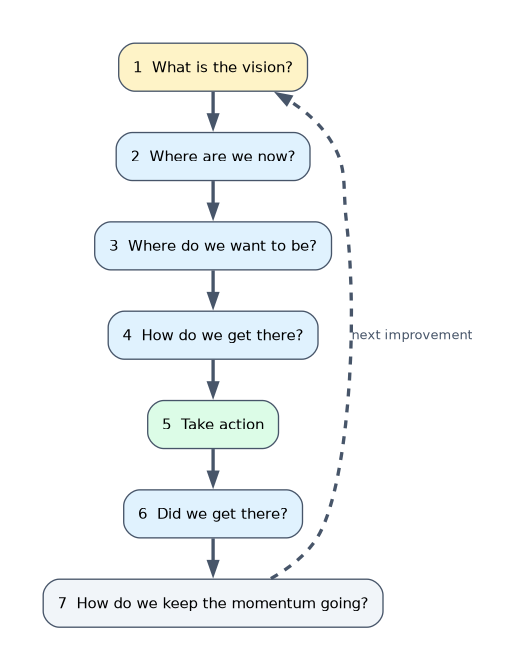
| Step | Question | What happens |
|---|---|---|
| 1 | What is the vision? | Set the high-level direction for the improvement, linked to the organization's vision and objectives |
| 2 | Where are we now? | Assess the current state before anything is changed |
| 3 | Where do we want to be? | Define the target state and measurable objectives |
| 4 | How do we get there? | Plan the route to the target |
| 5 | Take action | Carry out the plan |
| 6 | Did we get there? | Check whether the improvement achieved its intended results |
| 7 | How do we keep the momentum going? | Embed the change and look for the next improvement |
The model is a cycle: after step 7, the next improvement starts again from the vision.
Continual improvement in the value system
- It takes place at all levels of the organization, from strategic direction to day-to-day operation.
- It applies to products and services, practices, the value chain and the value system itself.
- Everyone has a part in it, not only a dedicated improvement team.
Links to the guiding principles
| Principle | Link to continual improvement |
|---|---|
| Start where you are | Step 2 builds on what already exists |
| Progress iteratively with feedback | Improvements are organized as short, reviewed cycles |
| Focus on value | The vision and targets are set in terms of value |
Learn the seven steps in order, with their question wording. Exam options often give the right step with the wrong job, for example "Where are we now?" described as setting direction.
How the exam asks about this
- "Which step sets the high-level direction?" What is the vision?
- "Which step assesses the current state?" Where are we now?
- "Where does continual improvement take place?" At all levels of the organization.
What to remember for the exam
- Seven steps: vision; where are we now; where do we want to be; how do we get there; take action; did we get there; how do we keep the momentum going.
- Step 2 assesses before change; step 6 checks results.
- Continual improvement keeps everything aligned with changing needs.
- It happens at every level, by everyone.
- It is one of the five components of the ITIL Value System.
Taking action before assessing the current state means you cannot measure whether the improvement worked.
Common mistakes
Swapping steps 2 and 3. Now comes before the target.
Treating improvement as a one-off project. It is continual.
Limiting it to one team. It happens at all levels.
Check yourself
Which step of the model checks whether the improvement achieved its results?
Did we get there?
What is the purpose of continual improvement?
To keep products, services, practices and the organization aligned with changing needs.
Which guiding principle supports organizing improvement as short reviewed cycles?
Progress iteratively with feedback.
Topic 5 of 5 in The ITIL Value System
Test yourself on The ITIL Value System
The full PeopleCert ITIL 5 Foundation question bank has 527 questions, with timed practice exams and an explanation for every answer.
This study guide is independent and is not affiliated with, endorsed by, or sponsored by PeopleCert. Vendor names, certification names and exam codes are trademarks of their respective owners and are used for identification only.