The ITIL Product and Service Lifecycle · Topic 1 of 2
Lifecycle Activities: Discover, Design, Acquire and Build
The ITIL Product and Service Lifecycle, why its activities are iterative, and the purpose of the discover, design, acquire and build activities.
- 3 min
- Includes a diagram
- Eight activities: discover, design, acquire, build, transition, operate, deliver, support.
- They are not sequential or linear; they can run in parallel and be revisited.
- Discover: understand needs and opportunities.
What it is
The ITIL Product and Service Lifecycle has eight activities. This page covers the first four, which bring a product or service into being: discover what is needed, design how to meet it, acquire what is required, and build it. It also explains the lifecycle's most tested idea: the activities are used iteratively, not as a one-off sequence.
How it works
Iterative, not linear
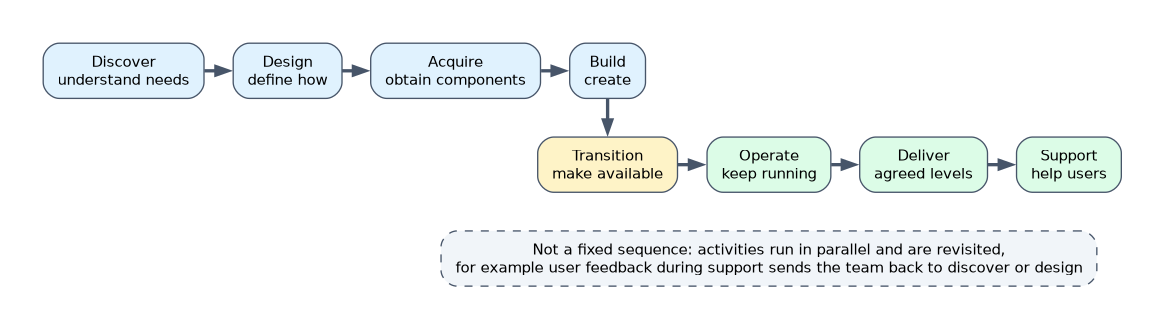
- The eight activities are not sequential or linear. They can run in parallel, and any activity can be revisited after others.
- Each activity is not performed exactly once: if live feedback reveals a missed requirement, the team returns to discover or design while the service stays live.
- If a supplied component cannot meet the specification during build, the team may go back to acquire (choose another component) and design (amend the specification).
Discover
Purpose: to understand needs and opportunities.
Work in discover includes studying what consumers need, exploring market opportunities and assessing ideas before committing resources. Its value is that later effort is aimed at real demand.
Design
Purpose: to define how needs will be met.
Typical outputs are models, a specification of the solution and decisions on capacity, security and user experience. If a live service later proves under-sized, design is the activity revisited to correct the plan.
Acquire
Purpose: to obtain the components and resources a product or service needs.
Its input is usually a design that lists what is needed. Examples include buying a licence for a tool, contracting a supplier or obtaining cloud capacity.
Build
Purpose: to create product or service components.
Build uses the components obtained through acquire and creates or integrates them to match the approved specification. Adapting a purchased application to the organization's needs is also build work.
| Pair | Difference |
|---|---|
| Discover and design | Discover explores needs; design plans how to meet them |
| Acquire and build | Acquire obtains components; build creates with them |
A licence, a supplier contract or bought capacity points to acquire. Creating or integrating components points to build.
How the exam asks about this
- "How many lifecycle activities are there?" Eight.
- "How should the activities be used?" Iteratively: revisited, combined and run in parallel as needed.
- "Buying a licence for a needed tool is typical of which activity?" Acquire.
What to remember for the exam
- Eight activities: discover, design, acquire, build, transition, operate, deliver, support.
- They are not sequential or linear; they can run in parallel and be revisited.
- Discover: understand needs and opportunities.
- Design: define how needs will be met.
- Acquire: obtain components and resources. Build: create product or service components.
Do not treat the lifecycle like a waterfall project plan. Exam options that say each activity must finish before the next begins are wrong.
Common mistakes
Confusing acquire and build. Obtaining versus creating.
Thinking discover happens once. It can be revisited at any time.
Placing a specification in build. Specifications come from design.
Check yourself
What is the purpose of the discover activity?
To understand needs and opportunities.
How does acquire differ from build?
Acquire obtains components and resources; build creates the product or service using them.
Can lifecycle activities run in parallel?
Yes. They are used iteratively and can run in parallel or be revisited.
Topic 1 of 2 in The ITIL Product and Service Lifecycle
Test yourself on The ITIL Product and Service Lifecycle
The full PeopleCert ITIL 5 Foundation question bank has 527 questions, with timed practice exams and an explanation for every answer.
This study guide is independent and is not affiliated with, endorsed by, or sponsored by PeopleCert. Vendor names, certification names and exam codes are trademarks of their respective owners and are used for identification only.