MikroTik MTCINE Practice Exam
MikroTik Certified Inter-Networking Engineer (MTCINE)
The MikroTik Certified Inter-Networking Engineer (MTCINE) certification validates the skills needed to deploy and manage complex networks using BGP, MPLS, and Traffic Engineering. It covers Autonomous Systems, iBGP/eBGP configuration, route reflectors and confederations, MPLS label distribution and VPLS tunnels, penultimate-hop-popping, and traffic engineering concepts like RSVP and bandwidth allocation. Candidates should hold MTCNA and MTCRE certifications.
Question bank updated : questions, answers, explanations and chapters.
Certification Overview
- Exam name: MTCINE
- Vendor: MikroTik
- Exam code: MTCINE
- Duration: 60 minutes
- Total questions: about 25
- Official passing score: 60% (source)
- Our practice exam pass mark: 60%
Who Should Take This Exam?
Network Engineer, Network Technician, Systems Administrator, IT Specialist, Telecommunications Engineer, Technical Support Engineer, Infrastructure Engineer, Network Analyst
Prerequisites
MTCNA and MTCRE certifications
Topics Covered
- BGP (Border Gateway Protocol)
- MPLS (Multi-Protocol Label Switching)
- Traffic Engineering
Question Types
- Multiple Choice (Single Answer)
- Multiple Choice (Multiple Answers)
- True / False
- Scenario-Based
MTCINE Practice Questions
Our question bank contains 489+ practice questions for this certification. Sample questions from each exam chapter. Expand a question to see the answer choices. With full access, you get unlimited practice exams with randomised questions from our full question bank.
BGP (Border Gateway Protocol)
What is the purpose of BGP in networking?
- A. To provide DNS services
- B. To manage local area network traffic
- C. To route data between different autonomous systems Correct answer
- D. To encrypt data in transit
BGP (Border Gateway Protocol) is primarily used to route data between different autonomous systems, making option C the correct answer.
Your organization needs to establish a BGP session with a neighboring router. What information is required?
- A. Routing protocol type
- B. Neighbor's IP address and AS number Correct answer
- C. Router's MAC address
- D. Subnet mask of the local network
To establish a BGP session, the IP address and the Autonomous System (AS) number of the neighboring router are required.
When configuring BGP, which attribute is used to prevent routing loops?
- A. Local Preference
- B. AS Path Correct answer
- C. Multi-Exit Discriminator
- D. Next Hop
The AS Path attribute in BGP is used to prevent routing loops by keeping track of the autonomous systems a route has traversed.
How can an administrator ensure that specific prefixes are advertised to external BGP peers?
- A. By configuring OSPF
- B. By enabling route redistribution
- C. By applying a route policy Correct answer
- D. By using the 'network' command Correct answer
Option D is correct because the 'network' command is essential for advertising a prefix in BGP. Option C is also correct since applying a route policy can control which prefixes are advertised. Options A and B are incorrect as they pertain to different routing protocols and do not directly relate to BGP prefix advertisement.
A network engineer configures a MikroTik router to use BGP. If the router receives a route advertisement from a peer with a lower AS-path length, the route will be preferred over others with higher AS-path lengths.
- A. True Correct answer
- B. False
BGP prefers routes with the shortest AS-path length, thus a route with a lower AS-path length will indeed be preferred.
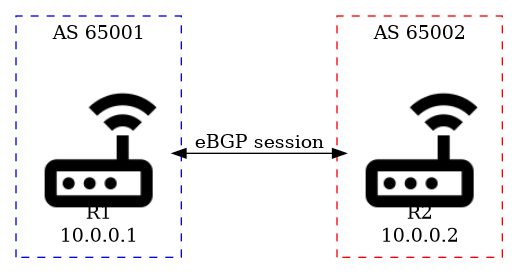
Two routers are connected as shown. R1 is in AS 65001 and R2 is in AS 65002. What type of BGP session exists between them?
- A. Multi-hop BGP (mBGP)
- B. External BGP (eBGP) Correct answer
- C. Internal BGP (iBGP)
- D. Confederation BGP (cBGP)
Option B is correct because R1 (AS 65001) and R2 (AS 65002) sit in different autonomous systems and peer directly, which is the defining trait of an eBGP session. Options A, C, and D describe multi-hop, internal, or confederation BGP sessions, none of which apply to two directly-connected routers in different ASes.
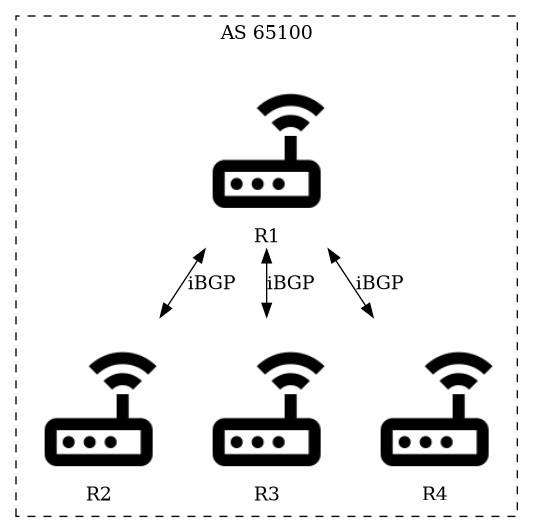
In this BGP topology, R1 has iBGP sessions to R2, R3, and R4, but R2, R3, and R4 have no direct BGP sessions with each other. What role does R1 serve?
- A. Confederation border router
- B. Route reflector Correct answer
- C. External BGP peer
- D. Route distinguisher
Option B is correct because R1 maintains iBGP sessions to R2, R3, and R4 while those three routers have no sessions with each other -- that hub-and-spoke pattern, where R1 reflects routes between clients that don't peer directly, is exactly what a route reflector does. Options A, C, and D describe confederation borders, external peering, or route distinguishers, none of which match this topology.
MPLS (Multi-Protocol Label Switching)
In an MPLS network, a label can be swapped at each hop without needing to examine the packet's Layer 3 header. This is a key advantage of MPLS over traditional IP routing.
- A. True Correct answer
- B. False
MPLS allows for label swapping at each router hop, which means the Layer 3 header does not need to be inspected, thus speeding up the forwarding process.
Which of the following is a key benefit of using MPLS in a service provider environment?
- A. Improved broadcast traffic management
- B. Support for traffic engineering Correct answer
- C. Simplified Layer 2 switching
- D. Increased data encryption capabilities
One of the key benefits of using MPLS in a service provider environment is its support for traffic engineering, allowing better control over data flows and resource allocation.
How does MPLS determine the path a packet should take through the network?
- A. Using labels assigned to packets Correct answer
- B. Based on the destination IP address only
- C. Using Layer 2 MAC addresses
- D. By looking up routing tables
MPLS determines the path a packet should take through the network using labels assigned to each packet, which dictate the forwarding decisions made at each router in the path.
When configuring MPLS, what must be set up for label distribution?
- A. Label Distribution Protocol (LDP) Correct answer
- B. Dynamic Routing Protocol
- C. Traffic engineering
- D. Virtual Routing and Forwarding
For label distribution in MPLS, the Label Distribution Protocol (LDP) must be set up. LDP is responsible for distributing labels that are used to forward packets in an MPLS network.
What are two purposes of Label Distribution Protocol (LDP) in MPLS?
- A. To facilitate label switching Correct answer
- B. To manage routing paths
- C. To assign labels to packets Correct answer
- D. To encrypt data packets
Label Distribution Protocol (LDP) is used to assign labels to packets for MPLS forwarding and to facilitate label switching in the MPLS network. These functions are crucial for the operation of MPLS.
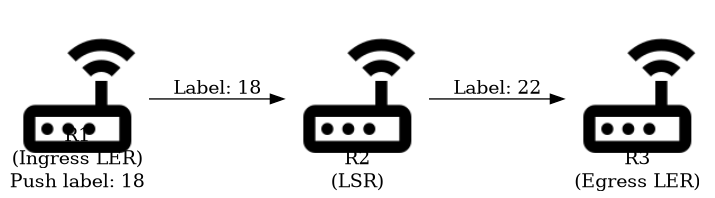
Based on the MPLS forwarding diagram, what operation does R2 (LSR) perform on the labeled packet?
- A. Pushes a new label onto the existing label stack from R1
- B. Stores the packet in the LFIB until a new LDP mapping arrives
- C. Removes label 18 and forwards the original IP packet to R3
- D. Swaps label 18 for label 22 and forwards based on the LFIB Correct answer
Option D is correct because R2 is an LSR in the middle of the LSP, receiving the packet with label 18 and forwarding it out with label 22, which is exactly what a label swap operation does. Options A, B, and C describe pushing an additional label, buffering the packet, or performing PHP, none of which match an LSR forwarding between two labels on an established LFIB entry.
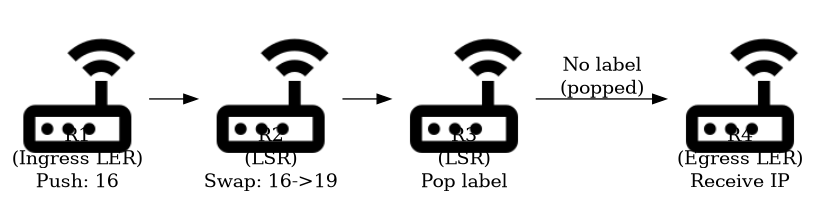
In the MPLS path shown, R3 removes the label before forwarding the unlabeled packet to R4 (egress LER). What is this MPLS behavior called?
- A. MPLS traceroute label removal
- B. Label imposition at the egress LER
- C. Penultimate Hop Popping (PHP) Correct answer
- D. Implicit Null label allocation
Option C is correct because R3 removes the outgoing label one hop before the actual egress LER (R4), which is the defining behavior of Penultimate Hop Popping -- it offloads the final label lookup from the egress router since it would otherwise just pop the label immediately anyway. Options A, B, and D name unrelated tools or the wrong stage of label handling, none of which describe what happens one hop before egress.
Traffic Engineering
A network operator configures MPLS with label-switched paths (LSPs) using RSVP-TE. This configuration allows for dynamic bandwidth adjustment based on network conditions.
- A. True Correct answer
- B. False
RSVP-TE supports dynamic bandwidth adjustment by signaling LSPs and allowing for on-the-fly changes based on network conditions, making the statement true.
A company is implementing MPLS and needs to optimize bandwidth while ensuring low latency for voice traffic. Which method is the BEST to achieve this while accommodating existing IP traffic flows?
- A. Enable MPLS with default settings without specific traffic policies.
- B. Configure MPLS Traffic Engineering (TE) to reserve bandwidth for voice calls.
- C. Use RSVP-TE to signal bandwidth for all traffic types equally.
- D. Implement Class of Service (CoS) with prioritization for voice traffic. Correct answer
Implementing Class of Service (CoS) allows for prioritization of voice traffic, ensuring low latency and optimized bandwidth for critical applications. This approach effectively differentiates traffic types based on their requirements.
How does MPLS enhance traffic engineering in a network?
- A. By allowing for dynamic IP address assignment
- B. By simplifying the network topology
- C. By enabling the use of labels for routing decisions Correct answer
- D. By providing redundancy protocols
MPLS enhances traffic engineering by enabling the use of labels for routing decisions, allowing for more granular control over data flows and improved management of bandwidth.
To optimize traffic flow in an MPLS network, which feature allows the operator to influence the selection of the path that packets take?
- A. Quality of Service (QoS)
- B. Traffic Engineering (TE) Correct answer
- C. Label Distribution Protocol (LDP)
- D. Label Stacking
Traffic Engineering (TE) allows network operators to influence the path selection for packets, optimizing traffic flow and resource utilization in an MPLS network. Label stacking, LDP, and QoS are important but serve different purposes.
Which two features are associated with MPLS Traffic Engineering (TE)?
- A. Dynamic bandwidth allocation Correct answer
- B. Enhanced security protocols
- C. Static IP assignment
- D. Path optimization Correct answer
MPLS Traffic Engineering (TE) involves dynamic bandwidth allocation, allowing for efficient use of network resources. It also focuses on path optimization to ensure data takes the most efficient route through the network.
Your organization has implemented MPLS and is facing issues with path selection. Which two mechanisms can assist in optimizing path selection for MPLS traffic?
- A. Label Switched Path (LSP) metrics Correct answer
- B. MPLS Label Stack
- C. MPLS Traffic Engineering (TE) Correct answer
- D. IPsec tunneling
Label Switched Path (LSP) metrics and MPLS Traffic Engineering (TE) are both mechanisms that can optimize path selection in an MPLS network. LSP metrics help determine the best path based on network conditions, while MPLS TE allows for the explicit routing of traffic flows based on defined criteria.
Free Study Guide
Read the free MikroTik MTCINE study guide: every exam topic explained in plain English, with diagrams, exam tips and the mistakes to avoid.
More MikroTik Practice Exams
Practise with realistic mock exams to prepare for your MikroTik certification.