Juniper Mist Network Operations and Management · Topic 3 of 3
Access Assurance
Learn Juniper Mist Access Assurance: cloud NAC for wired and wireless, 802.1X and MAB, auth policies and labels, identity providers, RadSec and Mist Edge.
- 5 min
- Includes a diagram
- Access Assurance is cloud based NAC for wired and wireless, built on microservices.
- Methods: 802.1X (EAP-TLS, EAP-TTLS/PAP) and MAC Authentication Bypass.
- Mist APs and switches use RadSec to the cloud automatically.
What it is
Juniper Mist Access Assurance is a cloud based network access control (NAC) service. It gives identity based access to users and devices on both wired and wireless networks, using simple rules to allow or deny groups such as guests, corporate devices, IoT and BYOD.
It runs on a microservices architecture in the cloud, so there is no on premises NAC server to install. The authentication service is decoupled from the rest of the Mist cloud and runs as a standalone service in several regions.
How it works
Authentication methods
Access Assurance supports two families of authentication.
| Method | Used for | Notes |
|---|---|---|
| 802.1X with EAP-TLS | Devices with certificates | Mutual certificate authentication; trusted CAs must be added in the portal; an identity provider is optional |
| 802.1X with EAP-TTLS/PAP | Users with a username and password | Credentials are sent inside a TLS tunnel; an identity provider is required |
| MAC Authentication Bypass (MAB) | Devices without 802.1X support, such as IoT | Identifies the device by MAC address |
The service identifies the user or device, checks context such as security posture and site, and returns a policy result such as a VLAN, a group tag or a role.
How devices reach the service
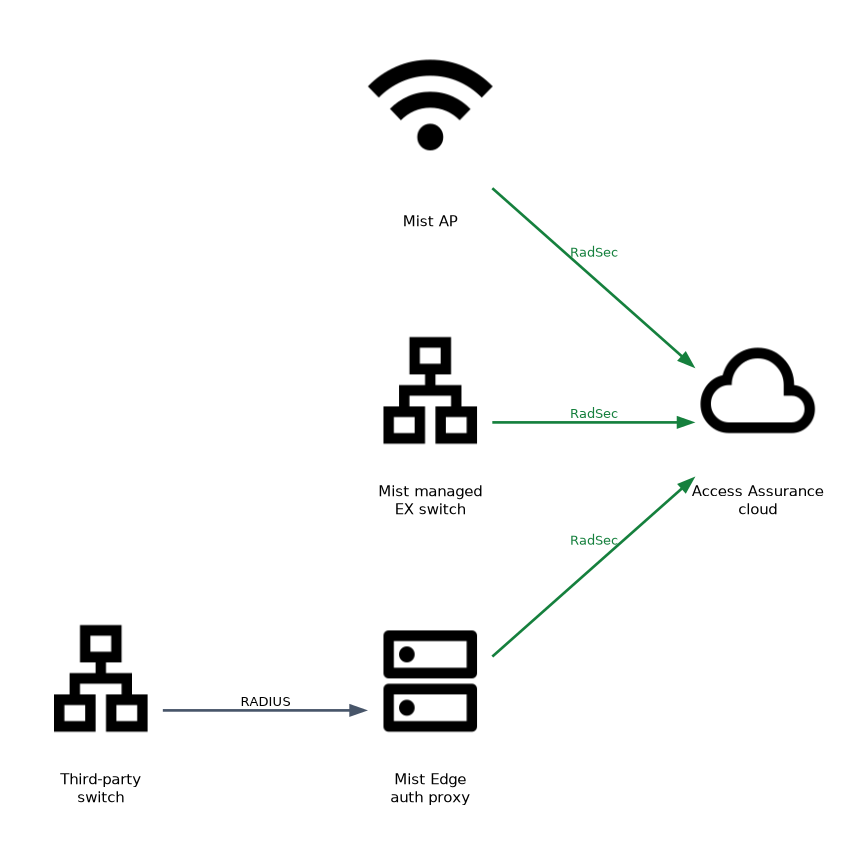 Mist managed APs and switches send authentication requests straight to the cloud. These requests are automatically encrypted using RADIUS over TLS (RadSec), so no RADIUS shared secret crosses the internet in the clear.
Third-party network devices speak plain RADIUS. For them, a Mist Edge acts as an authentication proxy: the third-party devices are added as RADIUS clients on the Mist Edge cluster, and the Mist Edge wraps the traffic into a RadSec tunnel to the cloud.
Geo-affinity and availability
Authentication traffic goes to the nearest Access Assurance point of presence, based on the site's location. If that cloud instance or one of its components fails, traffic moves automatically to the next nearest one.
Auth policies and labels
Rules live under Organization > Access > Auth Policies. Each rule has match criteria and a result.
| Part of a rule | Examples |
|---|---|
| Match criteria | Policy labels, sites or site groups |
| Policy action | Allow or Block |
| Assigned attributes | VLAN, role and similar attributes for allowed users |
| Rule status | Enable, Disable or Dry Run |
Labels do double duty: they are the matching criteria in a rule (for example EAP-TLS, Wired, or an MDM compliance label) and they also carry the attributes assigned to allowed users. Labels are managed on the Auth Policy Labels page under Organization > Access, or created while editing a rule.
A Dry Run rule records what it would have done, and request processing continues to the next rule in the list. It lets you test a new rule against real traffic before you enforce it.
A typical IoT rule matches MAB and Wired, sets the action to Allow and assigns an IoT VLAN. A typical corporate rule matches EAP-TLS and a certificate or directory group label.
Identity providers and other context
Access Assurance can query external directories to look up users and groups:
- Microsoft Entra ID (formerly Azure Active Directory)
- Okta
- Google Workspace
It can also take context from MDM platforms, such as Jamf and Intune, to decide whether a device is compliant.
Certificates
For EAP-TLS, the portal must trust the certificate authority that issued the client certificates. If the trusted CA is missing, the Mist authentication service will not trust client certificates and EAP-TLS fails. Mist also raises Certificate Alerts before user-added certificates, such as RadSec certificates, expire.
Benefits
| Benefit | How Access Assurance delivers it |
|---|---|
| No NAC hardware | Cloud microservices, nothing on premises |
| One policy for wired and wireless | A single set of auth policies |
| Zero trust | Identity based access for every user and device |
| Resilience | Geo-affinity and failover between cloud instances |
| Troubleshooting | Authentication events and Marvis in the same portal as the network |
The authentication service relays session information, metadata and analytics back to the Mist cloud. That means a failed login shows up next to the AP, switch and client data, and Marvis can use it for troubleshooting.
Common mistakes
Thinking third-party devices can talk RadSec to the cloud directly. Third-party gear sends standard RADIUS to a Mist Edge proxy, which converts it to RadSec.
Forgetting the identity provider for EAP-TTLS. EAP-TTLS checks a username and password, so an identity provider is mandatory. For EAP-TLS it is optional.
Treating Dry Run as enforced. A Dry Run rule only records the result and processing continues to the next rule.
Access Assurance is not a separate on premises appliance. Questions that say you must deploy a NAC server or a RADIUS appliance on site describe a traditional NAC, not Mist Access Assurance.
What to remember for the exam
- Access Assurance is cloud based NAC for wired and wireless, built on microservices.
- Methods: 802.1X (EAP-TLS, EAP-TTLS/PAP) and MAC Authentication Bypass.
- Mist APs and switches use RadSec to the cloud automatically.
- Third-party devices use RADIUS to a Mist Edge authentication proxy, which uses RadSec to the cloud.
- Auth policies are at Organization > Access > Auth Policies; actions are Allow or Block.
- Labels are both match criteria and assigned attributes.
- Rule status can be Enable, Disable or Dry Run.
- Identity providers include Microsoft Entra ID, Okta and Google Workspace.
- Traffic goes to the nearest cloud instance and fails over to the next nearest.
Check yourself
How does a third-party switch send authentication requests to Access Assurance?
It sends RADIUS to a Mist Edge acting as an authentication proxy, which forwards the traffic to the cloud inside a RadSec tunnel.
Which authentication method needs an identity provider: EAP-TLS or EAP-TTLS?
EAP-TTLS, because it checks a username and password against the identity provider; for EAP-TLS an identity provider is optional.
What happens when a request matches a rule set to Dry Run?
The result is recorded but not enforced, and processing continues to the next rule in the list.
Topic 3 of 3 in Juniper Mist Network Operations and Management
Test yourself on Juniper Mist Network Operations and Management
The full Juniper JNCIA-MistAI JN0-253 question bank has 668 questions, with timed practice exams and an explanation for every answer.
This study guide is independent and is not affiliated with, endorsed by, or sponsored by Juniper. Vendor names, certification names and exam codes are trademarks of their respective owners and are used for identification only.