WLAN Technology Basics · Topic 2 of 3
WLAN Networking Architecture and Scenarios
Learn WLAN networking for H12-811: Fat AP, AC plus Fit AP, cloud management, CAPWAP ports, in-path and off-path AC, direct and tunnel forwarding.
- 6 min
- Includes a diagram
- Fat AP works alone; Fit AP needs an AC; cloud APs are managed by a cloud platform.
- CAPWAP runs between AC and Fit AP: UDP 5246 control, UDP 5247 data.
- Layer 2 networking can use broadcast discovery; Layer 3 needs DHCP option 43 or a static AC address.
What it is
WLAN networking is the way APs, controllers and switches are arranged to deliver wireless service. The main choice is who manages the APs: each AP itself (Fat AP), an access controller (AC + Fit AP), or a cloud platform (cloud management).
In the AC + Fit AP design you also choose how the AC attaches and how user data is forwarded.
How it works
WLAN networking overview: the architectures
| Architecture | How it works | Typical use |
|---|---|---|
| Fat AP | The AP is autonomous: it holds its own configuration and does all WLAN functions | Homes and very small offices with one or two APs |
| AC + Fit AP | Fit APs do radio work; the AC manages, configures and controls them centrally | Medium and large enterprises, campuses |
| Cloud management | Cloud APs are managed through a cloud platform such as Huawei iMaster NCE-Campus | Many small branches with no local IT staff |
| Leader AP | One AP acts as a controller for the other APs in a small network | Small and midsize sites that do not want an AC |
| Agile distributed | A central AP manages remote units (RUs) placed in each room | Hotels, dormitories, wards: many small rooms |
Fat APs are configured one by one, so they do not scale. Fit APs cannot work alone; they get their configuration from the AC.
WLAN networking architecture: AC + Fit AP
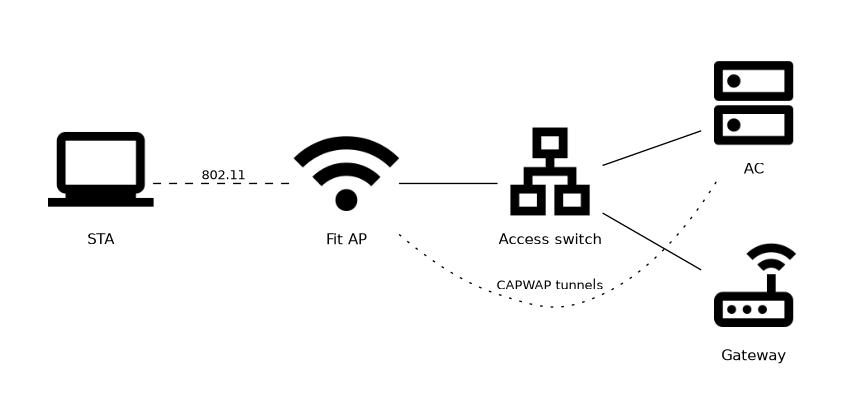 The AC and Fit APs talk over CAPWAP (Control And Provisioning of Wireless Access Points, RFC 5415).
| CAPWAP tunnel | UDP port | Carries |
|---|---|---|
| Control tunnel | 5246 | Management and configuration messages between AP and AC |
| Data tunnel | 5247 | User data, when tunnel forwarding is used |
The control channel can be protected by DTLS.
Layer 2 or Layer 3 networking between AC and AP
| Networking | Meaning | How the AP finds the AC |
|---|---|---|
| Layer 2 | AC and APs are in the same broadcast domain | Broadcast discovery works |
| Layer 3 | AC and APs are in different IP subnets | DHCP option 43 or a statically configured AC IP address |
In-path or off-path AC
| AC position | Meaning |
|---|---|
| In-path (inline) | The AC sits on the traffic path, usually acting as the aggregation switch; all data passes through it |
| Off-path (bypass) | The AC is attached to a side port of an aggregation or core switch; only the traffic sent to it reaches it |
Direct or tunnel forwarding
| Forwarding mode | Data path | Notes |
|---|---|---|
| Direct forwarding (local) | User data leaves the AP directly onto the wired network; only control goes to the AC | Less load on the AC; Huawei VAP profile default |
| Tunnel forwarding (centralized) | User data is sent inside the CAPWAP data tunnel to the AC, which forwards it | Central control of user traffic; AC must handle all data |
In both modes, CAPWAP control traffic always goes to the AC.
WLAN networking application scenarios
| Scenario | Typical design |
|---|---|
| Office building, campus | AC + Fit AP, indoor APs on ceilings, PoE from access switches |
| Many small rooms (hotel, dormitory, hospital ward) | Agile distributed: one RU per room, managed by a central AP |
| High-density venues (stadium, lecture hall, exhibition) | Many high-density APs, directional antennas, steer clients to 5 GHz |
| Outdoor areas (squares, ports, parks) | Outdoor APs rated for weather, often with external antennas |
| Places where cabling is impossible | WDS or Mesh: APs connect to each other over radio backhaul |
| Many small branches | Cloud management, plug-and-play APs configured from the cloud |
A worked example
A company has a three-layer wired campus and wants WLAN on every floor without redesigning the wired network. The engineer attaches the AC to the core switch as an off-path AC. The APs are in VLAN 100 in a different subnet from the AC, so this is Layer 3 networking, and the DHCP server gives the APs option 43 with the AC address.
The guest VAP uses tunnel forwarding for central control; staff traffic uses direct forwarding to spare the AC.
How the exam asks about this
- "Which UDP ports does CAPWAP use?" → 5246 for the control tunnel and 5247 for the data tunnel.
- "In which forwarding mode is user data encapsulated in CAPWAP and sent to the AC?" → Tunnel forwarding (centralized forwarding).
- "When the AC and APs are on different subnets, how can the APs learn the AC address?" → Through DHCP option 43 or a static AC IP address configured on the AP.
What to remember for the exam
- Fat AP works alone; Fit AP needs an AC; cloud APs are managed by a cloud platform.
- CAPWAP runs between AC and Fit AP: UDP 5246 control, UDP 5247 data.
- Layer 2 networking can use broadcast discovery; Layer 3 needs DHCP option 43 or a static AC address.
- In-path AC is on the data path; off-path AC hangs off a switch and suits adding WLAN to an existing network.
- Direct forwarding sends data straight from the AP; tunnel forwarding sends it to the AC over CAPWAP.
Off-path does not mean tunnel forwarding. AC position and forwarding mode are separate choices; an off-path AC can use direct or tunnel forwarding.
Common mistakes
Thinking control traffic follows the forwarding mode. Forwarding mode only decides where user data goes. CAPWAP control traffic always runs between the AP and the AC.
Using a Fat AP design for a large campus. Fat APs must be configured one at a time and do not coordinate. Large networks use AC + Fit AP or cloud management.
Mixing up the two CAPWAP ports. 5246 is control and 5247 is data. Remember that control comes first.
Check yourself
Why is an off-path AC popular when adding WLAN to an existing network?
The AC connects to a side port of an existing switch, so the wired topology does not need to change.
What is the main drawback of tunnel forwarding?
All user data passes through the AC, so the AC can become a bandwidth bottleneck.
Which WLAN architecture suits a hotel with many small rooms?
Agile distributed, with a remote unit in each room managed by a central AP.
Topic 2 of 3 in WLAN Technology Basics
Test yourself on WLAN Technology Basics
The full Huawei HCIA-Datacom H12-811 question bank has 600 questions, with timed practice exams and an explanation for every answer.
This study guide is independent and is not affiliated with, endorsed by, or sponsored by Huawei. Vendor names, certification names and exam codes are trademarks of their respective owners and are used for identification only.